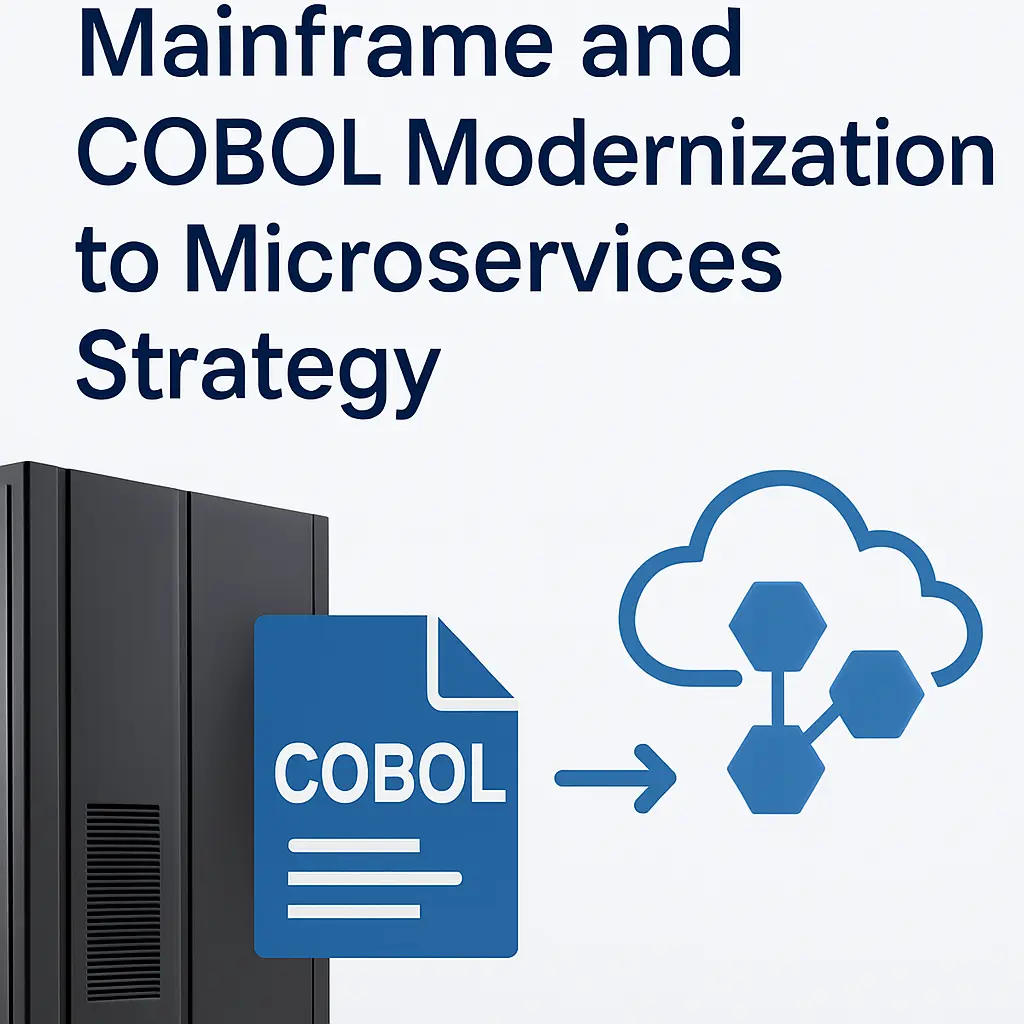
The pressure to modernize legacy mainframe systems is greater than ever, as organizations seek agility, scalability and data-driven decision-making. Yet, transforming decades-old COBOL-based platforms into flexible, cloud-native architectures is a complex journey. This article explores how to move from monolithic mainframes to microservices with modern databases, and how a structured legacy modernization strategy can reduce risk while maximizing long-term business value.
Why and How to Modernize Mainframe and COBOL-Based Systems
Many enterprises still run their core business operations on mainframes and COBOL applications: banking ledgers, insurance policy administration, inventory and logistics, billing, and more. These systems are battle-tested and reliable, but they increasingly hold organizations back from digital transformation. Understanding why modernization is essential and how to approach it systematically is the first step toward a successful transformation.
1. The business drivers behind modernization
Several converging forces are making mainframe and COBOL modernization urgent rather than optional:
- Skill shortage: COBOL and mainframe specialists are retiring faster than they are being replaced, making it costly and risky to maintain legacy systems.
- Innovation bottlenecks: Monolithic architectures slow down feature delivery, integration with digital channels, and experimentation with new business models.
- Operational cost and rigidity: While mainframes can be cost-effective for specific high-throughput workloads, licensing models, hardware constraints, and proprietary tooling often increase total cost of ownership and limit flexibility.
- Data accessibility: Crucial business data is often locked in opaque, tightly coupled schemas, making real-time analytics, AI and cross-channel experiences difficult.
- Regulatory and security demands: Modern security practices, auditability and data governance are harder to implement and automate across fragmented, legacy landscapes.
Together, these drivers create a strong economic and strategic case for modernization—even when the legacy system appears to be “working fine” on the surface.
2. Understanding what you are modernizing
Before deciding on technology choices, organizations must fully understand the current system landscape:
- Application portfolio: Which COBOL programs, batch jobs, online transaction monitors and utilities exist? How many are truly critical vs. redundant or unused?
- Business capabilities: Map technical components to business functions: customer onboarding, payments, claims processing, inventory allocation, etc.
- Data landscape: Catalog data stores (VSAM files, hierarchical or relational mainframe databases) and their schemas, access patterns, and data quality issues.
- Integration points: Identify all the consumers and providers of mainframe data: external partners, internal applications, reporting tools, APIs and message queues.
- Non-functional constraints: Performance, throughput, latency, uptime requirements and regulatory constraints that must be maintained or improved.
This discovery phase typically surfaces hidden dependencies and “shadow processes” that can make a big-bang rewrite dangerous. It provides the factual basis for deciding which modernization pattern is appropriate for each system component.
3. Choosing modernization patterns: incremental evolution vs. replacement
There is no one-size-fits-all approach. Instead, organizations usually combine several patterns:
- Encapsulation: Wrapping existing COBOL logic with APIs to expose specific capabilities without changing the core code. This is useful as a first step or for low-change components.
- Rehosting (“lift and shift”): Moving COBOL workloads from a physical mainframe to a mainframe emulator or a cloud-based environment with minimal code changes. This reduces hardware costs but does not by itself deliver architectural agility.
- Replatforming: Migrating data and applications to new platforms (e.g., from mainframe DB to a relational or distributed database) with limited code adaptation, improving scalability and integration options.
- Refactoring and decomposition: Gradually breaking the monolith into domain-aligned services, rewriting or transforming COBOL into modern languages (e.g., Java, C#, Go) where it makes sense.
- Replacement: Implementing or purchasing new systems (e.g., SaaS or COTS) and decommissioning parts of the legacy stack entirely.
Effective strategies usually start with lower-risk, high-return moves—like encapsulation and selective replatforming—while planning for deeper refactoring and service decomposition over time.
4. From monolith to microservices: domain-driven thinking
Shifting from a single, monolithic COBOL codebase to a landscape of microservices requires a clear domain model. Rather than slicing the monolith along technical boundaries (e.g., “billing programs” vs. “customer programs”), a domain-driven approach focuses on business capabilities and bounded contexts.
Useful steps include:
- Event storming and domain modeling: Collaborate with business and technical stakeholders to identify core domains (e.g., account management, payments, risk, fulfillment), subdomains and their relationships.
- Service candidates: For each domain, identify cohesive capabilities that could become microservices: “customer profile service”, “payment authorization service”, “policy pricing service”, etc.
- Strangler pattern: Use the strangler fig pattern to incrementally route specific features or screens from the mainframe to newly built services. Over time, the legacy core shrinks as more capabilities are reimplemented.
- Anti-corruption layer: Introduce translation and orchestration layers between microservices and legacy databases to prevent legacy data models from leaking into new services.
This domain-centric view directly informs how data should be reshaped and owned by microservices, which is where modern databases become critical.
5. Aligning modern databases to microservices
Traditional mainframes often centralize data in a single logical schema. Microservices architectures favor decentralized data ownership: each service controls its own schema and persistence technology, chosen to best fit its needs.
When transitioning From COBOL-Based Systems to Microservices with Modern Databases, organizations typically adopt a mix of database technologies:
- Relational databases (RDBMS): Ideal for strongly consistent, transactional workloads (e.g., payments, account balances). They provide robust ACID guarantees and mature tooling.
- NoSQL databases: Document, key-value or wide-column stores support flexible schemas, high scalability and rapid evolution for services like customer profiles or product catalogs.
- Event stores and logs: Systems like Apache Kafka can act as durable, ordered logs of domain events, decoupling services and enabling event sourcing or CQRS patterns.
- Analytical and lakehouse platforms: Modern data lakes and warehouses support downstream analytics, AI and regulatory reporting without burdening transactional services.
The challenge is to re-architect data models so domain services have autonomy while the overall system still preserves data integrity, compliance and business invariants.
6. Data modernization: from legacy schemas to domain-aligned models
Legacy mainframe schemas often reflect decades of incremental modifications, performance optimizations and historical constraints. These rarely map cleanly to modern domain boundaries. Careful data modernization is therefore essential:
- Schema discovery and semantic mapping: Reverse-engineer COBOL copybooks, VSAM structures or hierarchical DB schemas to understand what each field represents, how it is used, and where inconsistencies exist.
- Normalization vs. denormalization: Decide which services need normalized models (for strong consistency) and where denormalized, document-like structures better match domain aggregates.
- Data ownership and duplication: Accept some controlled duplication of data across services. The emphasis shifts from a single global schema to consistent behaviors and contracts.
- Reference and master data: Design shared reference data services or master data management components when multiple domains rely on the same canonical data (e.g., currencies, geographies, regulatory codes).
- Data quality remediation: Use the migration as an opportunity to cleanse, reconcile and standardize data, rather than simply reproducing legacy inconsistencies in new technologies.
Data modernization is not a one-off effort. It requires iterative refinement as new services are introduced and new business requirements emerge.
Designing and Executing a Sustainable Legacy Modernization Strategy
Modernization succeeds when it is guided by a coherent strategy, not just a series of isolated technical projects. Organizations must balance short-term risk mitigation with long-term architecture goals, coordinate multiple teams and ensure that business stakeholders continuously see value.
1. Building a modernization roadmap aligned with business goals
A sound roadmap starts from business outcomes and works backward to technical steps:
- Define measurable objectives: Faster time-to-market, new digital services, reduced downtime, cost optimization, improved analytics or regulatory compliance.
- Prioritize domains by value and risk: Identify which business capabilities will benefit most from agility or improved data access—and which have the highest legacy risk due to skills shortages or fragility.
- Identify quick wins and foundational enablers: Quick wins create momentum, while foundational work (e.g., establishing CI/CD, observability, data pipelines) underpins long-term success.
- Balance investments: Avoid over-investing in low-value legacy areas while critical domains remain constrained by the old architecture.
The roadmap should be revisited regularly based on delivery feedback, new opportunities and evolving constraints.
2. Organizational and cultural shifts
Moving from mainframes to microservices with modern databases is as much an organizational change as a technical one:
- Cross-functional product teams: Instead of siloed mainframe, database and front-end teams, create domain-aligned teams that own services end-to-end—from code to production.
- DevOps and platform engineering: Standardize tooling for build, test, deployment, monitoring and security. Shared platforms reduce cognitive load while allowing teams to innovate within guardrails.
- Upskilling and knowledge transfer: Capture the deep business knowledge of COBOL experts, pairing them with engineers experienced in cloud-native architectures. Offer training for modern languages, databases and practices.
- Governance without heavy bureaucracy: Introduce architectural principles, security guidelines and data governance models that enable autonomy while preventing fragmentation and compliance issues.
Modernization often fails when organizations try to copy old structures into new architectures. The goal is to realign teams around the flow of value, not just new technologies.
3. Risk management and the strangler pattern in practice
Replacing a mission-critical mainframe in one step is rarely feasible. Instead, risk is managed through incremental, reversible changes:
- Strangler routing: Layer a gateway or routing mechanism in front of legacy entry points. For specific functions (e.g., viewing transaction history), route traffic to new microservices while the rest of the functionality still uses COBOL programs.
- Parallel run and canary releases: For high-risk processes (e.g., end-of-day settlement), run old and new implementations in parallel, compare outputs and gradually shift production load.
- Feature flags and toggles: Control exposure of new capabilities without frequent redeployments, enabling rapid rollback if issues arise.
- Robust monitoring and observability: Invest in logs, metrics and traces that span legacy and new systems, so that behavior changes are detected early and root cause analysis is possible.
A disciplined approach to risk allows organizations to modernize core functions while meeting strict uptime and correctness requirements.
4. Security, compliance and data governance in the new architecture
Distributing functionality and data across many services can increase the attack surface if not properly managed. Security and governance must be designed in from the start:
- Zero-trust principles: Services authenticate and authorize every request; network location alone is never trusted.
- Centralized identity and access management: Use consistent identities and roles across services and data stores to manage who can access what.
- Data classification and protection: Tag personal, financial and sensitive data, and ensure appropriate encryption, masking and retention policies are applied.
- Auditability and traceability: Maintain tamper-evident logs and event histories to support regulatory audits and incident investigations.
- Policy-as-code: Express security and compliance rules in code and enforce them automatically through pipelines and runtime policy engines.
Done well, modernization can actually improve security and compliance compared to aging and opaque legacy environments, but it requires disciplined architecture and governance.
5. The role of expert consulting in legacy modernization
Because of the high stakes—regulatory penalties, operational outages, reputational damage—many organizations choose to work with external specialists who bring proven patterns, tooling and experience. Engaging partners for legacy system modernization consulting can accelerate roadmap creation, de-risk architectural decisions and provide hands-on support in areas like mainframe connectivity, data migration, and microservices design.
Consultants can also act as neutral facilitators between business and IT stakeholders, helping to resolve competing priorities and establish governance structures that support long-term agility rather than short-lived projects.
6. Continuous improvement and long-term evolution
Modernization does not end when the last COBOL program is decommissioned. Technologies, business models and regulatory requirements continue to change. A sustainable approach includes:
- Regular architecture reviews: Ensure services remain aligned with domain boundaries, performance needs and security standards.
- Technical debt management: Track and proactively address shortcuts taken during the initial migration that could hinder future evolution.
- Data lifecycle management: Periodically review data retention, archival and anonymization strategies as regulations and customer expectations evolve.
- Experimentation and feedback loops: Encourage teams to test new technologies or patterns in controlled ways, learning from successes and failures.
The ultimate goal is not just to escape legacy constraints but to establish an organization capable of adapting continuously, using modern architectures and data capabilities as enablers.
In summary, mainframe and COBOL modernization is a multidimensional journey that spans architecture, data, organization and governance. By grounding the effort in clear business objectives, applying domain-driven thinking, gradually decomposing monoliths into microservices, and carefully reshaping data into modern databases, organizations can unlock agility and innovation while controlling risk. With the right strategy, skills and partners, modernization becomes not a disruptive one-time project but a stepping stone to a more resilient, adaptable digital core.