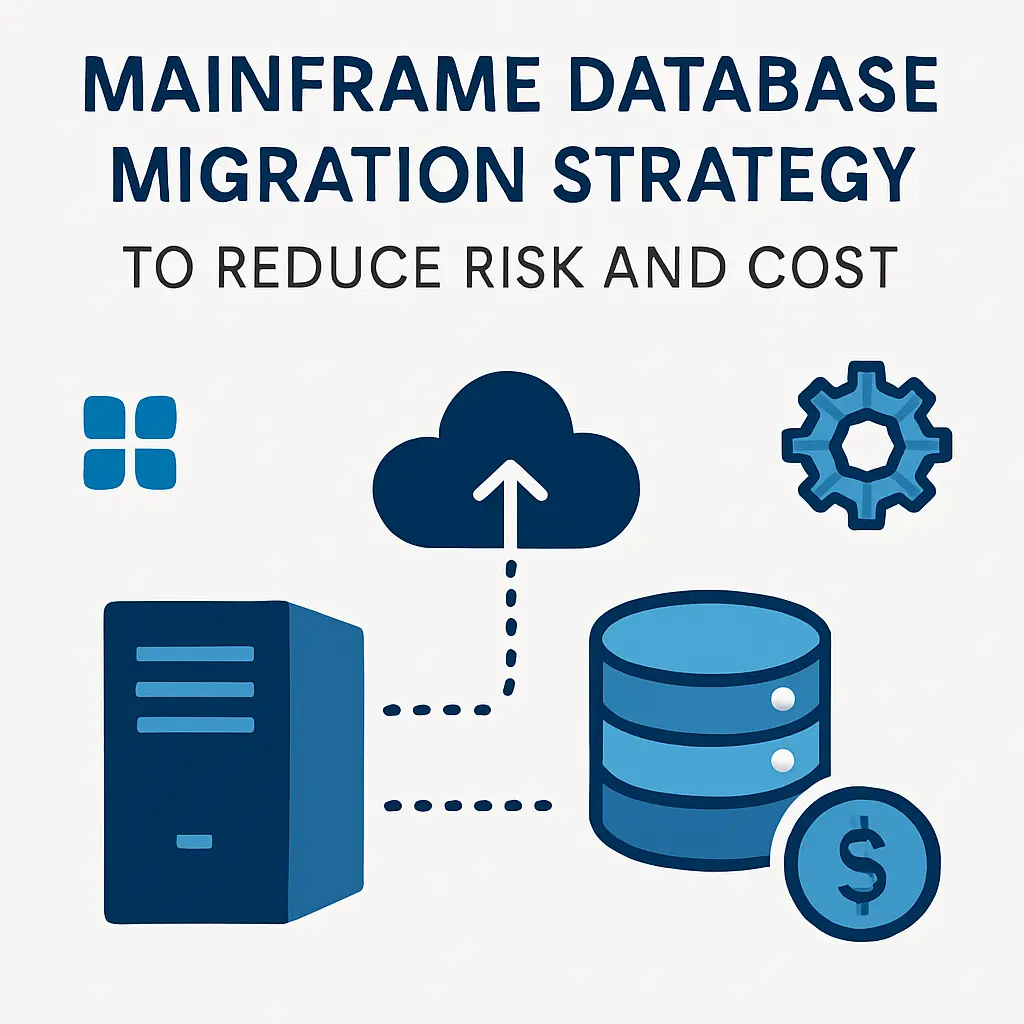
Mainframe database migration looks straightforward on paper: export, transform, and load into a modern platform. In reality, it’s a long, risky journey involving hidden dependencies, obscure business rules, and decades of technical debt. This article explores the real complexity behind mainframe database migration and provides a structured, practical path to reduce risk, control cost, and actually achieve modernization—without breaking the business.
Understanding the Hidden Complexity of Mainframe Database Migration
Mainframes are not just old databases sitting in a corner; they are usually the beating heart of critical business processes. That’s why their modernization is filled with traps that most high-level plans completely miss. To see the full picture, you must understand the technical, organizational, and business dimensions of complexity—and how they interact.
As a starting point, it’s useful to read about the real-world traps and blind spots shared in The Hidden Complexity of Mainframe Database Migration: What Nobody Tells You. Below, we go deeper and structure these challenges into a repeatable approach you can actually execute.
1. Mainframe databases are more than tables—they encode business reality
Mainframe “databases” often involve a mix of:
- Relational systems (DB2, IMS/DB in relational mode)
- Hierarchical or network databases (IMS, IDMS, Adabas, VSAM files)
- Flat files and sequential data sets that work like shadow databases
Over decades, these systems accumulate:
- Embedded business rules in procedural code (COBOL, PL/I) that interpret raw records and apply validations, conversions, and cross-file logic.
- “Implied” data models where the true schema is scattered across copybooks, JCL, load modules, and report layouts.
- Multiple truth sources, such as separate files holding customer status, credit limits, and segmentation, all assumed to align but never formally modeled together.
When you migrate, you are not just replacing a database; you are reconstructing an entire semantic model of your business. If you treat this as a simple schema conversion, you will end up with a shiny new database that doesn’t fully behave like the old one—and that’s when production bugs appear.
2. Hidden dependencies turn a simple migration into a systems archaeology project
Mainframe environments are interwoven with batch jobs, online transactions, external feeds, and reporting tools. For any given table or file, you may have:
- Dozens of batch jobs that read or update it
- Real-time transactions that rely on its availability and latency profile
- Downstream consumers such as data warehouses, regulatory exports, and partner integrations
The challenge is that many of these dependencies:
- Are not documented anywhere current
- Use partial data—only some fields in a record, or fields interpreted differently over time
- Depend on ordering, timing, or concurrency behavior specific to mainframe batch windows and locking semantics
Simply “moving the data” to a cloud platform without reinspecting these dependencies can cause downstream failures. For example:
- A nightly batch job that expects records sorted by an implicit key might now receive them unsorted.
- A downstream reporting system that assumes end-of-day snapshots might now be reading continuously changing data.
These are not obvious until they break production. That’s why any serious migration plan must include dependency discovery and behavioral analysis, not just schema work.
3. Data quality and semantic drift accumulate over decades
Mainframe databases often contain records spanning 10, 20, or even 40 years. During that time, the meaning of fields, encoding standards, and validation rules may have changed multiple times. Consider some common issues:
- Field overloading: a “status” field that used to hold Y/N values, then codes like A/I, then extended values like S, F, D for special states—without updating all consuming logic.
- Documentation drift: the data dictionary says a field is optional, but every real system assumes it’s present.
- Soft-deleted records: instead of deleting rows, a flag is set. Some applications filter them; others ignore the flag.
- Undocumented encoding: custom EBCDIC encodings, bit flags, and concatenated fields that no one has revisited in years.
When migrating, if you don’t account for this semantic drift, you’ll import corrupted or misinterpreted data into your target system. Worse, the new environment will enforce stricter schemas and constraints, causing failures when loading “dirty but tolerated” legacy records.
4. Performance, concurrency, and SLAs are fundamentally different
Mainframes and their databases are tuned for:
- High-throughput batch processing within narrow time windows
- Predictable concurrency models and locking behavior
- Deep vertical scaling on specialized hardware
Modern platforms—whether cloud or on-prem relational/NoSQL—have very different characteristics:
- Distributed storage and compute
- Eventual consistency patterns in some architectures
- Different I/O and network latency profiles
If you migrate “as is,” you may find that:
- Batch jobs that used to complete in a 2-hour window now run too slowly because of chatty network calls or suboptimal access patterns.
- Custom lock-based concurrency control breaks when moved to a system with different isolation guarantees.
Performance equivalence is rarely automatic; it requires rethinking both the physical data model and the processing architecture.
5. Organizational and cultural complexity is as dangerous as technical debt
Even if you master the technical aspects, migration will fail without addressing human factors:
- Knowledge concentration: a few experts understand the real behavior of the system; they are also the ones keeping it alive every day.
- Risk aversion: business owners fear disruption of mission-critical processes; they are reluctant to sign off on aggressive changes.
- Competing priorities: modernization competes with regulatory projects, market launches, and daily firefighting.
Successful initiatives treat migration as a strategic program that includes change management, stakeholder alignment, and careful communication—not as a back-office IT technical task.
From Discovery to Design: Building a Realistic Mainframe Migration Strategy
Once you appreciate the complexity, the question becomes: how do you systematically plan and execute a migration that delivers value instead of chaos? The answer is a phased, feedback-driven approach that marries deep discovery with incremental delivery.
1. Clarify business drivers and define “success” in concrete terms
Before touching a line of code or a schema, define:
- Strategic drivers: cost reduction, risk reduction (retiring unsupported tech), agility (faster changes), or innovation (new digital products).
- Scope boundaries: which business capabilities and processes are in-scope for the first wave.
- Success metrics: e.g., 30% reduction in infrastructure cost over three years, ability to deliver new features in weeks vs. months, or decommissioning a specific mainframe LPAR by a set date.
These business-level decisions influence technical choices: what must be migrated first, what can be re-platformed “as is,” and where a full re-architecture is justified.
2. Perform deep inventory and dependency analysis
A genuine inventory goes beyond listing databases. It should include:
- Data assets: databases, files, queues, reference tables, lookup data.
- Application dependencies: online transactions, batch jobs, external API consumers, reporting systems.
- Data flows: how data is created, transformed, and consumed over time; which jobs are upstream/downstream of which data stores.
- Critical paths: flows that are business-critical or highly regulated (e.g., financial close, payroll, trading, billing).
Use multiple techniques:
- Automated scanning: parse JCL, COBOL copybooks, SQL, and job schedulers to detect data access patterns.
- Runtime tracing: for key workloads, capture which tables/files they read and write.
- Expert interviews: complement tools with the tacit knowledge of operators and developers.
The result should be a map that shows not just what exists, but how it interacts. That map is the foundation for designing cutover strategies and identifying migration waves.
3. Reconstruct the true data model and semantics
To avoid migrating “mystery data,” reconstruct the logical and conceptual data models:
- Group related tables/files into domains (customer, product, contract, billing, risk, etc.).
- Identify entities and relationships that are currently implicit (e.g., a customer-account relationship dispersed across three files).
- Document field-level semantics: meaning, valid values, default behaviors, and how they have changed over time.
This is where you decide whether to preserve the legacy data model or to evolve it. Often, a hybrid approach works best:
- For high-risk, heavily integrated domains, keep data structures relatively close to the original at first.
- For isolated or simpler domains, take the opportunity to clean, normalize, or even reimagine the data model.
4. Choose your target architecture and migration style carefully
The target platform—whether cloud RDBMS, NoSQL, data lakehouse, or a combination—should be chosen based on:
- Access patterns (OLTP vs. analytics vs. mixed workloads)
- Latency and throughput SLAs
- Regulatory constraints (data residency, encryption, auditability)
On top of that, decide the migration style for each domain:
- Rehosting (lift-and-shift): minimal change, moving workloads to emulation or compatible environments. Lower risk but limited modernization benefit.
- Replatforming: move to a new database engine with limited changes to code and model, focusing on compatibility.
- Refactoring/Re-architecting: redesign data models and applications to match modern domain-driven or event-driven architectures.
In practice, you will use all three, depending on the business criticality, complexity, and ROI of each domain.
5. Plan migration waves and cutover strategies
Instead of a “big bang,” create a sequence of waves:
- Each wave focuses on a coherent business domain.
- Within each wave, prioritize the smallest viable slice that delivers real value without destabilizing the whole system.
For each wave, define a cutover strategy:
- Big bang for a limited scope: for self-contained systems or low-risk domains.
- Phased dual-run: run old and new in parallel, compare results, then gradually route traffic to the new system.
- Strangler pattern: route specific transactions or processes to the new platform while others stay on the mainframe until fully cut over.
Use data replication or change data capture (CDC) where necessary to keep legacy and modernized systems in sync during the transition.
6. Treat data transformation and quality as first-class citizens
Plan explicit workstreams for:
- Data profiling: understand distributions, null rates, invalid values, outliers, and referential inconsistencies.
- Data cleansing: fix or quarantine invalid and inconsistent records; align codes, formats, and reference data.
- Transformation logic: codify conversions of historically overloaded fields, code mappings, and structural changes.
Critically, these transformations should be:
- Versioned and repeatable, so that you can rerun them as you iterate on the target model.
- Tested with real-production-like datasets, not just small samples.
Data quality is not a one-off project; it will continue to evolve even after the initial migration, so plan for ongoing monitoring and remediation.
7. Build a robust testing and validation framework
Mainframe migration testing must go far beyond “does the table exist?” and “does the query run?”. You need:
- Structural tests: schemas, constraints, indexes, and access paths are correctly implemented.
- Data integrity tests: row counts, checksums, referential integrity, distribution comparisons.
- Functional equivalence tests: compare business outcomes for critical processes (e.g., monthly billing amounts, payroll runs) between old and new systems.
- Performance and load tests: simulate peak batch windows and online workloads.
- Resilience tests: failover, rollback, and recovery from partial cutover attempts.
Automate as much as possible. Migration is iterative; you will re-run these tests many times as you refine the design and fix defects.
8. Align people, process, and governance
To keep the initiative on track, you need:
- Clear ownership: business and IT co-own outcomes; data domains have named stewards.
- Decision frameworks: explicit criteria for when to accept a risk, delay a wave, or change scope.
- Communication plans: regular updates to stakeholders about progress, risks, and impacts on operations.
- Training and enablement: upskilling teams to operate and develop against the new data platforms.
Migration is not finished when the data lands in a new database; it’s finished when the organization can reliably operate, enhance, and govern that new ecosystem.
Connecting Mainframe Migration to Broader Legacy Database Modernization
Mainframe migrations are one part of a broader modernization journey. Many organizations also have non-mainframe legacy systems (on-prem RDBMS, proprietary platforms) that interoperate with the mainframe. Modernization decisions for one often affect the others.
Some key cross-cutting themes include:
- Domain-based decomposition: define data products and services by business domain, not by legacy system boundaries. This allows mainframe and non-mainframe portions of the same domain to be modernized coherently.
- Event-driven integration: replace brittle point-to-point file transfers with event streams and APIs, enabling incremental cutover of producers and consumers.
- Unified data governance: apply consistent policies for lineage, access control, quality, and retention across old and new systems.
- Stepwise decommissioning: retire legacy components only when their responsibilities are fully covered by modern platforms, with clear evidence from monitoring and parallel runs.
Because of these overlaps, many organizations treat their mainframe migration as the flagship initiative in a larger strategy to migrate legacy database systems across the enterprise. The approaches that work for mainframe—the emphasis on discovery, domain modeling, testability, and phased delivery—generalize well to other legacy platforms, creating a consistent modernization playbook.
Conclusion
Mainframe database migration is far more than copying tables from an old system to a new one. It demands reconstructing decades of implicit business logic, mapping complex dependencies, addressing deep data-quality issues, and rethinking performance and resiliency patterns. By treating migration as a strategic, phased program—anchored in business outcomes, robust discovery, careful architecture, and rigorous testing—you can modernize safely, reduce risk, and build a data foundation fit for the next decades instead of the last.