Legacy software remains the backbone of many organizations, yet it often slows innovation, increases maintenance costs, and creates security and integration risks. This article explores why modernization matters, how successful initiatives are planned, and what real-world patterns decision-makers can learn from. It also examines practical strategies, risks, and outcomes to help businesses approach legacy transformation with clarity and confidence.
Why Legacy Software Modernization Has Become a Strategic Priority
For many businesses, legacy software is both an asset and a burden. It holds years of operational knowledge, business rules, customer records, and process logic that cannot be replaced casually. At the same time, these systems are frequently built on aging architectures, outdated programming languages, tightly coupled dependencies, and infrastructure models that no longer support modern business expectations. As digital competition accelerates, organizations increasingly realize that modernization is not simply a technical refresh. It is a strategic decision tied to resilience, agility, customer experience, and long-term profitability.
Legacy systems usually become problematic not because they fail all at once, but because their limitations accumulate gradually. Maintenance grows expensive as fewer specialists remain available to support older technologies. Integration with newer applications becomes complex, slowing product development and limiting data visibility across the organization. Security weaknesses emerge because patching, compliance updates, and identity controls are harder to implement in inflexible environments. Performance may remain acceptable for historical workloads, but fail under modern demands such as mobile access, cloud connectivity, analytics, or real-time transactions.
These pressures often push leadership teams to ask whether they should replace, rehost, replatform, refactor, or rebuild core systems. The answer depends on the software’s role in business operations, the level of technical debt, budget constraints, and the organization’s tolerance for risk. In some cases, modernization can be evolutionary, with critical components migrated incrementally. In others, the architecture is so limiting that a deeper transformation becomes necessary. What is consistent across industries is that organizations can no longer afford to treat legacy systems as untouchable.
Modernization efforts are typically driven by a combination of business and technical factors:
- Operational efficiency: Older systems often require manual workarounds, redundant processes, and specialized support that increase overhead.
- Scalability needs: Growth in users, transactions, and data volume can overwhelm software designed for a different era.
- Security and compliance: Regulatory requirements demand stronger controls, encryption, auditing, and patching capabilities.
- Customer expectations: Users expect seamless digital experiences, fast response times, and connected services across devices.
- Innovation pressure: Companies want to launch features faster, adopt automation, use AI tools, and integrate with cloud-based ecosystems.
The business case for modernization therefore extends beyond IT cost reduction. It includes faster time to market, better user experiences, lower incident rates, improved data access, and stronger competitive positioning. However, modernization programs often fail when organizations view them only as infrastructure projects. A successful initiative starts with recognizing that legacy systems are embedded in business processes, team structures, reporting models, and customer interactions. Transforming software without understanding these relationships creates disruption and weakens return on investment.
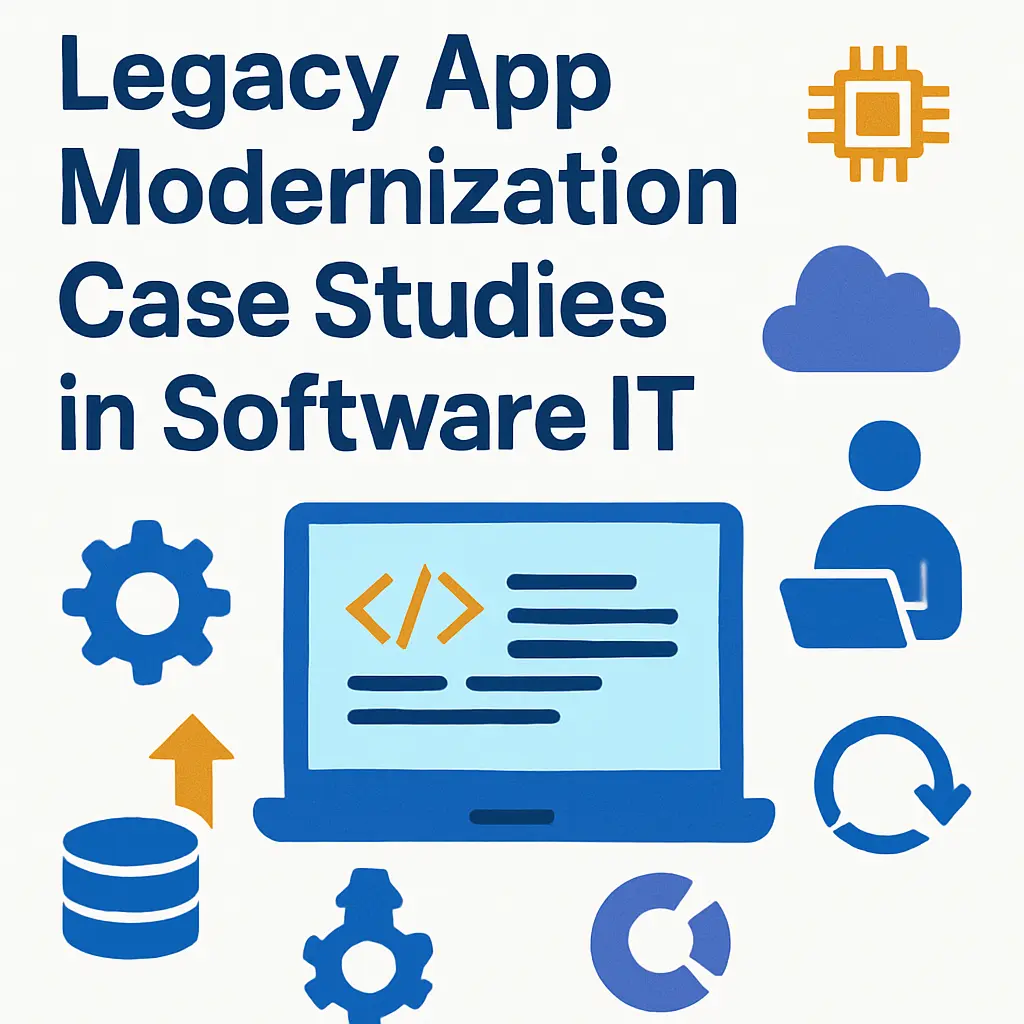
Another reason modernization has become urgent is the changing economics of technology. Cloud platforms, containerization, APIs, and automation tools have created new opportunities to break monolithic systems into manageable services. This allows organizations to modernize in stages rather than relying exclusively on high-risk “big bang” replacements. A carefully sequenced transformation can preserve critical functionality while reducing technical debt over time. This is one of the key lessons visible across many Legacy App Modernization Case Studies in Software IT, where phased execution often proves more sustainable than abrupt transitions.
Still, modernization is not always synonymous with rewriting everything. In fact, one of the most common mistakes is assuming that every old system must be replaced from scratch. Full replacement can be expensive, slow, and risky, particularly when undocumented logic has accumulated over decades. In many cases, the smarter path is selective modernization: identifying what creates the most business friction and focusing investment there first. This may involve exposing core functions through APIs, moving infrastructure to the cloud, redesigning the user interface, or isolating high-change components into modern services while preserving stable backend capabilities.
To make sound decisions, organizations need a structured assessment of their application landscape. This means evaluating systems across several dimensions:
- Business criticality: How central is the application to revenue, operations, customer service, or compliance?
- Technical health: Is the code maintainable, secure, documented, and testable?
- Integration complexity: How many systems depend on it, and how difficult is data exchange?
- Change velocity: How often does the application need updates to support business goals?
- Cost structure: What are the current and projected costs of maintaining the system compared with modernizing it?
This assessment creates a rational basis for prioritization. Without it, companies risk modernizing highly visible systems while leaving the most damaging bottlenecks untouched. They may also underestimate hidden dependencies, which is one of the main causes of overruns and service interruptions during migration projects.
In strategic terms, modernization is best understood as portfolio transformation rather than isolated system updates. Every application exists within a wider business and technology ecosystem. A billing platform may affect finance, sales, reporting, and customer support. A manufacturing system may influence procurement, logistics, and quality control. As a result, modernization decisions should be sequenced based on how value and risk move through that ecosystem. Organizations that approach the task in this integrated way are more likely to realize measurable gains rather than temporary technical improvements.
How Successful Modernization Programs Are Designed and Executed
Once leadership aligns on the need for modernization, the next challenge is execution. This is where many initiatives encounter difficulty. The gap between recognizing the problem and implementing the solution can be wide, especially when legacy systems are business-critical and operational downtime is unacceptable. The most effective modernization programs succeed because they combine architectural thinking with organizational readiness, disciplined governance, and measurable business outcomes.
The first step is defining a modernization strategy that reflects both present constraints and future ambitions. A company that needs rapid cloud scalability may choose a replatforming approach, moving workloads to modern infrastructure with limited code changes. A business struggling with deep architectural rigidity may require refactoring or decomposition into microservices. Another enterprise may decide on replacement with a software-as-a-service platform if its legacy system no longer provides strategic differentiation. The right path depends on the system’s purpose and the level of transformation the organization can absorb.
Common modernization approaches include:
- Rehosting: Moving applications to a different infrastructure environment with minimal code changes, often to reduce hardware and maintenance burden.
- Replatforming: Adjusting the application to run more efficiently in a modern environment while preserving much of its core design.
- Refactoring: Improving the code structure and architecture to enhance maintainability, scalability, and performance.
- Rearchitecting: Fundamentally redesigning the application, often to enable modularity, APIs, cloud-native patterns, or event-driven workflows.
- Replacing: Retiring the legacy system and implementing a new platform when the existing software no longer justifies further investment.
Although these categories are useful, real-world modernization rarely fits neatly into one model. Many organizations use hybrid approaches. For example, they may rehost a stable back-office component to reduce infrastructure risk while refactoring customer-facing modules that require faster feature delivery. The ability to tailor the strategy is important because business systems evolve unevenly. Some functions are strategic and dynamic, while others are transactional and relatively static.
Another major success factor is domain understanding. Legacy software often contains undocumented business rules, exception handling paths, approval logic, pricing calculations, and compliance checks that are not visible in system diagrams. Technical teams may understand the code, but operational users understand how the system behaves under real conditions. If modernization begins without capturing this institutional knowledge, the new environment may be technically improved but operationally weaker. This is why process mapping, stakeholder interviews, and dependency discovery are essential before major design decisions are finalized.
Execution also depends heavily on data strategy. In many modernization programs, the software itself is only part of the challenge. The larger issue is the quality, structure, accessibility, and governance of the data that flows through it. Historical records may exist in fragmented databases, custom formats, or duplicate repositories. Business definitions may differ across departments. Migration can therefore fail not because the application logic is flawed, but because data reconciliation is incomplete or inconsistent. A serious modernization effort should include data cleansing, schema mapping, archival policies, and validation frameworks from the beginning.
Integration design is equally critical. Legacy systems often connect to numerous internal and external services: ERP platforms, CRMs, payment gateways, supplier portals, identity systems, reporting tools, and industry-specific databases. During modernization, these integrations must either be preserved, redesigned, or replaced. A thoughtful API strategy can reduce long-term coupling and make future change easier. By contrast, a rushed point-to-point approach may recreate the same fragility that modernization was supposed to solve.
Successful organizations also treat testing as a strategic discipline rather than a final checkpoint. Because legacy applications support core operations, modernization introduces risk not only in functionality but also in performance, security, and user behavior. Test coverage should include regression testing, integration testing, performance testing, failover validation, security scanning, and user acceptance testing under realistic conditions. Where possible, automated testing frameworks should be introduced early to support incremental release cycles. This is especially valuable when modernization unfolds in phases and teams need confidence to deploy change continuously.
Beyond the technical work, organizational alignment often determines whether modernization delivers expected value. Teams may resist change because they fear disruption, job displacement, or loss of familiar workflows. Business leaders may expect immediate visible results, even when foundational architecture work takes time. Finance departments may evaluate the initiative through short-term cost lenses rather than multi-year value creation. These tensions can weaken programs unless communication is clear and governance is strong.
Effective governance usually includes:
- Executive sponsorship: Senior leadership support ensures decisions are made quickly and modernization stays aligned with business priorities.
- Cross-functional ownership: IT, operations, security, compliance, and business stakeholders share responsibility for outcomes.
- Milestone-based delivery: Work is structured into measurable stages that demonstrate progress and reduce risk.
- Value tracking: Teams monitor KPIs such as incident reduction, deployment speed, cost savings, uptime, and customer satisfaction.
- Change management: Training, documentation, and user engagement help the organization adopt new processes successfully.
Case-study patterns consistently show that modernization succeeds when organizations prioritize continuity alongside innovation. They preserve what is valuable, isolate what is limiting, and transform what creates strategic advantage. This practical balance is evident in many Modernization Case Studies for Legacy Software Systems, where the best outcomes do not come from the most radical technical plans, but from the most disciplined alignment between architecture, business goals, and execution sequencing.
One recurring lesson from these transformations is that modernization should be measured in outcomes, not activity. Moving workloads to the cloud, adopting containers, or decomposing applications into services are not valuable in themselves unless they solve business problems. The real questions are whether teams can release changes faster, whether customers experience smoother interactions, whether security improves, and whether the organization gains flexibility to support future growth. Technology choices matter, but they matter because of the operating model they enable.
Another important lesson is the value of incremental wins. Large-scale modernization programs can span months or years, which creates pressure to justify ongoing investment. By delivering improvements in stages, organizations build confidence and reduce resistance. A modernized reporting layer may provide better analytics early in the journey. An API wrapper around a core system may accelerate integration without changing the underlying engine immediately. A redesigned user interface may reduce training costs and improve productivity while backend refactoring continues in parallel. These visible gains help maintain momentum and prove that modernization is not an abstract IT initiative, but a business improvement program.
Risk management remains central throughout the journey. The most common modernization risks include underestimated complexity, incomplete requirement discovery, weak stakeholder alignment, data migration errors, and insufficient rollback planning. Mature teams respond by creating architecture blueprints, conducting dependency inventories, validating assumptions through pilots, and maintaining fallback mechanisms for critical cutovers. They avoid treating modernization like a one-time conversion event and instead manage it as a controlled transition with continuous learning.
It is also worth noting that modernization creates an opportunity to rethink operational discipline. Older systems often survive despite weak documentation, informal support models, and limited observability. During modernization, organizations can introduce better logging, monitoring, incident response processes, infrastructure automation, and DevOps practices. This means the value of modernization is not limited to software architecture. It can improve the entire way technology is managed, governed, and evolved.
In the long term, the organizations that benefit most from modernization are those that shift their mindset from project completion to capability building. They do not ask only how to replace an aging system. They ask how to create an application ecosystem that can change predictably, integrate efficiently, and support business strategy over time. That mindset transforms modernization from a defensive response into a platform for growth.
Conclusion
Legacy software modernization is no longer optional for organizations that need agility, security, and sustainable growth. The strongest results come from aligning technical change with business priorities, sequencing work carefully, and focusing on measurable outcomes. By learning from proven case-study patterns and approaching modernization as a strategic capability, companies can reduce risk, unlock innovation, and build systems prepared for future demands.