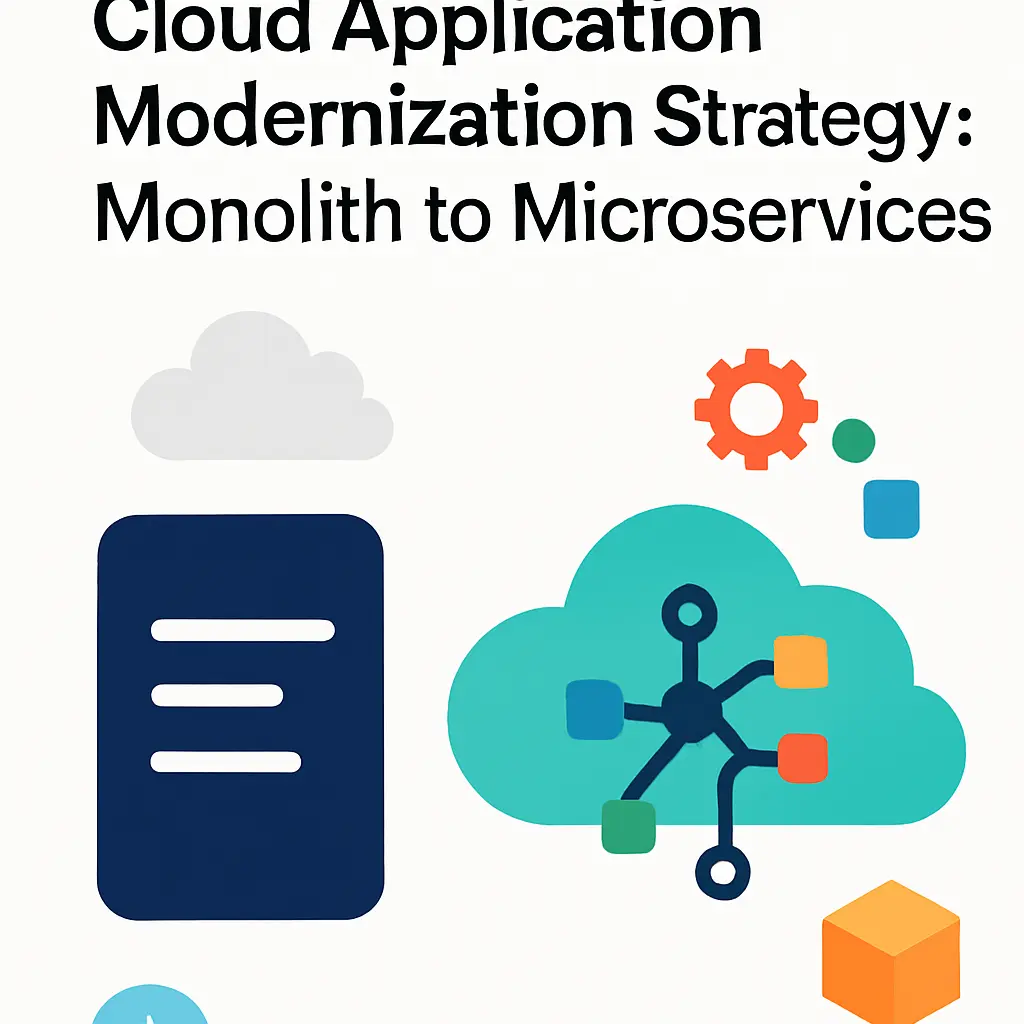
Modernizing legacy applications is now a strategic imperative rather than a nice-to-have upgrade. As digital expectations rise, organizations must rethink how they design, deploy, and evolve software. In this article, we explore what an effective cloud application modernization strategy looks like and how the migration of monolith to microservices fits into a broader, value-driven transformation journey.
From Legacy Constraints to Cloud-Native Potential
The starting point for any meaningful modernization effort is understanding why you are modernizing in the first place. Many organizations rush towards the cloud or microservices because “everyone else is doing it,” and then struggle with escalating costs, unexpected complexity, or cultural resistance.
Instead, you should treat modernization as a business transformation, not just a technical one. That means anchoring every architectural and tooling decision in clear business outcomes such as:
- Reducing time-to-market for new features
- Improving reliability and uptime for critical services
- Lowering infrastructure and operational costs over time
- Enhancing customer experiences and personalization
- Strengthening security and regulatory compliance
Once these outcomes are defined and prioritized, the rest of your modernization roadmap starts to fall into place. You can evaluate technologies and patterns based on their contribution to those goals, rather than chasing trends.
Assessing the Current State: Application, Architecture, and Organization
A thorough assessment phase is non‑negotiable. The objective is to map the current landscape—both technical and organizational—so you can identify the best modernization paths for each component. Key dimensions to analyze include:
- Application portfolio: Which systems are core revenue drivers, which support operations, and which are low-value or redundant? Tag applications by criticality and business domain.
- Technical architecture: Degree of coupling, technology stacks, middleware dependencies, and where performance or resilience issues occur.
- Data landscape: Data stores, integration patterns, data ownership, quality, and latency requirements between systems.
- Operational processes: Current deployment model, release cycles, change management, incident handling, and observability.
- Organizational structure: Team boundaries, ownership of business capabilities, skill sets, and collaboration patterns.
From this holistic assessment, you can categorize each application into modernization options, often framed as:
- Retain: Keep as is, possibly moving to a more cost‑effective platform later.
- Rehost: “Lift and shift” to cloud infrastructure with minimal code changes.
- Replatform: Move to managed services (databases, application platforms) while making light modifications.
- Refactor: Restructure the internals, reduce technical debt, and decouple components while preserving functionality.
- Rearchitect: Fundamentally change the architecture, often towards microservices or event‑driven models.
- Retire or replace: Decommission legacy systems or swap them with SaaS or COTS solutions.
Prioritizing What to Modernize First
You rarely want to modernize everything at once. Instead, you create a modernization backlog and then prioritize initiatives based on a mix of business impact, technical feasibility, and risk. Common prioritization criteria include:
- Business value: Revenue impact, cost savings, customer experience improvements, and strategic importance.
- Risk and compliance: Security exposure, compliance gaps, and end-of-life technologies.
- Dependency map: Upstream/downstream dependencies that might block or amplify other modernization efforts.
- Complexity vs. benefit: Size of the effort versus expected payoff.
This step often surfaces “keystone” systems whose modernization unlocks improvements across multiple domains, such as shared customer data services or core order management platforms.
Cloud-Native Principles as the Foundation
As you shape your roadmap, cloud‑native principles provide a guiding star for your target state, even if you adopt them incrementally:
- Elastic scalability: Applications scale horizontally rather than vertically, matching demand patterns.
- Automation-first operations: Infrastructure as code, automated deployments, and policy‑as‑code for governance.
- Resilience and fault isolation: Systems handle partial failures gracefully, relying on patterns like circuit breakers and retries.
- Observability: Rich metrics, logs, and traces provide deep insight into system behavior.
- Loose coupling and clear contracts: Services communicate over well-defined APIs and messaging protocols.
These principles are not limited to greenfield builds; they can systematically steer refactoring efforts around your existing systems so you gain the benefits of modern architectures without rewriting everything at once.
Operating Model and Culture: The Often-Ignored Dimension
Any modernization strategy that focuses purely on technology will eventually stall. How your teams collaborate, make decisions, and assume ownership is just as important as your choice of tools or architectures.
Key operating-model shifts that typically accompany modernization include:
- From project teams to product teams: Long‑lived teams own specific business capabilities end‑to‑end, including operations.
- DevOps and platform engineering: Shared platforms and paved paths for CI/CD, observability, and security, reducing friction for product teams.
- Autonomy with guardrails: Teams have freedom to experiment within a framework of standards, reference architectures, and compliance requirements.
- Continuous learning: Blameless postmortems, internal communities of practice, and investment in upskilling.
If you view modernization as a multi‑year transformation, you can align your organizational evolution with your technical roadmap, ensuring that each new architectural pattern is backed by the right skills, processes, and incentives.
Governance, Security, and Compliance in a Modernized Landscape
Modern architectures increase flexibility but also expand the security and governance surface if not handled thoughtfully. Your strategy must embed guardrails from the outset, not bolt them on as an afterthought. This typically involves:
- Central identity and access management integrated with applications via standardized protocols.
- Data protection and classification, including encryption, retention policies, and access auditing.
- Security-by-design, including threat modeling and secure coding practices integrated into the development lifecycle.
- Compliance automation where possible, using policy-as-code to enforce baseline requirements across all environments.
With these strategic elements in place, you are prepared to move from vision to execution, and this is where the architecture of your applications—especially monoliths—comes into sharp focus.
From Monolith to Microservices: Execution of the Modernization Strategy
The migration of monolith to microservices is one of the most visible and impactful modernization patterns, but also one of the most misunderstood. Microservices are not a universal remedy; they amplify both your strengths and weaknesses. Done thoughtfully, they can accelerate delivery and resiliency. Done hastily, they create a distributed monolith that is hard to manage and even harder to change.
When Microservices Make Sense—and When They Don’t
Before decomposing a monolith, you should validate whether microservices align with your strategic objectives and your readiness level. Microservices are typically a good fit when:
- Your organization needs to scale development across many teams working in parallel.
- You require independent deployment of features without impacting the entire system.
- Different parts of the system have very different scalability, performance, or resilience requirements.
- You want technology diversity (polyglot architectures) for specific components where it adds clear value.
Microservices may not be the right first step if:
- Your team is small and can move quickly within a modular monolith.
- Your primary bottleneck is process (e.g., manual testing, slow approvals) rather than architecture.
- You lack basic DevOps automation, observability, or cloud experience.
In these cases, it is often more effective to invest first in refactoring, automation, and modularization within a monolith, then evolve into microservices when the maturity and need are clear.
Defining Service Boundaries Using Domain-Driven Design
Successful decompositions are guided by the business domain, not just technical layers. Domain-Driven Design (DDD) provides tools for finding natural service boundaries—known as bounded contexts—that map to business capabilities such as “Order Management,” “Billing,” or “Inventory.”
By aligning services around these capabilities, you reduce cross‑cutting dependencies and ensure each service has a clear purpose and ownership. Typical steps include:
- Collaborating with domain experts to map core domains, subdomains, and supporting domains.
- Identifying current pain points where cross‑domain coupling hinders change.
- Defining clear contracts (APIs, events) between domains that reflect business language.
This domain-centric approach helps you avoid splitting your monolith into many small services that still share data and logic in tangled ways.
Incremental Decomposition Patterns
Rather than rewriting a monolith from scratch, most organizations adopt incremental decomposition. Several patterns are commonly used:
- Strangler Fig pattern: New functionality is built as services around the existing monolith. Over time, old modules are replaced or routed to microservices until the monolith shrinks or disappears.
- Extract Module: A tightly cohesive module with few dependencies is pulled out of the monolith and exposed as a standalone service, with the monolith calling it via an API.
- Backend for Frontend (BFF): You introduce specialized backends for each client type (web, mobile, partner), gradually re‑routing calls.
- Event-first refactoring: You identify domain events within the monolith and externalize them via a messaging system, enabling asynchronous interactions and loosening coupling before full extraction.
Incremental approaches let you maintain business continuity and validate assumptions early, reducing the risk of massive, long-running projects that deliver value only at the end.
Data: The Hardest Part of Decomposition
Monolithic applications typically rely on a shared relational database that tightly couples multiple modules. Breaking this apart is often the most complex part of modernization. Key practices include:
- Service-owned data: Each microservice owns its data store and is the only service that writes to it, eliminating conflicting writes and hidden dependencies.
- API- or event-based integration: Other services access that data via APIs or consume change events, rather than directly querying the database.
- Data duplication and projections: Read models or cached projections are used where cross-service joins were previously handled in the database.
- Gradual schema decomposition: You start by identifying tables most closely aligned to candidate services and migrate them along with the associated logic.
Adopting patterns like CQRS (Command Query Responsibility Segregation) and event sourcing can help in some cases, but they introduce their own complexity and should be applied selectively where they clearly solve existing problems.
Observability, Testing, and Operational Excellence
As you move from a monolith to a set of distributed services, visibility and reliability become harder to maintain without strong engineering practices:
- Observability: Implement centralized logging, metrics, and distributed tracing from the outset so you can diagnose issues that cross multiple services.
- Automated testing: Invest in contract tests between services, smoke tests, and robust integration tests to catch regressions early.
- Resilience patterns: Timeouts, retries, bulkheads, and circuit breakers prevent cascading failures across the ecosystem.
- Deployment and release strategies: Techniques like blue‑green deployments, canary releases, and feature flags allow safe, incremental rollouts.
These capabilities need to be built into your platform and development lifecycle as first-class citizens; retrofitting them later is far more painful and costly.
Team Topologies Aligned to Services
Architecture and organization evolve together. To fully realize the benefits of microservices, align your team structures with the capabilities and services they own. A few practical patterns include:
- Stream-aligned teams that own a specific flow of work from idea to production, often mapped to a product or business capability.
- Platform teams that provide shared tooling, infrastructure, and paved paths to streamline delivery.
- Enabling teams that help others adopt new practices like test automation, observability, or security.
This alignment reduces handoffs, clarifies accountability, and encourages teams to think in terms of long-term stewardship rather than short-term project completion.
Measuring Success: From Vanity Metrics to Business Outcomes
Finally, your modernization journey—especially as you decompose monoliths—should be measured not just by technical achievements but by tangible business results. Useful metrics include:
- Lead time for changes: Time from code commit to production deployment.
- Deployment frequency: How often you can safely release features or fixes.
- Change failure rate: Percentage of releases that cause incidents or require rollbacks.
- Mean time to recovery (MTTR): How quickly you can restore service after an incident.
- Business KPIs: Uplift in conversion, reduced churn, improved NPS, or lowered operational costs.
Tracking these metrics before and after modernization efforts helps you validate that your architectural choices are delivering the intended outcomes—and enables you to adjust course early if they are not.
Conclusion
Modernizing applications is a strategic, multi‑dimensional journey that spans technology, processes, and people. By grounding your efforts in business outcomes, assessing your current state honestly, and adopting cloud‑native principles incrementally, you can build a sustainable roadmap. Thoughtful decomposition of monoliths into microservices—supported by strong data strategies, observability, and aligned teams—turns modernization from a risky overhaul into a controlled, value‑driven evolution.