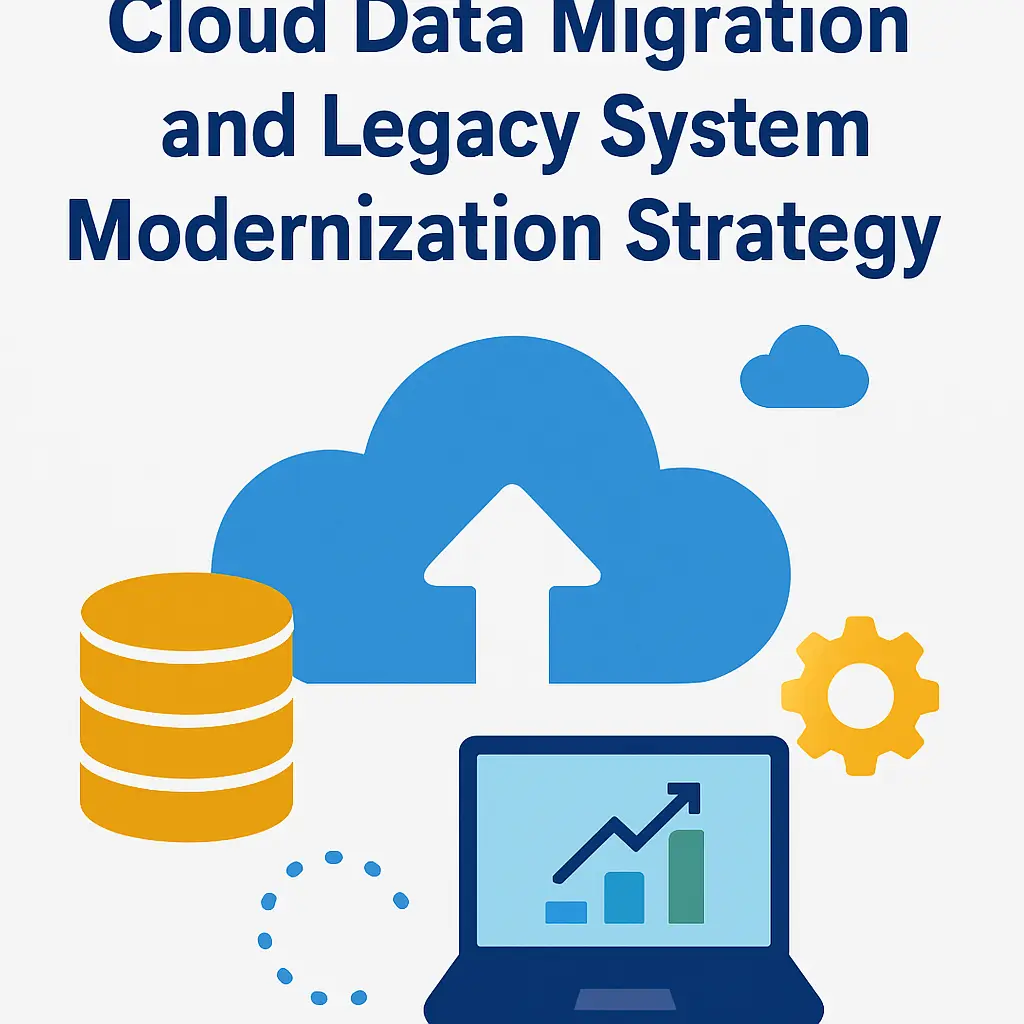
Cloud migration and legacy system modernization have become strategic imperatives for organizations that want to stay competitive, secure, and data‑driven. In this article, we’ll explore how to design a resilient, scalable cloud data migration strategy, how to modernize aging systems without disrupting business, and how to connect both into one coherent transformation roadmap that delivers measurable ROI and long‑term agility.
Navigating Cloud Data Migration and Legacy Modernization as One Strategy
Many organizations still treat cloud migration and legacy modernization as two separate initiatives: one driven by infrastructure and IT operations, the other by applications and business stakeholders. This separation is one of the main reasons digital transformation projects stall, overspend, or underdeliver.
In reality, your cloud migration strategy and your modernization strategy are two sides of the same coin. Your data lives in legacy systems; your applications depend on it; your business processes are encoded in both. Migrating data without rethinking how it is produced and consumed simply moves technical debt into a new environment. Modernizing applications without a clear data and platform foundation leads to brittle architectures and fragmented analytics.
To avoid these pitfalls, you need a cohesive approach that:
- Aligns business objectives, technical architecture, and operating model from the start
- Treats data, applications, and integration patterns as a single ecosystem
- Combines short‑term risk reduction with long‑term modernization goals
- Continuously measures value, cost, and risk across both migration and modernization streams
Below, we’ll first dive into how to frame and design a robust cloud data migration strategy anchored in business value, and then examine how to modernize legacy systems in a way that leverages your new cloud foundation rather than working against it.
Designing a Cloud Data Migration Strategy That Actually Delivers Value
A data‑centric cloud migration is more than moving databases into managed services. It reshapes how data is collected, governed, shared, and monetized across the enterprise. Start with business goals and work backward to the right technical patterns, rather than beginning with tools or providers.
1. Start from outcomes, not from infrastructure
Before selecting a cloud provider or migration tooling, define what success looks like in terms the business understands. Common outcome categories include:
- Operational resilience: Reduce downtime, improve disaster recovery, and improve observability.
- Scalability and performance: Support growth, seasonal peaks, and real‑time analytics.
- Cost optimization: Lower total cost of ownership, but also optimize cost per business event processed.
- Innovation velocity: Reduce lead time to deploy new features or data products.
- Compliance and security: Strengthen data protection, auditability, and regulatory alignment.
Each outcome implies different migration constraints and priorities. For example, if reducing downtime is critical, you might favor online replication and phased cutovers; if rapid innovation is the priority, de‑coupling data producers and consumers through streaming or APIs becomes central.
2. Inventory, classify, and prioritize your data landscape
Most enterprises underestimate the complexity and fragmentation of their data estate. A rigorous inventory is non‑negotiable:
- Catalog systems of record and systems of engagement: ERP, CRM, core banking, manufacturing control, web and mobile apps, and so on.
- Classify data domains: customer, product, finance, operations, HR, IoT/telemetry, etc.
- Map dependencies: batch interfaces, ETL jobs, message queues, file drops, and reporting tools.
- Assess criticality and sensitivity: business‑critical, mission‑critical, regulated, confidential, public.
From there, you can build a risk‑based prioritization:
- High value, low risk: early candidates to prove value in the cloud.
- High value, high risk: candidates for detailed proof‑of‑concepts and incremental migration.
- Low value, high risk: consider retirement or consolidation rather than migration.
This classification stops you from migrating obsolete or redundant data that only bloats your cloud bill and complicates governance.
3. Choose migration patterns intentionally
Different workloads and data types call for different migration patterns. Some of the most common include:
- Lift and shift (rehost): Move databases or VMs largely as they are into cloud infrastructure. This is fastest, but preserves most legacy constraints.
- Replatform: Move to a cloud‑native data platform (e.g., managed relational databases, cloud data warehouses, or lakehouses) while leaving application code largely unchanged.
- Refactor or re‑architect: Redesign data models, interfaces, and storage patterns to leverage microservices, event‑driven architectures, or domain‑oriented data products.
A smart strategy mixes these patterns. For example, you might:
- Lift and shift a mission‑critical database first to get out of an aging data center with security risks.
- Replatform reporting and analytics into a modern lakehouse to enable self‑service BI and advanced analytics.
- Refactor specific high‑change domains (such as customer or order data) into a domain‑driven, event‑based architecture as you modernize the associated applications.
The key is to plan transitions, not one‑off moves. It’s acceptable to rehost today if you have a clear roadmap to replatform or refactor later, and if the short‑term step materially reduces risk or cost.
4. Architect for data integration and interoperability from day one
Legacy landscapes are full of point‑to‑point integrations: nightly batches, flat‑file transfers, ad‑hoc APIs. Cloud migration is your chance to rationalize this.
Core design principles include:
- Separation of concerns: isolate ingestion, storage, transformation, and serving layers.
- Standardized interfaces: favor well‑governed APIs, data contracts, and streaming topics over ad‑hoc file exchanges.
- Canonical data models where they add value: common, well‑defined representations for shared entities such as customer or product, with room for domain‑specific extensions.
- Event‑driven patterns: publish changes as events rather than relying solely on batch extracts, particularly for operational and real‑time analytics use cases.
Neglecting integration leads to a fragmented cloud estate that replicates, and often worsens, on‑premises silos. Designing for interoperability ensures that future modernization efforts—new services, new analytics, new channels—can plug into a coherent data backbone.
5. Build data governance into the migration rather than bolting it on
Modern cloud platforms make it easier to control access, audit activity, and enforce policies. But technology alone doesn’t give you governance; you also need processes, roles, and clear ownership.
Key governance elements to embed in your migration program include:
- Data ownership and stewardship: every major data domain has accountable owners (often in the business) and stewards (often in data teams).
- Classification and tagging: label data with sensitivity, regulatory requirements, and lifecycle policies so they can be enforced programmatically.
- Access control models: define role‑based and attribute‑based controls that are manageable at scale, with least privilege as the default.
- Quality monitoring: set up automated checks and data observability so issues surface quickly and are tied to clear escalation paths.
Done properly, governance and migration are mutually reinforcing: as data moves into the cloud, it becomes better documented, more traceable, and easier to protect, which in turn builds trust and encourages wider use.
6. Plan for coexistence, not just end states
Most organizations will operate hybrid environments for years. Critical questions include:
- Where is the system of record during transition? Is the authoritative data on‑premises, in the cloud, or split by domain?
- How will changes synchronize? Batch replication, CDC (change data capture), event streams, or dual‑write patterns?
- How long will key systems run in parallel? What are the criteria for turning off legacy components?
Underestimating coexistence complexities leads to data inconsistencies, user confusion, and failed cutovers. A realistic, carefully staged coexistence plan is as important as the target architecture itself.
7. Measure value and adapt continuously
Finally, data migration is not a one‑time project; it’s an evolving program. Establish KPIs and feedback loops:
- Reduction in infrastructure and licensing cost versus baseline
- Improved query performance and data availability
- Decrease in incidents related to data quality or integration failures
- Business metrics influenced by new capabilities (for example, faster customer onboarding or more accurate forecasts)
Use these insights to reprioritize the backlog, refine your architecture, and inform the next wave of legacy modernization.
Modernizing Legacy Systems on a Cloud Foundation
Once you’ve established a strategic migration path for your data, you’re in a stronger position to modernize legacy applications. However, modernization is not simply rewriting old code in new languages or platforms; it’s about rethinking how your systems support business capabilities, resilience, and change.
1. Connect modernization to capabilities, not technologies
Begin by mapping business capabilities—what the business does and needs to do—rather than starting with the application inventory alone. Typical capability areas might include:
- Customer acquisition and servicing
- Order management and fulfillment
- Billing, payments, and collections
- Asset and inventory management
- Risk, compliance, and reporting
Then map legacy systems and components to these capabilities. This allows you to:
- Prioritize modernization where it will unlock strategic capabilities or remove bottlenecks.
- Identify high‑coupling between capabilities that may require joint modernization.
- Define coherent modernization “slices” that can be delivered incrementally.
Capabilities provide a stable language for aligning stakeholders; technologies change, but capabilities remain relatively constant.
2. Understand modernization options and choose per component
Not every legacy system deserves the same treatment. Typical modernization approaches include:
- Retire: decommission systems that provide low or no business value, often revealed by usage and cost analysis.
- Retain (encapsulate): keep the system as‑is but expose its functionality via APIs or integration layers to reduce direct dependencies.
- Rehost (lift and shift): move the application to cloud infrastructure without major code changes.
- Replatform: migrate to managed runtimes or PaaS offerings, reducing operational overhead.
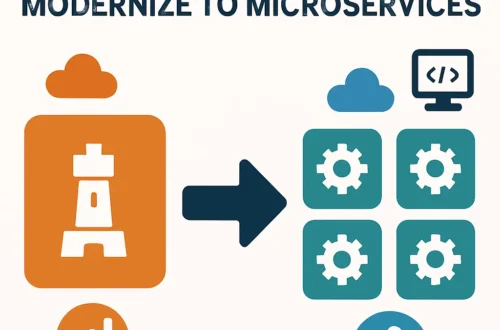
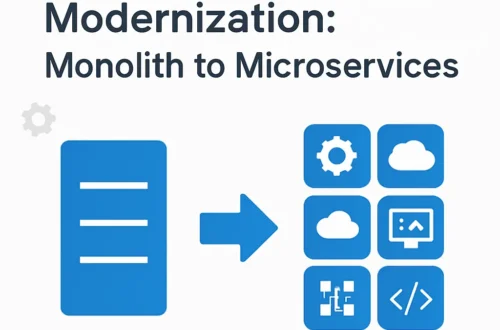
- Refactor or re‑architect: break up monoliths, redesign domains, and adopt cloud‑native, microservices, or serverless patterns.
- Replace: adopt SaaS or COTS products where differentiation is low and vendor solutions are mature.
A good modernization roadmap details which approach applies to each application or component and why—based on business criticality, strategic differentiation, technical fit, and cost‑benefit analysis.
3. Use strangler patterns to reduce risk
Direct “big bang” replacements of large legacy systems are notoriously risky. The strangler fig pattern offers a safer approach:
- Wrap the legacy system behind a façade or gateway that all consumers use.
- Incrementally build new services or components in the cloud that handle specific functions or business flows.
- Reroute traffic for those functions from the façade to the new components.
- Gradually shrink the legacy system until it can be retired.
This pattern pairs well with a strong cloud data foundation. As new components are built, they can consume and emit data through your standardized data platform—APIs, streams, or data products—rather than creating new silos.
4. Align modernization with your target data architecture
Legacy systems often encode their own data models and persistence strategies. To avoid reproducing fragmentation, your modernization program should be tightly coupled with your target data architecture.
Consider:
- Domain‑driven design: align services and data stores with business domains and bounded contexts, reducing cross‑domain entanglement.
- Data products or domain data marts: create well‑owned, documented data sets that correspond to business domains, with clear contracts and SLAs.
- Event sourcing and CQRS where appropriate: for high‑throughput or audit‑critical domains, capture state changes as events and use materialized views for queries.
When each modernized service integrates with the same data principles and platform, you build an ecosystem that is easier to reason about, govern, and evolve. This is where a structured legacy system modernization case study is particularly useful: it illuminates how organizations handled data alignment, sequencing of services, and the interplay of migration and modernization.
5. Modernize security and compliance in tandem
Legacy systems often carry outdated security assumptions: coarse‑grained permissions, shared accounts, or insufficient encryption and logging. Modernization is an ideal moment to uplift your security posture:
- Centralize identity and access management: single sign‑on, MFA, and consistent role models across cloud and on‑premises.
- Apply zero‑trust principles: authenticate and authorize each request, minimize network trust zones, and use service‑to‑service identities.
- Enhance observability: structured logs, distributed tracing, and security analytics that can span old and new components.
From a compliance standpoint, ensure that data residency, retention, and consent rules are built into your new architectures. Compliance should be codified in policies and infrastructure, not manual processes.
6. Manage organizational and cultural change
Technology change fails when organizations do not adapt their structures, processes, and skills. Cloud migration and modernization inevitably alter:
- Team boundaries: cross‑functional product or platform teams often replace siloed application teams.
- Funding models: from large capital projects to ongoing product‑oriented investment.
- Release and change management: from infrequent big releases to continuous delivery and experimentation.
Effective modernization programs invest in:
- Training and upskilling in cloud infrastructure, data engineering, and modern development practices.
- Clear ownership models for platforms, data domains, and business capabilities.
- Communications that link technical work to visible business benefits.
Ignoring the human dimension is a leading cause of resistance, shadow IT, and re‑centralization of decision‑making that undermines cloud benefits.
7. Build a feedback‑driven modernization portfolio
Just as with cloud migration, modernization should be governed as a dynamic portfolio, not a one‑time plan. Establish:
- Value hypotheses: for each modernization initiative, define the expected benefits and how they will be measured.
- Regular portfolio reviews: adjust priorities based on delivered value, changing business conditions, and emerging risks.
- Sunset milestones: clear dates or criteria for decommissioning legacy components to avoid “zombie” systems that persist indefinitely.
This approach turns modernization into a continuous capability rather than a sporadic crisis response when systems become unmaintainable.
Conclusion
Cloud data migration and legacy system modernization are most effective when treated as one integrated strategy. By defining business‑driven outcomes, classifying and prioritizing data and systems, and using phased, risk‑aware patterns, you create a solid cloud foundation and progressively modernized application landscape. Aligning architecture, governance, security, and organizational change ensures that each step compounds value, leading to a more resilient, agile, and data‑driven enterprise.