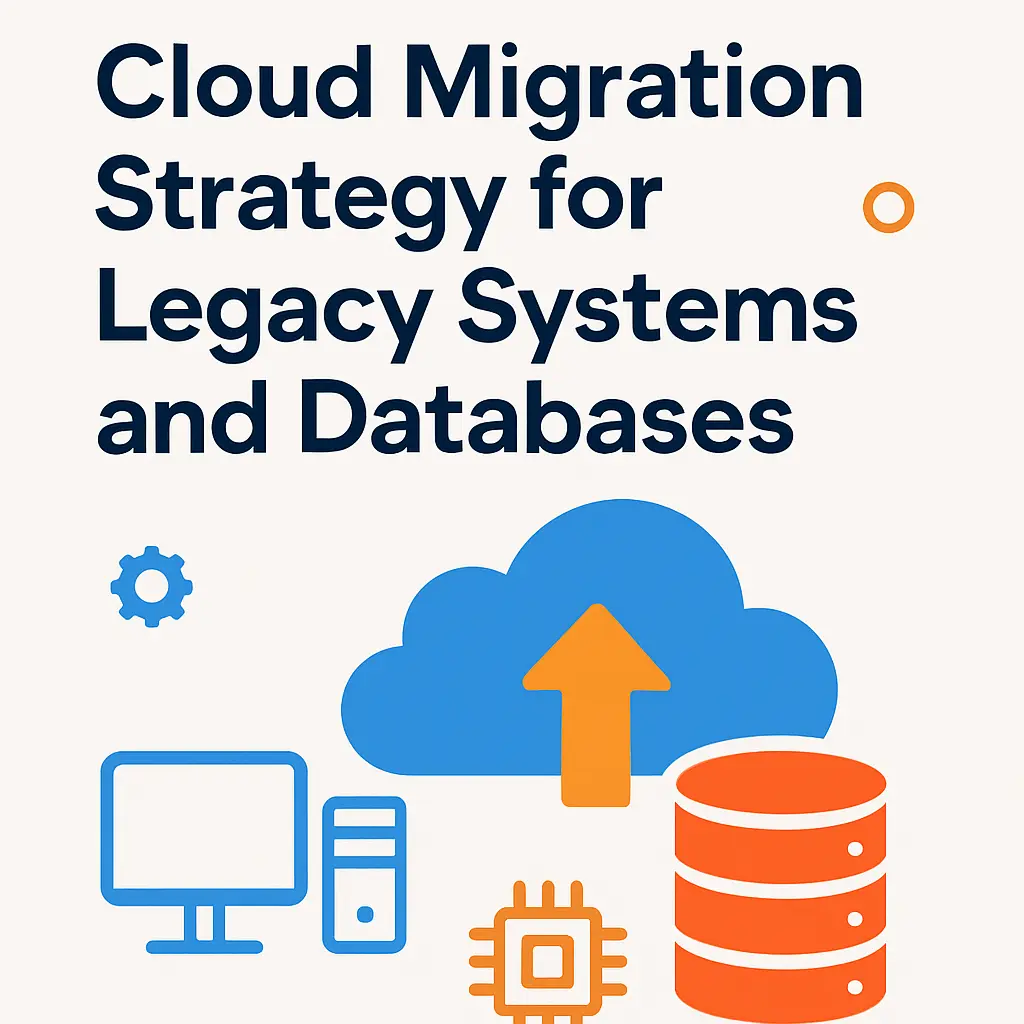
Modernizing legacy systems is one of the most impactful ways to improve reliability, scalability and innovation speed in any organization. But cloud transformation can easily fail without a clear vision and detailed execution plan. In this article, we’ll explore how to build a practical cloud migration strategy and then dive deep into the critical topic of legacy database migration, tying both into one coherent modernization journey.
From Legacy Constraints to Cloud-Native Advantage
Legacy systems are usually the backbone of core operations: billing, logistics, manufacturing, banking, insurance, and more. They often “just work,” but at a high hidden cost—technical debt, fragile integrations, slow change cycles, and difficulty scaling to new digital channels. Moving these systems to the cloud is not just an infrastructure project; it is a strategic transformation that reshapes how technology supports the business.
To avoid common pitfalls—budget overruns, endless delays, and degraded performance after go‑live—organizations must connect business objectives, architecture choices and implementation tactics in a single, linear plan. That plan should cover not only applications and services, but also the data that powers them, especially the legacy databases that typically become the hardest bottleneck in any transformation.
The sections below follow that linear journey: we start with how to approach overall migration planning and architecture decisions, then zoom into the specifics of modernizing and migrating legacy databases in a way that preserves data integrity while unlocking cloud-native capabilities.
Designing a Cloud-Centric Path for Legacy Systems
The starting point for any modernization effort is clarity on why you are moving. Vague goals such as “reduce costs” or “be more agile” are too broad to guide concrete trade-offs. Instead, define specific, measurable objectives:
- Reduce deployment time for core applications from weeks to hours.
- Improve peak-season scalability without a full hardware refresh cycle.
- Increase system availability to a specific SLA (e.g., 99.9% or 99.99%).
- Enable data-driven features such as real-time analytics or personalization.
These targets then inform which systems to prioritize, which cloud services to adopt and how aggressively to refactor existing applications versus lifting and shifting them as‑is.
Rationalizing and Prioritizing the Application Portfolio
Legacy landscapes are usually complex, with overlapping systems delivering similar functionality, shadow IT solutions and a spider web of batch jobs and point-to-point integrations. Before deciding how to migrate, carefully analyze what you have:
- Business criticality: Which systems directly support revenue or regulatory compliance?
- Technical health: What is the tech stack, code quality, test coverage and known vulnerabilities?
- Change frequency: Which applications change often and would benefit most from cloud agility?
- Dependency map: How data and processes flow across applications and databases.
Based on this analysis, categorize each application into migration patterns such as:
- Rehost: Move to cloud infrastructure with minimal changes—useful for stable, low-risk workloads.
- Replatform: Make limited optimizations (e.g., managed databases, containers) without rewriting core logic.
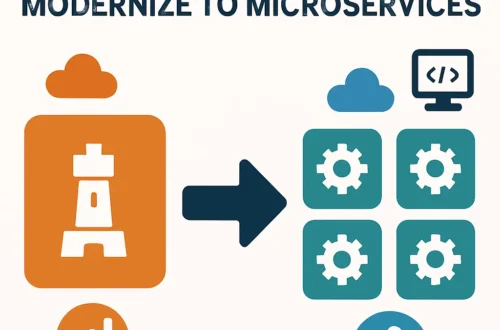
- Refactor: Redesign for cloud-native (e.g., microservices, event-driven architectures) where agility and scalability justify the investment.
- Retire/Replace: Decommission obsolete systems or replace with SaaS when the business no longer needs custom capabilities.
The outcome is a staged roadmap that sequences applications and their underlying data stores in a way that minimizes risk while maximizing early business value. This is much more effective than a big-bang migration, which often collapses under its own complexity.
Architecture Principles for Legacy-to-Cloud Transitions
Good migration roadmaps rest on a small set of architecture principles that keep the effort coherent over several years:
- Decouple before you move: Reduce tight coupling between frontends, backends and data by introducing APIs or message queues, making it easier to move components independently.
- Strangle, don’t rewrite: Use the “strangler pattern” to build new capabilities in the cloud while gradually routing traffic away from monolith components, instead of attempting an all‑or‑nothing rewrite.
- Design for failure: Assume that network calls fail, nodes restart and services temporarily go offline; use retries, circuit breakers and idempotent operations as default patterns.
- Automate everything: Infrastructure as code, automated tests, CI/CD pipelines and policy-as-code turn migration into a repeatable process instead of a one-off hero project.
However, architecture work can only progress so far before you confront the hardest question: what to do with the legacy databases. They are the gravity wells of your system—heavy, central and entwined with application logic and reporting workflows. Unlocking true cloud benefits requires a deliberate strategy to modernize and migrate these data platforms.
Security and Compliance as First-Class Design Concerns
Legacy environments often rely on perimeter security: secure the network and trust what is inside. Cloud-native architectures flip this assumption. Every service, user and integration must be explicitly authenticated and authorized. This shift has direct implications for how you move legacy systems:
- Identity and access: Centralize identity (SSO, SAML, OIDC) and move towards least-privilege roles for services and data stores.
- Data protection: Use encryption at rest and in transit by default; plan key management (KMS, HSM) with clear rotation and access policies.
- Compliance mapping: Document how each control in frameworks such as ISO 27001, SOC 2, PCI-DSS or HIPAA is addressed in the new architecture.
Security and compliance constraints heavily influence where data can reside, which cloud regions to use, and how you design cross-border replication. All of this becomes even more complex when you transform the database layer itself, which we explore next.
Organizational Readiness and Operating Model
No migration plan survives contact with an organization that is not ready to operate in the cloud. Before deep database changes, ensure you have:
- Upskilled teams: Developers and DBAs trained in cloud services, managed databases, observability tools and new deployment pipelines.
- Joint ownership: Cross-functional squads (developers, operations, security, data engineers) owning services end-to-end.
- Clear runbooks: Defined processes for incident response, performance tuning, backup/restore and capacity planning in the new environment.
Updating the operating model in parallel with technical migration significantly reduces the risk of outages and productivity dips once the new systems go live.
Modernizing Legacy Databases Without Losing the Business
Databases are not just storage; they encode years of business rules, reporting logic and integration conventions. That is why careless database migration is one of the fastest ways to break a business-critical application. A disciplined approach to modernization must cover data modeling, platform choice, migration tooling, and the stepwise cutover strategy.
Assessing the Current Database Landscape
Begin with a comprehensive inventory of existing data platforms:
- Technology stack: Mainframes, hierarchical DBs, old versions of Oracle/SQL Server, proprietary appliances, in-house file-based systems.
- Usage patterns: OLTP vs. reporting, batch workloads, analytic queries, ETL pipelines and external integrations.
- Quality and governance: Data duplication, inconsistent schemas, missing documentation, ad-hoc reports directly querying production.
- Non-functional constraints: Required latency, throughput, uptime, regulatory data residency and retention rules.
This assessment reveals which databases can be lifted into a managed equivalent with minimal change and which require deeper re-design, such as sharding, schema normalization, or even a complete switch to a new data model (e.g., from relational to document or key-value for specific use cases).
Choosing Modern Data Platforms Intentionally
Cloud providers offer a wide portfolio of managed databases: relational, document, wide-column, graph, time-series and more. It is tempting to adopt many of them at once, but diversity without governance quickly becomes new technical debt. A sound strategy usually includes:
- A small, well-governed core set: For example, one primary relational engine, one document store and one analytic warehouse/lakehouse as the default choices.
- Use-case alignment: Transactional systems remain on strongly consistent relational stores; content and event payloads might move to document or key-value stores; analytics consolidate into a single warehouse.
- Managed first: Prefer fully managed PaaS services for backups, patching, high availability and security updates—freeing teams to focus on data modeling and performance.
Before finalizing choices, run performance and functional pilots with representative workloads. This validates assumptions around query patterns, latency, cost and operational overhead.
Data Modeling and Schema Evolution
Legacy schemas often reflect historic constraints and compromises: denormalized tables, overloaded columns, and implicit relationships known only to a few long-tenured engineers. Moving to the cloud is a unique chance to clean this up, but it must be done carefully to avoid breaking dependencies.
Key tactics include:
- Canonical models: Define domain-based canonical data models (e.g., customer, order, product) to serve as a stable contract between systems.
- Versioned schemas: Introduce explicit schema versioning so producers and consumers can evolve independently, especially in event-driven systems.
- Backward compatibility: Apply additive changes first (new columns, new tables, optional fields) while still supporting existing consumers, and only later phase out deprecated structures.
Automating schema migrations through version-controlled scripts and migration tools ensures repeatability across environments and accelerates testing cycles.
Zero-Downtime and Low-Risk Migration Patterns
For mission-critical systems, extended database downtime is often not acceptable. To move large datasets safely, organizations typically combine several patterns:
- Bulk load + change data capture (CDC): Perform an initial bulk copy into the target database, then apply ongoing changes via log-based CDC until the new database is caught up.
- Bi-directional sync (carefully scoped): For some transitions, run both source and target in sync for a limited period, ensuring no data divergence; this requires strict conflict resolution rules.
- Canary cutovers: Route a small subset of traffic (e.g., a specific region, internal users) to the new database first, monitor behavior, then expand gradually.
Invest heavily in validation: record-level checksums, aggregated metrics comparison, and end-to-end business scenario testing that confirms not just data equality, but correct application behavior and reporting outcomes.
Performance and Observability in the New World
Database performance issues often only show up under real load. Before migrating, establish baseline metrics for current systems—query latencies, throughput, CPU, I/O, lock contention, and slow query profiles. In the new environment, instrument:
- Detailed query monitoring: Slow query logs, execution plans, and automated recommendations.
- Resource usage: CPU, memory, storage and network patterns to tune instance sizes or autoscaling rules.
- End-to-end traces: Distributed tracing between application calls and database queries for full request visibility.
Build feedback loops: use production metrics to adjust indexes, partitioning strategies, caching layers and connection pooling limits, iteratively optimizing cost and performance.
Governance, Security and Data Lifecycle Management
Moving databases to the cloud must also elevate your data governance posture, not weaken it. Mature organizations align modernization with strong disciplines in:
- Data classification: Label data (public, internal, confidential, restricted) and tie these labels to technical controls such as encryption, masking and network boundaries.
- Access control: Implement role-based or attribute-based access, with just-in-time elevation where necessary and continuous monitoring for anomalies.
- Lifecycle policies: Define how long data is kept in hot, warm and cold storage; automate archival and deletion to meet regulatory and cost goals.
- Backup and disaster recovery: Regular, automated backups with tested restore procedures, cross-region replication where needed, and clear RPO/RTO objectives.
Robust governance not only reduces risk; it creates trust in the data, enabling advanced analytics and AI use cases built on the modernized foundations.
Aligning Application and Database Evolution
The final piece of the puzzle is coordination: database changes and application changes must be choreographed, not executed in isolation. Effective approaches include:
- Feature toggles: Allow applications to switch between old and new data paths dynamically, enabling gradual rollout and quick rollback.
- Dual writes and reads (temporarily): For some migrations, applications write to both old and new stores while reads are gradually switched, maintaining consistency until full cutover.
- Contract testing: Ensure that APIs and event schemas remain compatible across legacy and new services during the transition period.
By aligning changes across applications, data pipelines and databases, you avoid the “broken middle layer” where systems are technically migrated but functionally impaired, undermining user trust and business confidence.
Conclusion
Modernizing legacy systems demands more than moving servers to the cloud; it requires a coherent strategy that links business goals, architecture choices and disciplined execution. By planning the transformation as a staged journey, aligning security and operating models early, and treating database modernization as a structured, low-risk process, organizations can unlock agility, scalability and innovation while safeguarding their core operations and data integrity.