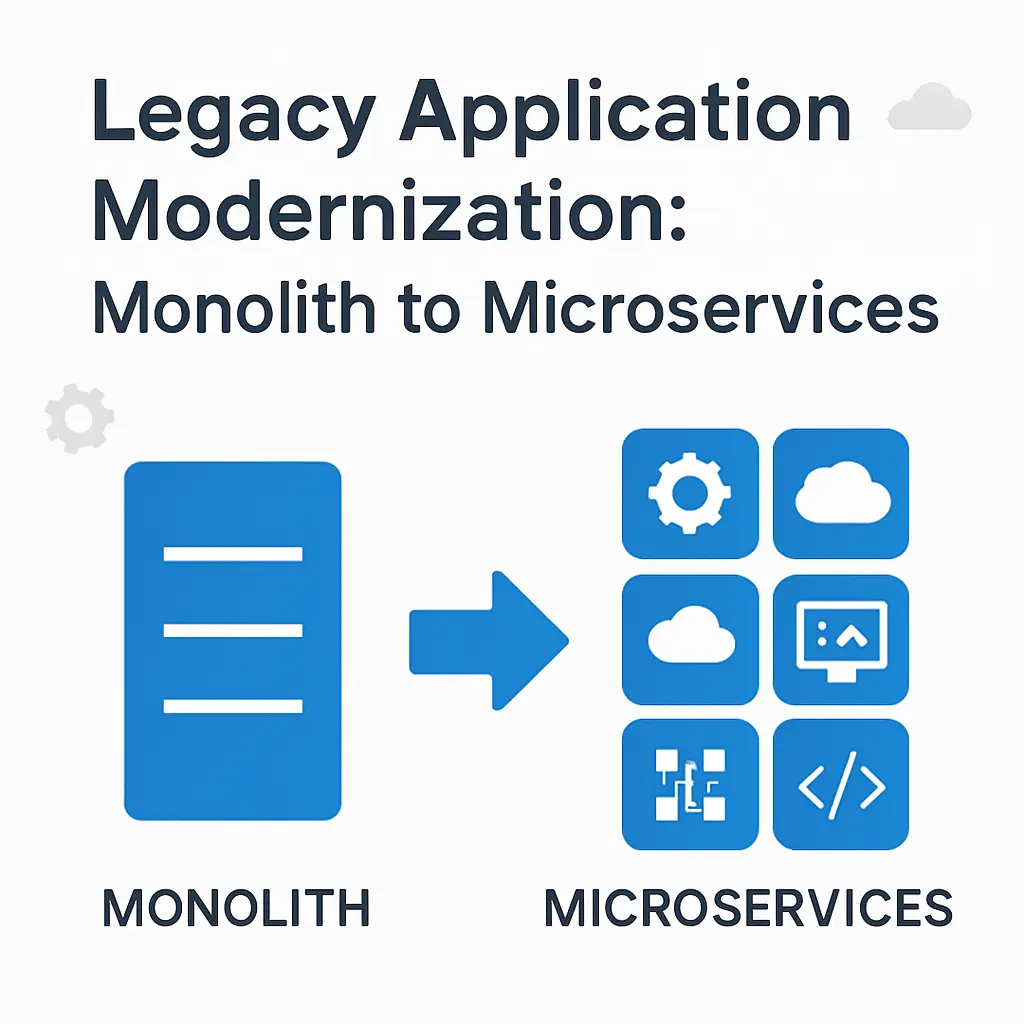
Modernizing legacy systems and migrating from monoliths to microservices are now central to long‑term digital strategy, not just tactical IT projects. Organizations want to move faster, scale reliably, and innovate without being constrained by aging applications. This article explains how to design a sustainable legacy application modernization strategy and then execute data migration as you transition from monolithic architectures to microservices.
Designing a Sustainable Modernization Strategy
Modernization is often misunderstood as a simple “rewrite” or “lift‑and‑shift” of existing systems. In reality, it is a multi‑year transformation that must align architecture, data, processes, and people. A sustainable strategy starts with understanding why you are modernizing, what to modernize first, and how to reduce risk while continuously delivering value.
Clarifying business drivers and success metrics
Before touching technology, organizations should articulate the business outcomes they expect from modernization. Without this, technical decisions become arbitrary and priorities get skewed toward “interesting” engineering work instead of value.
Common business drivers include:
- Accelerating time‑to‑market: Reducing cycle time from idea to production, enabling more frequent releases.
- Improving reliability and availability: Minimizing outages caused by tightly coupled legacy systems and brittle deployments.
- Scaling with demand: Handling peak loads without over‑provisioning infrastructure or degrading performance.
- Lowering operating and maintenance costs: Reducing manual work, vendor lock‑in, and specialized skills tied to obsolete technologies.
- Enhancing customer experience: Delivering new digital capabilities, personalized services, and consistent omnichannel experiences.
These drivers must be translated into measurable success metrics, such as release frequency, lead time for changes, service uptime, mean time to recovery, or infrastructure cost per transaction. This provides a concrete way to evaluate modernization options and track progress over time.
Assessing the legacy landscape
The next step is to understand the current environment in enough depth to make informed decisions. This assessment should be systematic rather than anecdotal, based on evidence instead of opinions about which system is “worst.”
Useful assessment dimensions include:
- Business criticality: Revenue impact, regulatory implications, and dependency on the application for day‑to‑day operations.
- Technical health: Code quality, test coverage, complexity, technology stack obsolescence, and security posture.
- Change frequency: How often the system needs new features or updates; systems under constant change are prime candidates for modernization.
- Integration complexity: Number and type of interfaces, data flows, and degree of coupling with other systems.
- Team capability and knowledge: Availability of skills to maintain or evolve the current technology stack.
By scoring applications along these criteria, you can build a modernization heatmap that highlights where risk and opportunity are concentrated. This becomes the basis for selecting modernization candidates and sequencing work.
Choosing appropriate modernization patterns
Modernization is not all‑or‑nothing; different applications warrant different approaches. Several patterns can be combined into an overall roadmap:
- Rehosting (lift‑and‑shift): Moving applications as‑is to new infrastructure, often cloud. This offers quick wins for cost or reliability but does not address structural issues in the code or architecture.
- Replatforming: Making minimal changes to leverage managed services (e.g., application servers, databases) while keeping core architecture intact. This balances speed and incremental improvement.
- Refactoring: Improving the internal structure of the code without changing external behavior. This increases maintainability, testability, and prepares systems for deeper modernization.
- Re‑architecting: Redesigning the application, often by decomposing monoliths into microservices or domain‑oriented components. This is higher risk and effort but unlocks significant agility and scalability.
- Replacing: Adopting commercial or SaaS solutions when building in‑house no longer makes strategic sense.
- Retiring: Decommissioning systems that no longer provide sufficient value and consolidating their functionality elsewhere.
A coherent modernization strategy typically mixes these patterns. High‑value, high‑change systems may be re‑architected, while low‑value systems are rehosted or retired. The key is intentionality: each system gets a deliberate modernization path informed by its role and constraints.
Sequencing modernization for incremental value
Many organizations fail by treating modernization as a single, massive project that must be “completed” before delivering business benefits. A better approach is to sequence work into increments that deliver visible value and reduce risk step by step.
Effective sequencing often follows this logic:
- Start with enabling systems that unlock future work, such as identity management, observability, automation, and continuous delivery pipelines.
- Target applications with high business impact and high pain—for example, systems that block new product launches or frequently cause outages.
- Defer large, high‑risk rewrites until you have matured your delivery practices and learned from earlier modernization initiatives.
This incremental approach requires robust program management, architectural governance, and clear communication with stakeholders so that expectations are realistic and dependencies are well understood.
Aligning architecture with domain boundaries
An enduring modernization strategy is grounded in a deep understanding of the business domain. Domain‑driven design (DDD) offers techniques to identify bounded contexts—coherent areas of business functionality with a well‑defined language and model. These contexts become natural candidates for services or modular components.
Instead of decomposing the monolith based on technical layers (e.g., separating UI, business logic, data access), focus on business capabilities such as customer onboarding, billing, inventory, or risk scoring. This alignment:
- Reduces cross‑team coordination overhead by localizing changes within a single domain.
- Supports independent scaling and deployment of services that map to business priorities.
- Improves ownership by assigning cross‑functional teams to end‑to‑end capabilities, not just technical layers.
Designing your target architecture around domain boundaries establishes a foundation that will be critical once you begin to extract services and migrate data.
Building organizational readiness
Technology choices cannot compensate for an organization that is not prepared to work in new ways. Successful modernization depends on:
- Cross‑functional teams that own services end‑to‑end, including development, testing, operations, and monitoring.
- DevOps practices such as automated testing, continuous integration, and continuous deployment to reduce risk and accelerate feedback.
- Product mindset where teams continuously improve their services based on user feedback and business outcomes, not just project deadlines.
- Governance that enables, not constrains, through guardrails (e.g., approved tech stacks, security standards) rather than detailed command‑and‑control.
A modernization strategy that ignores these organizational shifts will struggle to achieve its technical ambitions.
From Strategy to Execution: Migrating from Monolith to Microservices
Once a coherent strategy is in place, the next challenge is execution: translating architectural intent into concrete steps that safely reshape your landscape. For many organizations, this involves decomposing a core monolith and managing the intricate journey of data migration from monolith to microservices while the business keeps running.
Clarifying the target microservices architecture
Before cutting into the monolith, you must define what “good” looks like for your microservices architecture. This goes beyond simply “many small services.” Core design questions include:
- Service granularity: How small should services be? Overly fine‑grained services increase coordination overhead and network latency. Start with business capability services and only further split when clear benefits emerge.
- Communication patterns: When to use synchronous APIs (REST/gRPC) versus asynchronous messaging (event streams). Critical user flows that require low latency often need synchronous calls, while domain events support eventual consistency and decoupling.
- Data ownership: Each service should own its data and expose it via APIs or events; sharing databases across services reintroduces coupling and undermines independence.
- Observability and resilience: Built‑in logging, metrics, tracing, circuit breakers, and timeouts are essential to operate a distributed system reliably.
Defining these principles early creates a shared mental model and avoids fragmented architectures as different teams extract services in inconsistent ways.
Strangling the monolith: a controlled decomposition
One proven pattern for migrating from monolith to microservices is the “strangler fig” or “strangler pattern.” Instead of rewriting the monolith all at once, you gradually route specific capabilities to new services while the existing system remains operational.
The process typically follows these steps:
- Identify a bounded context or business capability that can be carved out with relatively few dependencies, such as customer profile management or notifications.
- Introduce an API gateway or routing layer in front of the monolith, enabling you to redirect selected requests to new services without changing clients immediately.
- Implement the new microservice, including its own domain model, persistence, and integration logic. Initially it may still depend on the monolith for certain data until data is fully migrated.
- Gradually switch traffic for the chosen capability from the monolith to the microservice, monitor behavior, and iterate until stable.
- Retire the corresponding code paths in the monolith once the service is fully responsible and all consumers use the new endpoints.
By iterating this pattern across domain boundaries, the monolith shrinks over time and eventually becomes small enough to retire or maintain as a stable legacy component with limited responsibilities.
Data migration as a core design problem, not an afterthought
Data is where many modernization efforts stumble. While service decomposition focuses on code and APIs, data migration involves deep decisions about consistency, integrity, and coexistence. The key is to treat data migration as a first‑class architectural concern from day one.
Important design questions include:
- Which service owns which data? Ownership should reflect domain boundaries, not just existing database schemas.
- What is the source of truth during transition? Will the monolith’s database remain the primary source until the end, or will ownership be handed over incrementally?
- How will you keep systems in sync? Will you use events, change data capture, dual writes, or batch synchronization?
- What consistency model is acceptable? Can your business processes tolerate eventual consistency, or do certain operations require strong consistency?
Addressing these questions early helps you design migration paths that preserve correctness while allowing incremental progress.
Patterns for incremental data migration
Several patterns can reduce risk and allow data migration to proceed in stages rather than as a single cutover:
- Read‑from‑legacy, write‑to‑new: New services become the system of record for writes, but they continue to read certain data from the legacy database until it has been fully migrated. Over time, read dependencies are removed.
- Change data capture (CDC): Database‑level change logs stream updates from the legacy database into new services or data stores. This enables near real‑time replication without modifying legacy code.
- Data duplication for read models: Microservices maintain their own local denormalized read models derived from events or CDC streams, optimized for their specific queries.
- Backfill and replay: Historical data is migrated in bulk (backfill), then incremental changes are applied by replaying events or log streams, aligning new stores with legacy reality.
Each pattern involves trade‑offs among complexity, latency, and operational overhead. Typically, a combination of these is used to accommodate different domain needs.
Managing consistency and integrity in a distributed world
Monoliths often rely on ACID transactions spanning multiple tables to ensure strong consistency. In a microservices world, such multi‑service transactions are impractical; distributed transactions (e.g., two‑phase commit) are fragile and hard to scale.
Instead, you typically embrace:
- Event‑driven workflows where services publish domain events (e.g., “OrderPlaced”, “PaymentAuthorized”) that trigger reactions in other services.
- Saga patterns to manage long‑running, multi‑step business processes. Each local transaction emits events, and compensating actions are defined for failure scenarios.
- Idempotent operations to handle retries gracefully without creating duplicates or corrupting state.
- Clearly defined consistency expectations for each operation: which require immediate consistency and which can tolerate eventual consistency.
These patterns must be built into the migration approach. Without them, data anomalies and partial failures will quickly undermine system reliability.
Testing and validation strategies during migration
Data migration and service decomposition drastically increase the number of moving parts. Strong testing and validation practices are thus critical:
- Contract testing between services ensures that interface expectations remain aligned even as services evolve independently.
- Shadow traffic (or dark launching) routes real production traffic simultaneously to old and new components, comparing responses without impacting users.
- Data reconciliation checks regularly compare aggregated metrics (e.g., counts, totals, key invariants) between legacy and new data stores to detect discrepancies early.
- Feature flags allow controlled rollout of new behavior to subsets of users and quick rollback if issues occur.
In addition to automated tests, operational monitoring—latency, error rates, throughput, and business KPIs—is essential to verifying that migration steps produce the desired outcomes without unintended side effects.
Security, compliance, and governance considerations
As systems become more distributed, the attack surface and regulatory complexity increase. Modernization and migration must incorporate:
- Centralized identity and access management with consistent authentication and authorization mechanisms across services.
- Data classification and protection so that sensitive data is encrypted, access‑controlled, and auditable regardless of which service owns it.
- API governance for versioning, documentation, and deprecation policies to prevent API sprawl and breaking changes.
- Compliance by design, embedding regulatory requirements (e.g., retention policies, right to be forgotten, audit trails) directly into data models and workflows.
These considerations cannot be bolted on after migration; they must be integral to architectural decisions and implementation patterns.
Cultural and operational shifts in the microservices era
Finally, the transition from monolith to microservices is as much about culture and operations as it is about technology. To fully realize the benefits of modernization:
- Teams must own services as products, with accountability for reliability, performance, and user satisfaction beyond initial delivery.
- Operational excellence becomes a shared responsibility: on‑call rotations, incident reviews, and continuous improvement are part of everyday work.
- Learning loops—through observability, user feedback, and experimentation—guide which services to optimize, extend, or even retire.
Organizations that invest in these capabilities find that modernization stops being a one‑time initiative and becomes an ongoing capability for adapting their systems to changing business needs.
Conclusion
Modernizing legacy applications and migrating from monoliths to microservices is a strategic, multi‑dimensional journey, not a single project. A clear modernization strategy aligns technical choices with business goals, domain boundaries, and organizational readiness. Thoughtful execution—especially around incremental decomposition and data migration—preserves stability while unlocking agility and scalability. By treating architecture, data, and culture as an integrated whole, organizations can build a platform that supports continuous evolution rather than periodic overhauls.