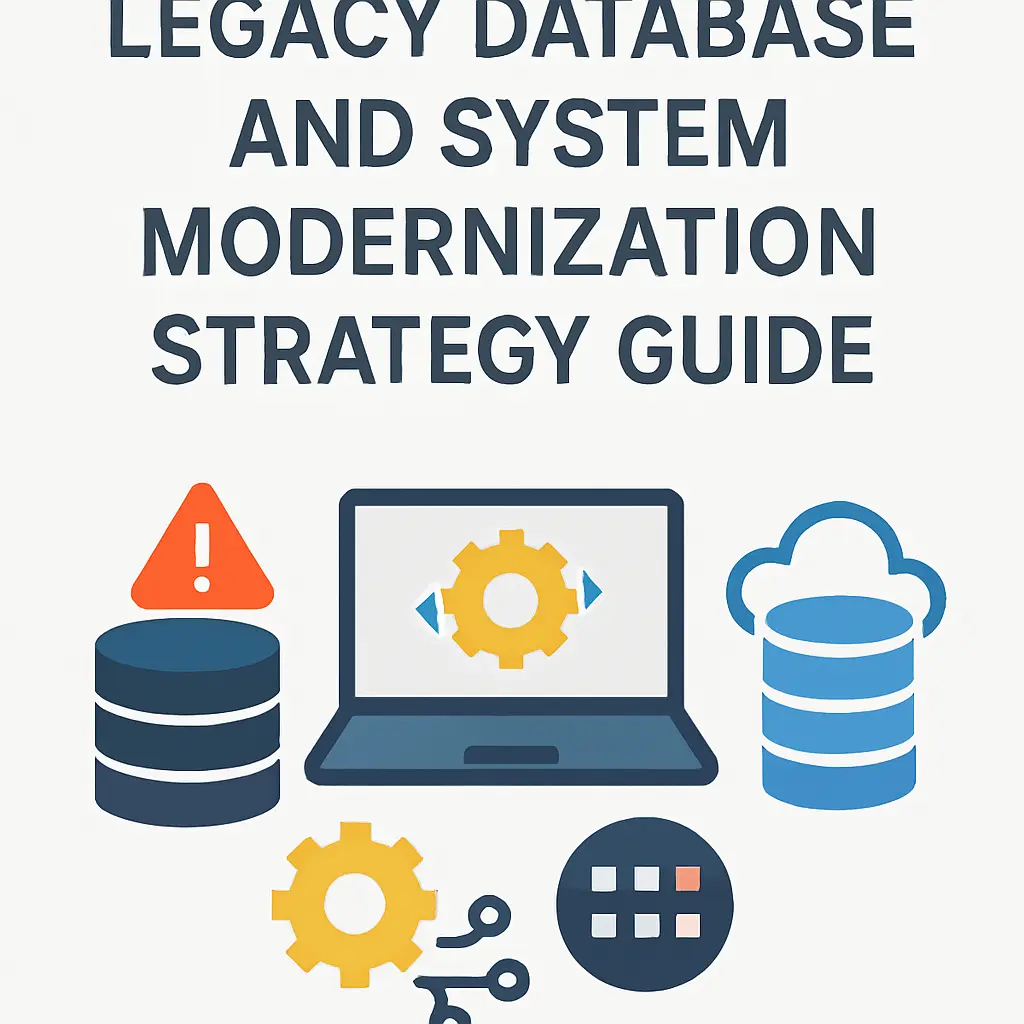
Modernizing Legacy Databases and Systems: A Practical, Strategic Guide
Modernizing aging enterprise systems is no longer optional—it is a requirement for performance, security, and innovation. Yet transforming long‑lived platforms without disrupting business is a complex, high‑risk challenge. This article explains how to understand and modernize legacy database systems and the surrounding applications, and how to select and execute effective legacy system modernization approaches that deliver measurable business value.
Understanding Legacy Complexity and Modernization Drivers
Legacy is not just about age. A system becomes “legacy” when it blocks your ability to change quickly, scale effectively, or control risk. Many organizations still run mission‑critical workloads on mainframes, monolithic applications, and tightly coupled databases that were designed for a very different era of business and technology.
Before designing a modernization program, it is essential to understand what makes these systems hard to evolve and why they require special treatment compared with newer architectures.
Key characteristics of legacy environments
Most legacy landscapes share a combination of these attributes:
- Tight coupling between application and data – Business logic, user interfaces, and persistence are often fused together. Even small schema changes can require code changes, test cycles, and coordinated deployments, increasing both time and risk.
- Monolithic deployment units – A single executable or large application server hosts many business capabilities. This makes independent scaling, partial upgrades, and selective rollback extremely difficult.
- Opaque, poorly documented behavior – Over years or decades, staff churn and emergency fixes accumulate. Institutional knowledge lives in a few key people’s heads or is gone entirely, making impact analysis very challenging.
- Rigid data models – Databases often reflect business structures from the past. They may assume regional boundaries, product lines, or regulatory regimes that no longer exist, slowing time‑to‑market for new offerings.
- Outdated technology and toolchains – Older programming languages, obsolete databases, and unsupported middleware create security exposure, constrain hiring, and limit integration with modern platforms and SaaS services.
- High operational risk – Because the systems are mission‑critical and poorly understood, any downtime or change is frightening. This creates a culture of fear around modification, entrenching the legacy further.
Business and technical drivers for modernization
Modernization is costly and disruptive, so it must be grounded in explicit drivers and measurable outcomes. Typical drivers include:
- Agility and time‑to‑market – Slow release cycles, long test phases, and complex approvals make it hard to respond to new regulations, customer demands, or competitor moves.
- Scalability and performance – Legacy architectures may struggle with traffic spikes, real‑time analytics, or global user bases, limiting digital growth.
- Cost optimization – Mainframe MIPS, proprietary databases, custom hardware, and specialized skills are expensive to maintain relative to cloud‑native and open‑source options.
- Security and compliance – Unsupported software, unpatched vulnerabilities, and weak audit trails create real risk exposure in regulated industries.
- Data leverage and analytics – Siloed, poorly structured data hampers machine learning initiatives, self‑service analytics, and advanced personalization.
- Talent and skills – Fewer engineers want to work with obsolete stacks, increasing recruitment costs and creating single points of failure in key roles.
Clarifying which drivers matter most is not just an initial planning step. It is the lens through which every modernization decision—technology choice, sequencing, and scope—should be evaluated.
Assessing and segmenting your legacy landscape
Modernization usually involves multiple applications and databases. Treating them as a single “modernization project” is a mistake. Instead, build a structured inventory and segmentation:
- Catalog systems and dependencies – Identify all major applications, interfaces, batch jobs, and data stores. Map inbound and outbound integrations, including file transfers and manual processes.
- Quantify business criticality – For each system, capture revenue impact, regulatory importance, user base, and tolerance for downtime or behavior change.
- Assess technical health – Evaluate code quality, test coverage, documentation, deployment automation, security posture, and technology obsolescence.
- Rate change frequency and friction – How often is the system modified, how long do changes take, and how risky are they? High‑friction systems are prime candidates for targeted modernization.
This segmentation will guide both the choice of modernization approach and the order in which systems are addressed.
From Strategy to Execution: Choosing and Applying Modernization Approaches
Modernization initiatives fail less due to technology constraints and more due to lack of strategy, overreach, or poor sequencing. To avoid this, treat modernization as a portfolio of interventions, each tailored to the specific system and business needs, rather than a monolithic “big bang.”
Core modernization patterns and when to use them
Multiple patterns are available, and they can be combined over time. Typical approaches include:
- Rehost (“lift and shift”)
- What it is: Moving an application and database to new infrastructure (often cloud) with minimal code changes.
- When it fits: You need rapid cost reduction or hardware refresh, but the application architecture will not change yet.
- Benefits: Reduced infrastructure costs, improved reliability, a foundation for further modernization.
- Limitations: Does not address architectural rigidity, code quality, or data model issues.
- Replatform
- What it is: Migrating runtime and database to more modern equivalents (e.g., from proprietary application server to containers, from on‑prem RDBMS to managed cloud database) with modest code changes.
- When it fits: You want improved scalability or managed services while minimizing disruption to business logic.
- Benefits: Access to modern operational capabilities (autoscaling, managed backups, observability) without a full rewrite.
- Limitations: Some technical debt will remain; core domain and data constraints may continue to hinder agility.
- Refactor / modularize
- What it is: Restructuring and cleaning existing code without changing its external behavior, often extracting modules, services, or APIs.
- When it fits: The core business rules are still correct and valuable, but the codebase is hard to change or test.
- Benefits: Better maintainability, testability, and performance; a stepping‑stone to microservices or event‑driven architectures.
- Limitations: Requires strong engineering discipline; benefits can be subtle and gradual rather than immediately visible to business stakeholders.
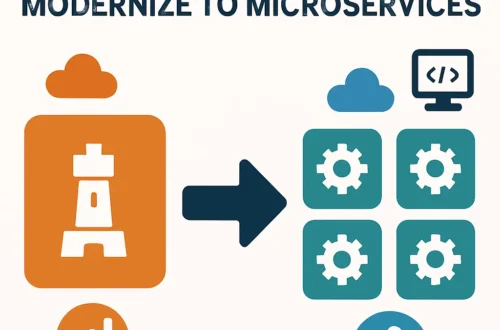
- Rearchitect / decompose
- What it is: Shifting to a new architectural style (microservices, modular monolith, event‑driven) while preserving domain semantics.
- When it fits: You face chronic scaling bottlenecks or agility issues that cannot be resolved via incremental refactoring alone.
- Benefits: Independent scaling and deployments, clearer bounded contexts, and better fault isolation.
- Limitations: High complexity; requires strong domain modeling and careful change management.
- Replace / rebuild
- What it is: Building or buying an entirely new solution and decommissioning the old one.
- When it fits: The legacy system no longer reflects your business processes, or its technology is so outdated that incremental improvement is unrealistic.
- Benefits: Clean slate design and technology choices, opportunity to simplify and standardize processes.
- Limitations: High risk and cost; easy to underestimate data and integration complexity.
In practice, enterprises rarely apply a single pattern. For instance, an organization may start with rehosting to stabilize operations, then selectively refactor core modules and finally replace certain components with SaaS or custom microservices.
Designing a modernization roadmap
Once you understand your legacy landscape and the available patterns, you can construct a roadmap that delivers value iteratively:
- Anchor the roadmap in outcomes – For each system, define 2–3 primary objectives: for example, “cut release cycle from quarterly to bi‑weekly” or “reduce nightly batch run from 8 hours to 2 hours.”
- Sequence by value and risk – Prioritize systems where impact is high and technical uncertainty is manageable. Heavily entangled or mission‑critical systems may require earlier, exploratory work but later large‑scale change.
- Invest in cross‑cutting capabilities – Before major rearchitecture, improve CI/CD, automated testing, observability, and security baselines. These capabilities reduce risk across the entire roadmap.
- Plan for coexistence – For a long period, legacy and modern components will operate side by side. Design integration patterns, data synchronization, and operational procedures for hybrid states from the outset.
Roadmaps should be living documents: reviewed quarterly, adjusted to reflect learning, and tied to both technology metrics and business KPIs.
Mitigating risk: strangler patterns and incremental migration
One of the most effective risk‑reduction concepts in modernization is the “strangler” pattern: gradually surrounding a legacy system with new capabilities, routing more traffic to the new components over time, and shrinking the old core until it can be safely retired.
Applied to both applications and databases, this typically involves:
- Introducing an API or façade – Instead of allowing direct access to legacy functions or tables, create an API layer that mediates calls. New capabilities are implemented behind this layer, hiding internal complexity.
- Redirecting specific journeys or use cases – For example, new customer onboarding could be moved to a new microservice while existing customer management stays in the legacy system until the new solution matures.
- Selective data replication or dual writes – Initially, data may flow to both legacy and modern stores. Over time, the modern database becomes the system of record for more entities, and legacy data is either read‑only or gradually migrated.
- Retiring functionality in slices – When a feature is fully implemented and stable in the new world, you decommission the corresponding part in the old system, reducing attack surface and operational burden.
This incremental approach demands strong observability and robust testing, but it dramatically lowers the chance of catastrophic “cut‑over” failures.
Data‑centric modernization considerations
While application code often receives the attention, data is where most modernization efforts either succeed or stall. Key considerations include:
- Data modeling for flexibility – Future‑proof schemas by modeling around stable business concepts (customers, contracts, products) rather than transient organizational structures. Consider bounded contexts instead of a single “enterprise” schema.
- Polyglot persistence – Not every workload belongs in a relational store. Time‑series databases, document stores, and key‑value caches can complement core RDBMSs, but require careful governance to avoid data sprawl.
- Data quality and lineage – Modern analytics and regulatory frameworks expect traceability and consistent definitions. Invest in mastering, metadata management, and clear ownership of critical data domains.
- Transactional integrity in hybrid states – When some transactions span legacy and new systems, design compensation patterns, idempotent operations, and eventual consistency carefully to avoid double‑charges, lost updates, or reconciliation nightmares.
Early, realistic planning for data migrations and hybrid operations can prevent significant disruption later in the program.
Organizational and cultural enablers
Technology changes are only half of the modernization story. Organizational structures, incentives, and skills decide whether the new platforms are actually used to their potential.
- Domain‑aligned teams – Move away from centralized “legacy teams” toward cross‑functional groups aligned to business domains or products, owning both legacy and modern components during transition.
- Shared goals between business and IT – Establish joint KPIs such as deployment frequency, incident rates, time to deliver new features, and customer NPS for digital channels.
- Upskilling and knowledge transfer – Pair engineers with deep legacy expertise with those skilled in modern stacks. Create structured programs for cross‑training, reducing single points of failure.
- Governance that balances autonomy with standards – Allow teams to choose appropriate tools within guardrails on security, observability, and compliance, so modernization does not create a new, fragmented “shadow IT” landscape.
Modernization done without cultural evolution often re‑creates old problems on new platforms. Addressing both in tandem yields durable gains.
Conclusion: Turning Legacy from Liability into Strategic Asset
Legacy systems encode decades of domain knowledge and revenue‑generating processes, but they also constrain agility, scalability, and security. By deeply understanding their characteristics, choosing targeted modernization patterns, and executing through incremental, strangler‑style migration, organizations can reduce risk while steadily increasing value. Combine thoughtful data strategy, architectural evolution, and organizational change to transform aging platforms into a resilient, adaptable foundation for future growth.