Modern organizations rely on data and software to compete, but many are constrained by outdated systems that are difficult to change and even harder to scale. In this article, we explore how to modernize legacy databases and applications in a way that reduces risk, increases agility, and unlocks new business value—while preserving the critical data and processes that keep your organization running.
Understanding the Legacy Landscape and Why It Matters
Before you can modernize anything, you must understand what you have, why it exists, and what it’s preventing you from doing. Legacy systems are rarely just “old software.” They are often the backbone of the business, deeply intertwined with operations, compliance, and customer experiences.
Many organizations first need to understand what is a legacy database in order to assess the real risks and opportunities it represents. Typically, legacy databases share several characteristics:
- Age and technical debt: Databases built on end-of-life platforms, using outdated data models and extensive custom code, are fragile and hard to modify. Every new change adds more complexity, making the system slower and riskier to maintain.
- Vendor or platform lock-in: Closed ecosystems, proprietary query languages, or limited integration capabilities can prevent you from adopting modern tools, migrating to the cloud, or leveraging AI/ML and analytics.
- Performance and scalability constraints: Older monolithic databases struggle to handle modern workloads: high transaction volumes, omnichannel customer interactions, and real-time data processing.
- Security and compliance gaps: Outdated databases may lack built-in encryption, granular access controls, or robust auditing, exposing organizations to data breaches, regulatory fines, and reputational damage.
- Skills scarcity: As technologies age, so do the specialists who know them. When only a few people understand the inner workings of a critical database, operational risk increases dramatically.
These factors impede innovation. For example, you might want to roll out a new digital product, but your database cannot support near real-time APIs, multi-region failover, or modern data analytics. The result: long lead times, high costs, and missed market opportunities.
Business Risks of Standing Still
Many organizations postpone modernization because “the system still works.” However, the risks of inaction compound over time:
- Operational outages: Aging hardware and software failures can cause unplanned downtime. Legacy systems often lack robust high-availability and disaster recovery setups.
- Regulatory non-compliance: New regulations might demand better data protection, retention policies, or traceability than the legacy system can offer without extensive retrofitting.
- Rising maintenance costs: License fees for obsolete platforms, extended support contracts, and expensive niche consultants can consume a growing portion of IT budgets.
- Lost competitive edge: When competitors can launch features faster, personalize experiences, and leverage advanced analytics, organizations tied to rigid systems steadily fall behind.
Recognizing these risks is the first step; the second is to define a modernization strategy that delivers value quickly while controlling risk.
Strategic Drivers for Modernization
A modernization initiative should never be driven solely by technology trends. Instead, it should be anchored in clear business outcomes. Typical strategic drivers include:
- Speed to market: Reducing time from idea to production by decoupling systems, automating deployment pipelines, and simplifying data access.
- Customer experience: Enabling omnichannel journeys, personalized offers, and real-time support depends on accurate, accessible, timely data.
- Cost optimization: Migrating away from legacy licensing models, consolidating databases, and leveraging cloud-native services can reduce both CapEx and OpEx.
- Risk reduction: Modern platforms typically offer better security, monitoring, and compliance capabilities, reducing organizational exposure.
- Innovation enablement: Modern data platforms make it easier to experiment with AI/ML, advanced analytics, and event-driven architectures.
Once these drivers are explicit, you can shape your modernization journey around them rather than engaging in a purely technical “lift and shift” that recreates old problems on new infrastructure.
Core Approaches to Legacy Database Modernization
Legacy database modernization is rarely a single event; it is a disciplined program composed of multiple patterns and phases. Common approaches include:
- Rehosting (“lift and shift”): Moving the existing database to new infrastructure—often cloud-based—without changing its schema or behavior. This can quickly reduce hardware risk and sometimes cost, but it does not address deeper structural issues.
- Replatforming: Migrating to a newer version or compatible managed service (for example, to a cloud-managed relational database). The goal is to improve scalability and operational characteristics with minimal code changes.
- Refactoring / re-architecting: Redesigning the database schema, data access patterns, and sometimes splitting a monolithic database into domain-oriented components, potentially mixing relational, NoSQL, and analytics engines.
- Replacing with SaaS or COTS: In some domains, packaged solutions can replace custom legacy databases entirely, especially for standardized business processes like HR, CRM, or finance.
- Retiring: Decommissioning systems that no longer provide business value, after archiving or migrating any residual data required for compliance.
In practice, you’ll likely combine these patterns: for example, rehost a system to the cloud for short-term stability, then selectively refactor high-value domains into modern, more flexible data services.
Data-Centric Considerations: Modeling, Quality, and Governance
Modernization is often treated as an infrastructure problem, but the most decisive work happens at the data level:
- Data modeling evolution: Legacy schemas often reflect decades-old process assumptions. Modern designs emphasize domain-driven boundaries, normalized transactional cores combined with denormalized data for analytics, and support for events and streams.
- Data quality remediation: As systems age, they accumulate inconsistent and duplicate records. Before or during migration, data must be profiled, cleansed, deduplicated, and enriched. This is crucial for trustworthy analytics and AI.
- Master and reference data: Especially in complex organizations, customer, product, and account data may be fragmented. A modernization initiative is a natural trigger to introduce or improve master data management.
- Governance and lineage: Modern architectures should embed governance from the start: clear data ownership, privacy controls, lineage tracking, and auditable transformations.
These data-centric activities often deliver independent business value—for example, better customer insights—even before the entire modernization program is complete.
Architectural Principles for the Target State
As you move away from a monolithic legacy database, architectural principles help prevent a new form of technical debt:
- Domain orientation: Structure data systems around business domains rather than technical layers. This aligns well with microservices, but can also work with modular monoliths.
- APIs and contracts: Replace tight database coupling with well-defined APIs and data contracts. Consumers should not depend on internal schema details.
- Polyglot persistence: Choose storage technologies based on use cases—relational for transactions, document or key-value for flexible unstructured data, columnar for analytics, and streaming platforms for events.
- Resilience and observability: Build in redundancy, automated failover, monitoring, tracing, and logging. Legacy systems often fail silently; modern ones should fail loudly and recover quickly.
- Security by design: Implement least privilege, encryption in transit and at rest, robust identity and access management, and automated policy enforcement from day one.
These principles ensure that modernization is not just a one-time upgrade, but a foundation for continuous evolution.
Incremental Delivery and Risk Management
Trying to modernize everything at once is usually a recipe for delays and failure. Instead, organizations should take an incremental, risk-aware approach:
- Slice by business capability: Identify self-contained capabilities (e.g., customer onboarding, billing, order tracking) and progressively modernize them end-to-end.
- Strangler patterns: Surround the legacy system with new services that gradually take over responsibilities. Traffic is migrated step by step, reducing big-bang risk.
- Parallel run and phased cutover: For critical processes, run old and new systems in parallel while validating outputs and performance before switching completely.
- Rollback and contingency plans: Every migration wave should have clear rollback procedures, data reconciliation plans, and communication protocols.
When modernization is framed as a sequence of manageable experiments and value increments, stakeholder confidence and adoption increase substantially.
People, Process, and Culture
Even the best database technology fails if your organization cannot adapt its ways of working. Modernization often requires:
- Upskilling and reskilling: Training teams on new data platforms, cloud tools, and modern engineering practices such as CI/CD, automated testing, and infrastructure as code.
- Cross-functional teams: Bringing together developers, DBAs, SREs, security, data engineers, and business stakeholders to own a product end-to-end.
- Agile and DevOps practices: Shorter feedback loops, iterative releases, and shared responsibility for reliability help ensure the new platform evolves smoothly.
- Change management and communication: Stakeholders must understand the rationale, timeline, and benefits of modernization, with transparent updates on progress and risks.
Ultimately, modernization is not just about replacing tools; it is about enabling the organization to work in a more responsive, data-driven way.
From Database Modernization to Full Application Modernization
Modernizing databases in isolation can only take you so far. Applications that depend on those databases may still be monolithic, brittle, and poorly suited to cloud-native practices. To unlock full benefits, database initiatives should feed into a broader application modernization services strategy that addresses the entire stack.
A holistic strategy typically includes:
- Application portfolio assessment: Classifying applications based on business criticality, technical health, and modernization potential. Some may be retired, others rehosted, and key ones re-architected.
- Coupling analysis: Understanding how applications and databases interact, including shared schemas, stored procedures, and cross-application queries, to design safe separation paths.
- API-first design: Shifting from database-centric integration to API-centric integration, so applications consume data through stable, versioned interfaces.
- Modern delivery pipelines: Establishing CI/CD, automated testing, and infrastructure automation that work consistently across applications and their databases.
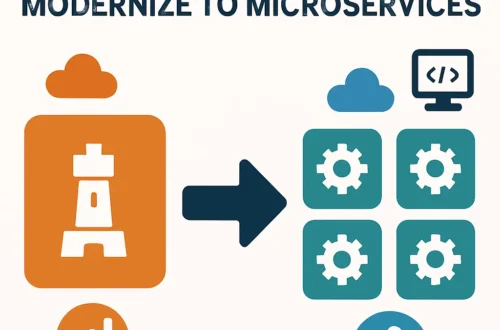
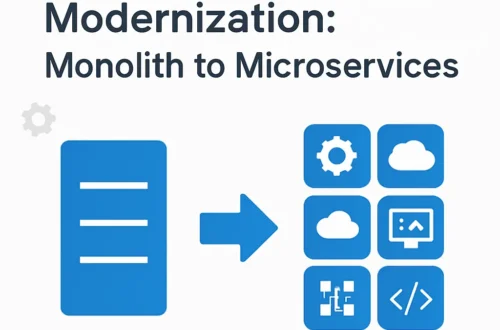
As applications modernize—into microservices, modular monoliths, or service-oriented architectures—the database landscape should evolve in tandem. Aligning the two streams prevents new integration bottlenecks and maximizes end-to-end agility.
Aligning Modernization with Business Roadmaps
Successful organizations do not treat modernization as an isolated IT project; they align it with product and business roadmaps:
- Feature-driven modernization: When planning a major new feature or product, incorporate necessary back-end and data improvements into the same initiative. That way, modernization directly underpins revenue or customer experience goals.
- Regulatory-driven milestones: Use upcoming compliance deadlines as catalysts to prioritize modernization work that addresses data protection, auditability, or reporting requirements.
- Cost and contract cycles: Align migration waves with the end of hardware leases or software support windows to maximize financial impact and avoid paying twice.
This alignment makes it easier to secure executive sponsorship, funding, and organizational support, because each modernization step is clearly tied to visible outcomes.
Measuring Success and Maintaining Momentum
To keep modernization on track, organizations need clear metrics that reflect both technical and business perspectives:
- Technical KPIs: System availability and mean time to recovery, query performance, deployment frequency, failure rate of changes, and time to restore service after incidents.
- Business KPIs: Time to launch new features, customer satisfaction scores, churn rates, operational cost savings, compliance audit results, and revenue from modernized capabilities.
- Data KPIs: Data quality scores, time to access data for analytics, number of self-service data consumers, and reduction in manual reporting.
Regularly reviewing these metrics with stakeholders helps validate assumptions, adjust priorities, and demonstrate incremental value—essential for sustaining multi-year modernization journeys.
Common Pitfalls and How to Avoid Them
Even well-intentioned programs can stumble. Frequent pitfalls include:
- Over-engineering the target state: Designing an idealized architecture that is difficult to implement and maintain. Focus on pragmatic, incremental steps aligned with real needs.
- Ignoring organizational readiness: Adopting tools and patterns that teams aren’t prepared to own. Invest in training and consider managed services to reduce operational burden.
- Underestimating data complexity: Treating data migration as a mechanical copy instead of a transformation, only to discover inconsistencies late in the process.
- Neglecting security and compliance early on: Retrofitting controls after the fact is costly and risky. Embed them from the beginning.
- Failing to plan for coexistence: Old and new systems often need to run together for an extended period. Clear coexistence patterns and synchronization mechanisms are vital.
Awareness of these risks, combined with deliberate planning and governance, significantly improves the odds of a successful modernization.
Designing for Continuous Evolution
Modernization is not a one-time project; it’s the start of continuous evolution. Once your databases and applications are on modern foundations:
- Continuously refactor: Small, regular improvements prevent the accumulation of new technical debt.
- Experiment safely: Use feature flags, blue-green deployments, and canary releases to trial changes without disrupting users.
- Evolve data products: Treat key data sets and analytical models as products with dedicated owners, roadmaps, and quality standards.
- Stay ahead of compliance and security trends: Regularly review your controls to keep pace with emerging threats and regulations.
By building these capabilities into your operating model, you ensure that today’s modernization does not become tomorrow’s legacy.
Conclusion
Modernizing legacy databases and applications is ultimately about enabling your organization to move faster, reduce risk, and make better use of data. By understanding your legacy landscape, adopting pragmatic modernization patterns, and aligning with a broader application and business strategy, you create a platform for continuous innovation. Thoughtful planning, incremental delivery, and strong governance transform modernization from a disruptive overhaul into a sustainable, value-generating capability.