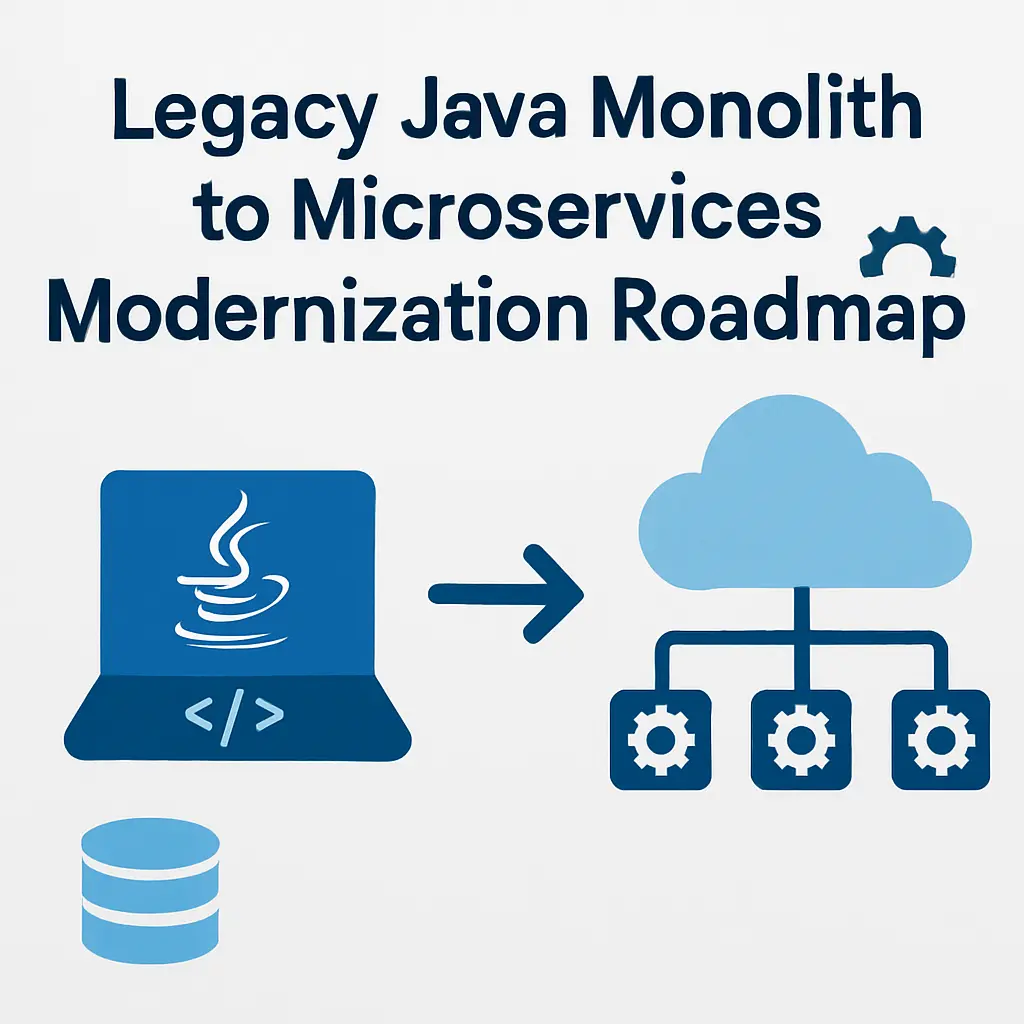
Modernizing a legacy Java monolith into a flexible, microservices-based architecture is no longer just an aspiration—it is a competitive necessity. In this article, we explore when modernization becomes urgent, what risks legacy systems pose, and how to approach transformation pragmatically. We will connect clear warning signs, business drivers, and practical monolith to microservices migration patterns into one coherent roadmap you can actually execute.
Recognizing When Legacy Java Is Holding You Back
Many organizations continue to rely on Java applications originally built a decade or more ago. These systems often encapsulate years of business logic, edge cases, and domain expertise. They are “too important to fail” and “too risky to touch” at the same time, which is exactly why they so often become blockers to innovation. Before you decide how to modernize, you must understand whether you really need modernization and why it matters now.
A useful place to start is by examining the most critical warning signs that your Java monolith is turning into a liability instead of an asset. Resources such as How to Recognize the Key Warning Signs a Legacy Java Application Needs Modernization can help frame these issues, but you also need to interpret them in your own context and connect them directly to business impact.
1. Mounting Technical Debt and Fragility
Technical debt in legacy Java applications typically shows up as:
- Outdated frameworks (e.g., old Spring versions, obsolete app servers) that are no longer supported or cannot be easily patched.
- Tight coupling between modules, where a change in billing unexpectedly breaks reporting or authentication.
- Large “God classes” and complex inheritance hierarchies that make reasoning about behavior extremely difficult.
When the codebase is fragile, simple feature requests trigger weeks of regression testing and nervous releases. Developers hesitate to touch certain modules because “no one fully understands them anymore.” This leads directly to slower time-to-market and higher defect rates.
2. Slowing Delivery and Developer Experience Breakdown
One of the clearest indicators that modernization is overdue is the speed of your delivery pipeline:
- Long release cycles: Quarterly or even yearly releases for core systems, because deployment is risky and largely manual.
- Bloated regression windows: QA teams needing weeks of manual, exploratory testing for even small releases.
- Poor onboarding: New developers taking months to become productive due to the system’s complexity and lack of documentation.
Remember that your software delivery process is part of your product. If your monolith greatly slows developers, it slows your entire business. When engineering teams spend most of their time patching and stabilizing instead of innovating, the organization loses its ability to respond to new ideas or competitive threats.
3. Scalability, Performance and Reliability Limitations
Legacy monoliths are often designed with vertical scaling in mind: add more CPU and RAM to a single big server. As usage grows or new channels appear (mobile apps, partner APIs, IoT devices), this model starts failing in several ways:
- All-or-nothing scaling: You must scale the entire application just to handle load on a few specific features, wasting infrastructure resources.
- Resource contention: Background batch jobs, reporting tasks, and core transactional operations compete for the same compute resources.
- Unpredictable failures: A spike in one part of the system (e.g., promotions, seasonal traffic) causes cascading failures everywhere.
Moreover, monoliths often rely on shared database schemas and heavyweight application servers, making it difficult to isolate performance bottlenecks. When you can’t scale specific services independently or introduce resilience patterns like bulkheads and circuit breakers around them, your availability and customer experience suffer.
4. Security and Compliance Risks
Security and compliance are often overlooked drivers for modernization but can be the most urgent:
- Older Java libraries and containers may contain known vulnerabilities with no straightforward patch path.
- Lack of clear service boundaries makes enforcing least-privilege access and zero-trust architectures difficult.
- Regulations (GDPR, PCI DSS, HIPAA, etc.) may require stronger separation of data and functionality than your monolith can provide.
When security teams flag systemic issues that cannot be addressed without major architectural changes, the cost of not modernizing becomes higher than the cost of modernization itself.
5. Business Misalignment and Inflexible Domain Model
Legacy systems tend to encode outdated business models. Over time, product lines change, pricing models evolve, customer journeys are reimagined—but the monolith still reflects the world as it existed years ago.
Symptoms include:
- New product or pricing models being rejected because “the system can’t support that.”
- Multiple teams hacking around the domain model with configuration tricks, stored procedures, or duplicated logic.
- Difficulty integrating with partners, platforms, or third-party ecosystems because domain concepts do not map cleanly.
At this stage, the architecture begins actively blocking strategic initiatives. Modernization then becomes less a technical project and more a business transformation effort.
6. Economic Signals: Rising TCO and Opportunity Cost
Modernization is not just about technology; it is a financial decision. Warning signs include:
- Increasing maintenance and operations budgets for the legacy system year over year.
- Growing opportunity cost: lost deals, delayed market entry, or inability to launch cross-channel experiences.
- Dependence on a shrinking pool of specialists with rare knowledge of outdated Java frameworks or proprietary platforms.
Once you quantify these costs, the ROI on modernization—even if significant up front—can become quite compelling.
Turning Warning Signs Into a Modernization Strategy
Recognizing the signals is not enough; you need a decision framework. Before reshaping your Java monolith, consider:
- Business priorities: Which capabilities most directly drive revenue, customer satisfaction, or regulatory compliance?
- Risk appetite: How much change can the organization tolerate at once, and how critical is the system to daily operations?
- Organizational readiness: Do you have or can you acquire the skills for microservices, containers, DevOps and observability?
This analysis naturally leads into the next stage: selecting an appropriate target state and a migration strategy that balances risk, cost and speed.
From Monolith to Microservices: Designing a Pragmatic Migration Path
You’ve identified that your legacy Java system is a bottleneck and that a microservices-based approach could unlock better scalability, resilience and agility. The risk now is swinging to the other extreme: a big-bang rewrite or an over-engineered microservices architecture that introduces more problems than it solves. A thoughtful, incremental approach is crucial.
1. Defining the Target Architecture Without Over-Engineering
Microservices are not an end in themselves; they are a tool to align architecture with business capabilities and to enable autonomous delivery. A healthy target architecture should focus on:
- Service boundaries aligned to business domains: Use Domain-Driven Design (DDD) concepts like bounded contexts to model services around capabilities (e.g., “Customer Profile,” “Billing,” “Order Management”), not technical layers.
- Independent lifecycle management: Each service should be buildable, testable and deployable on its own, without forcing system-wide releases.
- Clear data ownership: Each service owns its data model and storage, exposing information through APIs and messaging rather than shared tables.
The target architecture may also include API gateways, event buses, service meshes and observability stacks, but these should be added when they solve concrete problems, not as a checklist of fashionable technologies.
2. Choosing the Right Modernization Strategy
Legacy Java modernization does not always mean breaking everything into dozens of microservices right away. Common strategies include:
- Rehosting (“lift and shift”): Moving the monolith as-is to modern infrastructure (e.g., containers or cloud VMs). This reduces some operational risks and paves the way for further change but does not fix architectural issues.
- Refactoring in-place: Cleaning up the codebase within the monolith—modularizing, improving tests, updating frameworks. This can stabilize the system and prepare it for future decomposition.
- Strangler Fig pattern: Gradually building new services around the monolith, siphoning functionality away piece by piece until the old core can be retired.
- Selective rewrites: Rebuilding only the most constrained or strategically important parts of the system as microservices, leaving less critical features in the monolith for longer.
Most organizations adopt a hybrid approach that evolves over time. Early wins with targeted microservices can generate confidence, budget and momentum for broader modernization.
3. Identifying the First Services to Extract
The sequence in which you carve up your monolith can make or break the project. Ideal first candidates for microservices are:
- High business value and high pain: Features that are central to your value proposition and currently cause major delivery or performance problems.
- Relatively well-bounded domains: Functionality with clear inputs and outputs, minimal cross-cutting dependencies, and ownership by a small, stable team.
- Technical decoupling opportunities: Modules that already have some separation in code, database schemas, or deployment pipelines.
By prioritizing such services, you reduce integration risk while maximizing the perceived benefit of modernization early in the journey.
4. Handling Data During Migration
Data is frequently the hardest aspect of moving from a monolith to microservices. Legacy Java systems often depend on a single large relational database with a tightly coupled schema. Key techniques to manage this transition include:
- Database view or API facades: Introduce an abstraction layer between the monolith and its database, giving you a place to re-route calls as services are extracted.
- Shared database as a temporary step: For early microservices, you may temporarily allow read access to the shared database, while enforcing write-ownership by a single service to avoid corruption.
- Event-driven data replication: As services mature, publish domain events (e.g., “OrderCreated,” “PaymentCaptured”) so other services can maintain their own local read models.
Data migration should be treated as a sequence of small, reversible steps, with comprehensive monitoring and rollback strategies for each change.
5. Evolving Operational Capabilities Alongside Architecture
Microservices require stronger operational maturity than a monolith. Splitting your Java application into many services increases the number of deployable units, logs, metrics and failure modes. To avoid trading one set of problems for another, grow your DevOps and SRE practices in parallel with your architectural changes.
Core capabilities include:
- Continuous Integration/Continuous Delivery (CI/CD): Automated pipelines for building, testing and deploying each service independently.
- Observability: Centralized logging, metrics, tracing and alerting that provide a coherent view of cross-service flows.
- Resilience patterns: Timeouts, retries, circuit breakers and bulkheads implemented either in code or via a service mesh to prevent localized issues from causing system-wide outages.
- Security automation: Standardized authentication and authorization (e.g., OAuth2/OIDC), secrets management and dependency scanning integrated into pipelines.
The goal is for each small step in the migration to be safe, observable and reversible. This reduces the psychological and organizational resistance to change.
6. Organizational Alignment and Team Topology
Modernizing a legacy Java monolith is as much an organizational challenge as a technical one. Team structures and responsibilities should reflect your target architecture:
- Cross-functional teams: Combine developers, QA, operations and product people around business-facing services, not around technical layers.
- Clear service ownership: Each team should own a set of services end-to-end, from roadmap to production support.
- Incremental culture: Encourage small, frequent changes and a blameless postmortem culture when failures occur.
Conway’s Law tells us that systems reflect communication structures. If your teams remain siloed by technology or functional role, your microservices will likely inherit unwanted coupling and friction.
7. Measuring Progress and Value Throughout the Journey
A long-running modernization program needs visible, measurable progress. Beyond technical metrics, track:
- Lead time for changes: How long it takes to go from idea to production for features hosted in the old monolith vs. new services.
- Deployment frequency and change failure rate: Are you able to deploy more often and more safely for microservices?
- Business outcomes: Time to launch new product variants, partner integrations, or regional rollouts.
- Team satisfaction: Developer and operations feedback on maintainability, cognitive load and incident response.
These metrics help validate your strategy, maintain executive support and adjust the roadmap based on real-world learning.
8. Integrating Migration Patterns Into a Coherent Roadmap
Individual patterns—like strangler fig, anti-corruption layers, or database decomposition—are building blocks, not a complete plan by themselves. The art of modernization lies in sequencing these patterns intelligently to reduce risk while steadily eroding your dependence on the monolith.
In practice, this might look like:
- Stabilizing and containerizing the monolith to improve deployment consistency.
- Introducing an API gateway to standardize external access and route requests.
- Extracting one or two carefully chosen services behind an anti-corruption layer.
- Gradually decomposing shared data models, moving toward per-service databases.
- Retiring replaced modules in the monolith once traffic has successfully migrated.
By iterating this cycle and regularly reassessing priorities based on business feedback, you evolve toward a microservices landscape that directly supports your strategic objectives rather than merely following architectural fashion.
Conclusion
Legacy Java monoliths often start as proven foundations but gradually turn into barriers to scalability, security and innovation. Recognizing the warning signs—fragile code, slow delivery, scaling pain, security gaps and business misalignment—gives you the rationale for change. A carefully planned, incremental shift toward a microservices architecture, supported by modern DevOps practices and aligned team structures, allows you to reduce risk while continually delivering value, turning modernization from a one-time project into a sustainable competitive advantage.