Modernizing legacy systems is no longer optional for organizations that want to compete in a digital-first economy. Technical debt, aging platforms and fragmented applications slow down innovation, increase risk and inflate costs. In this article, we’ll explore how to approach legacy system modernization and build a cohesive, future-ready application modernization strategy that aligns technology with long-term business goals.
From Legacy Burden to Strategic Asset: Why and How to Modernize
Most companies did not intentionally build “legacy systems.” They built systems that made perfect sense at the time, then gradually accumulated patches, integrations and workarounds as the business evolved. The result is often a brittle landscape that constrains innovation rather than enabling it.
To turn this burden into a strategic asset, you first need to understand what makes a system “legacy,” why modernization is necessary and what options exist to move forward intelligently rather than reactively.
What really makes a system “legacy”?
A system is “legacy” less because of age and more because of its impact on the business. Typical characteristics include:
- High risk and fragility – Frequent outages, difficult rollbacks and obscure dependencies that make changes dangerous.
- Limited adaptability – Code and architecture that cannot easily support new products, channels, geographies or regulations.
- Vendor or skills lock-in – Obsolete technologies or specialized skills that are expensive or impossible to hire for.
- Low observability and automation – Minimal monitoring, manual deployments and weak testing, leading to slow, error-prone releases.
- Poor customer and employee experience – Slow response times, clunky interfaces and inconsistent data across channels.
The key point: a “legacy” system is any system whose cost of staying the same is higher than the cost and risk of change, once you look at the full picture.
The business case: beyond cost reduction
Modernization is often justified as a way to reduce infrastructure and maintenance costs. That’s only part of the story. The more strategic business drivers include:
- Speed to market – Faster release cycles enable you to test new ideas, respond to competitors and adapt to regulation quickly.
- Customer experience – Modern APIs and architectures support seamless omnichannel experiences, personalization and real-time interactions.
- Operational resilience – Cloud-native patterns and automation reduce downtime and improve disaster recovery.
- Data leverage – Clean, accessible, real-time data is essential for analytics, AI and informed decision-making.
- Talent attraction and retention – Engineers want to work on modern stacks, not patch decades-old systems.
When you quantify these benefits—shorter lead times, higher conversion, fewer outages, better customer retention—the business case becomes compelling even if modernization requires multi-year investment.
Understanding modernization options: the “7 Rs” in context
Modernization is not a single tactic; it’s a toolbox. A popular way to think about options is the “7 Rs” model. What matters is matching each option to the business context of each system or module:
- Retain – Keep the system as-is, often wrapping it with APIs to limit direct exposure. Suitable for stable, low-risk functionality with limited change needs.
- Rehost – “Lift-and-shift” to new infrastructure (often cloud) with minimal code changes. Good for quick wins and infrastructure cost optimization, but does not address deeper architectural issues.
- Replatform – Move to a new platform (e.g., managed database, container platform) with some optimizations (e.g., scaling, automation). Balances effort and benefit.
- Refactor – Restructure and improve the internal code without changing external behavior. Ideal for reducing technical debt while preserving business logic.
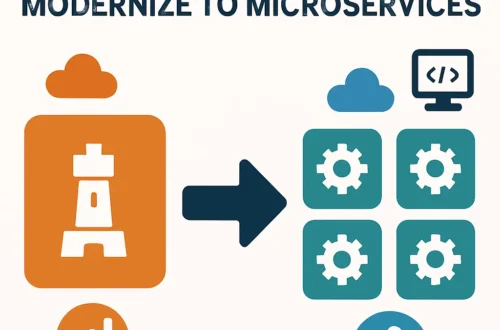
- Re-architect – Redesign the system to leverage modern architectures (e.g., microservices, event-driven) enabling scalability, resilience and faster change.
- Rebuild – Recreate the system from scratch, preserving business scope but using new technologies and patterns.
- Replace – Retire the system and adopt commercial SaaS or a different solution that covers the same business capabilities.
In practice, enterprises use a portfolio approach: some systems are retained, others rehosted, and the most strategic capabilities are re-architected or rebuilt. The art of modernization lies in sequencing these choices to minimize risk and maximize value.
Assessing your legacy landscape: where to start
A structured assessment forms the backbone of any serious modernization initiative. Without it, organizations either get paralyzed by complexity or jump into expensive rewrites that deliver little value.
Key dimensions to assess include:
- Business criticality – How central is the system to revenue, compliance, customer experience or core operations?
- Change frequency – How often does the business need changes? Stable, low-change systems may justify lower modernization priority.
- Technical health – Code quality, dependencies, test coverage, security posture, performance bottlenecks.
- Cost profile – Licensing, infrastructure, maintenance hours, incident management and opportunity cost.
- Integration complexity – Number and type of interfaces, data flows, batch jobs and external dependencies.
Using these criteria, you can classify systems into categories such as:
- Strategic and fragile – High priority for deep modernization (re-architecture, rebuild).
- Expensive but non-strategic – Candidates for replacement with SaaS or outsourcing.
- Stable and low value-add – Retain or minimally rehost, possibly wrapping with APIs.
- Emergent bottlenecks – Systems not critical today but likely to constrain future growth if left unchanged.
This assessment should not be purely technical. It requires close collaboration between IT and business stakeholders to avoid optimizing for technology while neglecting strategic priorities.
Risk management and phased modernization
Attempting to modernize everything at once is a recipe for failure. The most effective programs apply incremental, risk-aware strategies such as:
- Strangler fig pattern – Gradually build new capabilities around the legacy system, routing traffic to the new components until the old ones can be safely decommissioned.
- Domain-based decomposition – Use domain-driven design to slice monoliths into coherent domains, then modernize domain-by-domain.
- Parallel run and canary releases – Operate new and old systems in parallel, shifting a subset of users or transactions first before full cutover.
- Feature toggles – Deploy new features disabled by default, then progressively enable and monitor them to limit blast radius.
Risk management is not only technical. Change management, communication, training and stakeholder alignment are equally crucial. People will resist if modernization is perceived as disruption without clear benefits.
Governance: keeping modernization aligned with strategy
Without governance, modernization efforts become scattered projects chasing the latest technologies. Effective governance often includes:
- Clear decision-making structures – Defined roles for architecture boards, product owners and security teams.
- Principles and guardrails – E.g., “API-first,” “cloud-native by default,” or “build where we differentiate, buy where we don’t.”
- Standardized reference architectures – Reusable blueprints for common patterns: event-driven integration, API gateways, CI/CD pipelines.
- Value tracking – Measuring outcomes (lead time, failure rate, customer NPS, cost to serve) rather than just counting migrated systems.
Governance should not turn into bureaucracy. The objective is to accelerate modernization while ensuring consistency, security and alignment with business strategy.
Designing a Cohesive Application Modernization Strategy
Modernizing individual systems in isolation leads to a patchwork of technologies and patterns. To achieve sustainable transformation, organizations need a holistic application modernization strategy that connects business vision, architecture, delivery practices and operating model.
Start with business capabilities, not technology
A robust strategy begins by mapping your business capabilities—the stable “what” your business must do (e.g., “customer onboarding,” “order fulfillment,” “risk assessment”)—before debating the technical “how.”
Steps to make this concrete:
- Inventory capabilities – Create a business capability map at different levels of granularity.
- Assess maturity and pain points – For each capability, identify performance issues, customer complaints, regulatory risks and innovation needs.
- Overlay systems onto capabilities – Determine which applications (and modules) support which capabilities today.
- Prioritize transformation domains – Focus on capabilities where improvement will significantly impact revenue, risk or customer experience.
This capability-first view avoids modernizing low-impact systems while neglecting high-leverage areas. It also provides a shared language for business and IT.
Architectural direction: from monoliths to modular ecosystems
Once priority domains are identified, the strategy must define the target architectural principles. “Microservices” is not a strategy; it’s one possible pattern. The key architectural goals typically include:
- Modularity – Clearly bounded services or components aligned to business domains, enabling independent change and deployment.
- Loose coupling – Well-defined, stable APIs and contracts; minimized hidden dependencies.
- Resilience and elasticity – Graceful degradation, automated recovery, autoscaling and capacity planning.
- Data ownership and consistency – Each domain owns its data; consistency models are chosen explicitly (strong vs. eventual consistency) based on business needs.
- Security by design – Authentication, authorization, encryption, auditability and privacy baked into services and integration patterns.
From these goals, you can select appropriate patterns:
- Domain-oriented microservices where frequent change and independent scaling are crucial.
- Modular monolith where a full microservices split would add unnecessary operational overhead.
- Event-driven architectures for loosely coupled data sharing and reactive workflows.
- API gateways and service meshes to centralize cross-cutting concerns like security, routing, observability and rate limiting.
Define a target state architecture but treat it as a living artifact, periodically refined based on learning and evolving business priorities.
Cloud and platform strategy: foundation for modernization
Application modernization and cloud strategy are inseparable. Without a coherent platform approach, every team ends up reinventing the wheel for CI/CD, observability, security and runtime environments.
Key elements of a strong platform strategy include:
- Standardized runtime environments – Containers, serverless functions or PaaS offerings that provide consistent deployment and scaling models.
- Integrated CI/CD pipelines – Automated build, test, security scanning and deployment pipelines as a shared service.
- Unified observability – Logging, metrics, tracing and alerting with agreed naming conventions and dashboards.
- Security and compliance automation – Policy-as-code, automated configuration checks and guardrails for data residency, encryption and access control.
- Self-service for teams – Developers can provision environments, databases and services through well-governed self-service portals.
Whether you adopt a single cloud, multi-cloud or hybrid approach, the strategy should clarify which workloads go where, how data is managed across environments and how lock-in will be managed.
Data strategy: the hidden backbone of modernization
Many modernization programs fail not because of code, but because of data. Legacy systems often hold critical, inconsistent or poorly understood data. A thoughtful data strategy is crucial:
- Data discovery and cataloging – Identify critical data domains, ownership, lineage and quality issues.
- Domain-aligned data ownership – Align data stores with domain boundaries wherever possible, reducing shared “big ball of mud” databases.
- Integration patterns – Move away from point-to-point integrations and nightly batch jobs towards event streams, APIs or data hubs.
- Analytical vs. operational data – Separate the needs of real-time operations from analytics and AI uses, while ensuring consistent definitions.
- Data governance – Clear policies on access, retention, privacy and data quality, supported by automated enforcement where possible.
Modernization provides an opportunity to clean, standardize and better exploit data—if data strategy is treated as a first-class concern rather than an afterthought.
Operating model: aligning teams, processes and culture
Technology alone cannot deliver modernization benefits. The operating model determines how effectively you can build and run modern applications.
Important aspects include:
- Team topology – Cross-functional, product-aligned teams that own services end-to-end (build and run), rather than siloed dev/ops/business structures.
- Product thinking – Treating applications as evolving products with roadmaps, KPIs and continuous feedback, not one-off projects.
- Engineering practices – Test automation, trunk-based development, code reviews, pair programming, infrastructure as code.
- Security and compliance integration – “Shift left” by embedding security, risk and compliance considerations into daily work instead of late-stage gates.
- Upskilling and change management – Training, coaching and deliberate cultural work to move from risk-averse, ticket-driven processes toward empowered, accountable product teams.
Without evolving the operating model, modernized applications will still be delivered slowly and unreliably, and the investment will underperform.
Roadmapping and value realization
A modernization strategy must translate into a realistic roadmap. A good roadmap:
- Combines quick wins and foundational work – Balance visible business value (e.g., new customer features) with invisible, but critical, platform and architecture investments.
- Is incremental and revisable – Plan in horizons (e.g., 6, 12, 24 months), revisiting priorities based on feedback and changing conditions.
- Links initiatives to measurable outcomes – For each modernization initiative, define success metrics (cycle time, incident rate, customer satisfaction, revenue uplift).
- Clarifies dependencies – Identify which foundational capabilities must be in place before certain applications can be modernized.
Value realization is an ongoing discipline, not a closing phase. Continuously tracking and communicating outcomes is essential to maintain sponsorship and funding.
Common pitfalls and how to avoid them
Even well-intentioned strategies derail. Common pitfalls include:
- Technology-first thinking – Adopting microservices, Kubernetes or serverless without clear business or architectural rationale.
- Big-bang rewrites – Rebuilding huge systems from scratch with long timelines, only to discover misunderstood requirements and mismatched expectations.
- Underestimating data and integration work – Treating data migration and interface redesign as minor tasks rather than central challenges.
- Ignoring organizational resistance – Underinvesting in communication, training and governance, creating fear and pushback.
- Fragmented initiatives – Multiple teams modernizing in isolation, adopting different stacks and practices, leading to chaos instead of simplification.
Mitigation strategies revolve around disciplined scoping, incremental delivery, transparent communication, and a relentless focus on outcomes over outputs.
Putting it all together
When done well, modernization does not feel like a one-time “project.” It becomes a way of working: continuously aligning your application landscape, architecture and operating model with evolving business strategy and customer expectations.
Strategic clarity, architectural vision, a strong platform foundation, a robust data strategy and an empowered operating model jointly determine whether modernization efforts unlock agility, resilience and innovation—or become yet another expensive, unfinished transformation.
Conclusion
Legacy modernization is ultimately about transforming how your organization delivers value, not just updating technology. By carefully assessing existing systems, managing risk incrementally and grounding decisions in business capabilities, you can build a coherent application landscape that is modular, resilient and data-driven. Combine this with cloud platforms, strong engineering practices and a product-centric operating model, and modernization becomes a continuous competitive advantage rather than a one-off initiative.