Modern organizations rely on data for every decision, but many are still constrained by outdated, rigid systems that slow innovation and increase risk. In this article, we will explore what legacy systems really are, why they become a barrier to growth, and how to approach modernization strategically. You will learn practical, business-focused ways to transform old platforms into a modern, scalable digital foundation.
Understanding Legacy Systems and Why They Become a Problem
Before planning any modernization initiative, it is essential to understand what a legacy system actually is and why it becomes problematic over time. Many companies think “legacy” simply means “old,” but the reality is more nuanced and directly tied to business value, risk, and agility.
At the most basic level, a legacy system is any application, database, or technology stack that the organization still depends on, but that is difficult or costly to change. It might still work reliably day to day, yet it prevents the business from moving quickly, integrating new tools, or complying easily with emerging regulations. Age contributes to this, but the real issue is misalignment between the system and current business needs.
To make this more concrete, consider a 20-year-old core banking platform that still processes millions of transactions each day. It may be stable and “battle-tested,” but if it cannot expose modern APIs, integrate with mobile apps, or support real-time analytics, the bank’s ability to innovate is severely limited. The same applies across industries—manufacturing, healthcare, retail, logistics—where long-standing systems form the operational backbone yet are increasingly incompatible with modern expectations.
One of the clearest examples of this misalignment appears at the database level. Many organizations struggle to understand legacy database meaning in a business context. It is not just about using an older database engine; it is about being locked into rigid schemas, proprietary technologies, or on-premises infrastructure that slow down development and make collaboration with external partners more difficult. A database becomes legacy when it is a bottleneck rather than an enabler.
Common Characteristics of Legacy Systems
While every organization is unique, legacy systems tend to share several recognizable traits:
- Technological obsolescence: They run on outdated languages, frameworks, or operating systems that fewer people know how to maintain. Vendors may have reduced or ended support, increasing operational risk.
- High coupling and complexity: Business logic, data access, and user interface code are tightly interwoven. Even minor changes risk breaking critical functionality because there is no clear separation of concerns.
- Poor or missing documentation: Key knowledge lives in the heads of a few senior employees. When those people retire or leave, the organization loses critical know-how for safely modifying the system.
- Limited integration options: Data exchange with other systems requires brittle point-to-point integrations, custom scripts, or manual exports. Modern API-based connectivity is often difficult or impossible to add.
- Security and compliance gaps: Outdated encryption, unsupported operating systems, or lack of fine-grained access controls make meeting current regulatory requirements significantly harder.
- Rigid data models: Schema changes are complex and risky, which discourages adaptation to new reporting requirements or business processes.
When these characteristics converge, the organization experiences escalating maintenance costs, slower time-to-market for new features, and increasing operational risk. Teams become reluctant to touch the system out of fear of breaking “the thing that runs the business.”
Business Risks of Staying on Legacy Systems
Continuing to rely on legacy platforms may feel safer in the short term, especially if “everything still works.” However, strategic risk grows over time. Some of the most significant risks include:
- Competitive disadvantage: Competitors adopting cloud-native or API-driven architectures can launch new services, personalization, and data-driven features much faster.
- Talent shortage: Fewer engineers are willing—or able—to develop in older languages and stacks, leading to higher hiring and training costs.
- Operational fragility: Outages become more likely as hardware ages and vendor support ends. Recovering from incidents is slower because of the system’s complexity.
- Inhibited innovation: Experiments with AI, advanced analytics, or new channels (e.g., chatbots, IoT) require data and integration capabilities that legacy systems often cannot support.
- Escalating hidden costs: Licensing, specialized hardware, manual workarounds, and ad-hoc integration projects accumulate into a large, often invisible cost base.
The longer modernization is postponed, the more difficult it becomes. Data volumes grow, dependencies multiply, and staff who understand the system retire or move on. This compounding effect is one of the strongest arguments for tackling modernization deliberately and early.
Legacy Systems as Technical Debt
Legacy systems are essentially large blocks of technical debt—technology choices that made sense in the past but now constrain the future. Like financial debt, some level of technical debt is normal and even healthy; it is not realistic to rebuild everything constantly. The problem emerges when this “debt” is not consciously managed.
Viewing legacy systems as technical debt helps reframe modernization as a portfolio management exercise. Rather than trying to fix everything at once, organizations can:
- Assess where the debt is largest and most risky.
- Quantify business impact (e.g., lost revenue, increased time-to-market, compliance risk).
- Plan targeted “debt repayments” in the form of modernization projects with clear ROI.
This perspective also aids communication with non-technical stakeholders. Instead of talking about programming languages or database engines, leaders can discuss how modernization investments reduce risk, increase speed, and support the company’s strategic direction.
Why a Strategic Approach to Modernization Matters
Replacing or upgrading a core system is inherently risky. Doing it without a clear strategy can introduce even more complexity than existed before. Some organizations attempt a “big bang” replacement, only to suffer multi-year delays, budget overruns, or even failed projects that must be rolled back.
A strategic approach recognizes that modernization is not a one-time project but a staged transformation. It balances technical goals (scalability, maintainability, cloud readiness) with business priorities (customer experience, regulatory compliance, new revenue streams). It also acknowledges the importance of people and process—governance, skills, and culture—rather than treating modernization as a purely technical exercise.
This is where structured legacy system modernization strategies become invaluable. They provide a framework to evaluate options, align stakeholders, and define an executable roadmap that respects both business continuity and long-term evolution.
Key Drivers Behind Modernization Efforts
Organizations usually embark on modernization initiatives in response to one or more of the following drivers:
- Growth and scalability: The existing system cannot handle increased transactions, new markets, or expanded product lines without significant manual intervention or hardware upgrades.
- Customer expectations: Users expect real-time responses, mobile access, self-service, and consistent experiences across channels that older platforms cannot easily provide.
- Regulatory pressure: New regulations require granular auditability, data lineage tracking, or stronger security controls that are hard to retrofit.
- Cost efficiency: Cloud platforms and modern architectures offer variable cost models and automation that can substantially lower operational expenses over time.
- Data-driven decision-making: Business leaders want advanced analytics, machine learning, and unified data views across systems—capabilities often blocked by siloed, legacy data stores.
Understanding which of these drivers is most pressing in your context enables a more focused modernization strategy. For example, a company primarily aiming for cost reduction will prioritize different initiatives than one trying to rapidly expand into new digital channels.
Common Modernization Options and Trade-Offs
Modernization is not a single technique but a spectrum of approaches, each with its own balance of cost, risk, and benefit. At a high level, options include:
- Rehosting: Moving applications from on-premises to cloud infrastructure with minimal changes. This can yield faster wins in scalability and operations, but it does not address underlying code complexity or architectural rigidity.
- Replatforming: Adapting the application to take better advantage of cloud capabilities (managed databases, containers, orchestration) without a full rewrite. This offers more long-term value than pure rehosting, with moderate risk and effort.
- Refactoring: Restructuring and improving the internal design of the code while preserving external behavior. This reduces technical debt and increases maintainability but may not visibly change functionality for end users.
- Rearchitecting: Changing the core architecture—e.g., from a monolith to microservices or event-driven designs—to enhance scalability, resilience, and agility. This is more complex and time-consuming but can unlock substantial long-term benefits.
- Replacing: Adopting a new commercial or SaaS solution in place of homegrown systems. This can rapidly modernize capabilities but requires strong change management and thoughtful data migration.
- Retiring: Decommissioning systems that no longer deliver value once their data and critical functions are absorbed elsewhere.
No single approach is universally correct. Most organizations take a blended path, applying different methods to different systems based on criticality, complexity, and strategic importance.
Aligning Modernization with Business Strategy
Modernization efforts must directly support the company’s broader business strategy. Otherwise, they risk becoming expensive technical projects that deliver limited tangible value. A successful alignment process typically involves:
- Clarifying strategic goals: For example, entering new markets, improving customer retention, or accelerating digital product releases.
- Mapping systems to capabilities: Identifying which systems underpin critical capabilities (order processing, billing, regulatory reporting) and how their limitations impede strategic goals.
- Prioritizing modernization candidates: Selecting systems where modernization will yield the highest impact on strategic outcomes, not simply the ones that are most painful technologically.
- Defining measurable outcomes: Setting clear KPIs such as reduced incident rates, faster feature delivery, improved customer satisfaction, or lower unit costs.
This approach transforms modernization from “IT housekeeping” into a coherent investment portfolio, with clear expectations and accountability.
Managing Risk During Modernization
Upgrading critical systems always introduces some level of risk. However, risk can be managed and reduced through structured governance and careful execution. Important practices include:
- Incremental delivery: Breaking large modernization efforts into smaller, deliverable phases with value at each step, rather than relying on one massive cutover.
- Parallel run and fallback plans: Running new and old systems side by side for a period, with clear rollback procedures in case issues arise.
- Robust testing and automation: Implementing automated unit, integration, regression, and performance tests to detect problems early and repeatedly.
- Change management: Training users, updating documentation, and aligning business processes with new system capabilities to avoid operational disruption.
- Strong stakeholder communication: Keeping business leaders, operations teams, and end users informed about objectives, timelines, and potential impacts.
Well-managed risk does not eliminate challenges altogether, but it significantly reduces the likelihood of catastrophic project failure or prolonged outages.
From Monoliths to Modular Architectures
Many legacy systems are large monoliths—single, tightly integrated applications that handle everything from data storage to business logic to presentation. While monoliths can be efficient for small, stable domains, they become increasingly burdensome as requirements change and teams grow.
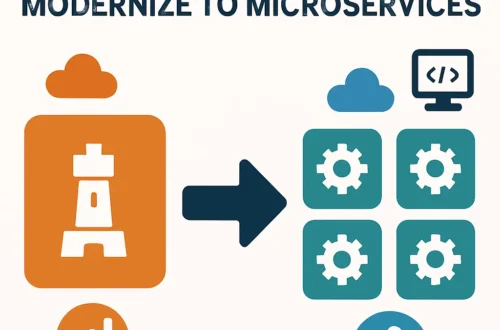
Modernization often aims to introduce more modular architectures, such as microservices or domain-driven designs. The core idea is to break down the monolith into smaller, independently deployable components that map more closely to business domains (e.g., customer management, inventory, billing). This enables:
- Faster, independent deployments by separate teams.
- Technology diversity, allowing each service to use the best-fit tools.
- Improved fault isolation: issues in one service do not necessarily bring down the entire system.
However, this transition must be handled carefully. Naively “splitting” a monolith without understanding domain boundaries or data ownership can result in a distributed monolith—an even more complex and fragile design. Successful modularization relies on thorough domain analysis, clear API contracts, and strong observability across services.
Data as the Foundation of Modernization
Regardless of architectural patterns, data is at the heart of every modernization effort. Legacy systems often lock data into rigid schemas, proprietary formats, or siloed storage. Freeing this data, cleaning it, and making it accessible for real-time and analytical use cases is a central objective.
Key data-related considerations during modernization include:
- Data quality and consistency: Resolving duplicates, conflicting records, and inconsistent formats across systems.
- Data governance: Defining ownership, stewardship, and access policies, especially when moving to cloud or shared data platforms.
- Migration strategies: Choosing between big bang cutovers, phased migrations by domain, or ongoing synchronization mechanisms.
- Analytical vs. operational needs: Designing data platforms that can serve both transactional workloads and analytics without one degrading the other.
Organizations that treat data as a strategic asset rather than a byproduct of applications are better positioned to realize the full value of modernization.
People, Skills, and Organizational Change
Modernization is as much about people and culture as it is about technology. Shifting from legacy practices to modern architectures, continuous delivery, and cloud-native operations requires new skills and mindsets.
Some of the most important human factors are:
- Upskilling and reskilling: Providing training programs and pairing opportunities for staff to learn modern frameworks, cloud platforms, and DevOps practices.
- Cross-functional collaboration: Encouraging developers, operations, security, and business stakeholders to work together rather than in isolated silos.
- Empowered teams: Giving teams more autonomy to own end-to-end services—from development to deployment to monitoring—within clear governance boundaries.
- Change readiness: Addressing fears about job loss or irrelevance by clearly communicating how roles will evolve and how existing expertise remains valuable.
Ignoring these aspects often leads to resistance, slow adoption, and underutilized new platforms. Conversely, investing in people accelerates the success of technical initiatives.
Measuring Modernization Success
Once modernization is underway, organizations need clear metrics to evaluate progress and justify ongoing investment. Useful measures include:
- Operational metrics: System uptime, incident frequency, mean time to recovery, and deployment frequency.
- Business metrics: Time-to-market for new features, customer satisfaction scores, conversion rates, and revenue from new digital channels.
- Cost metrics: Infrastructure spending, support and maintenance costs, and the ratio of spend on innovation versus “keeping the lights on.”
- Risk metrics: Number of high-severity security vulnerabilities, audit findings, and compliance exceptions.
Tracking these over time creates a feedback loop, allowing leaders to adjust priorities, refine strategies, and demonstrate tangible value from modernization efforts.
Conclusion
Legacy systems represent both a constraint and an opportunity. While they can slow innovation and increase risk, they also embody deep business knowledge and proven processes. By understanding what makes a system legacy, aligning modernization with strategic goals, and applying structured, incremental approaches, organizations can safely transform their technological core. The result is a more agile, scalable, and resilient digital foundation ready for future growth.