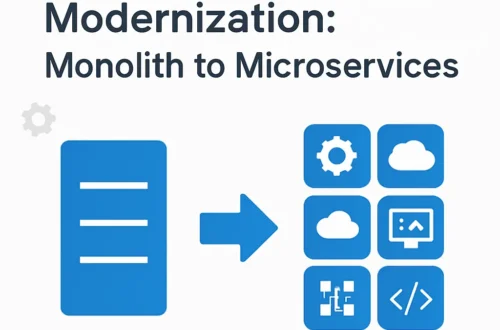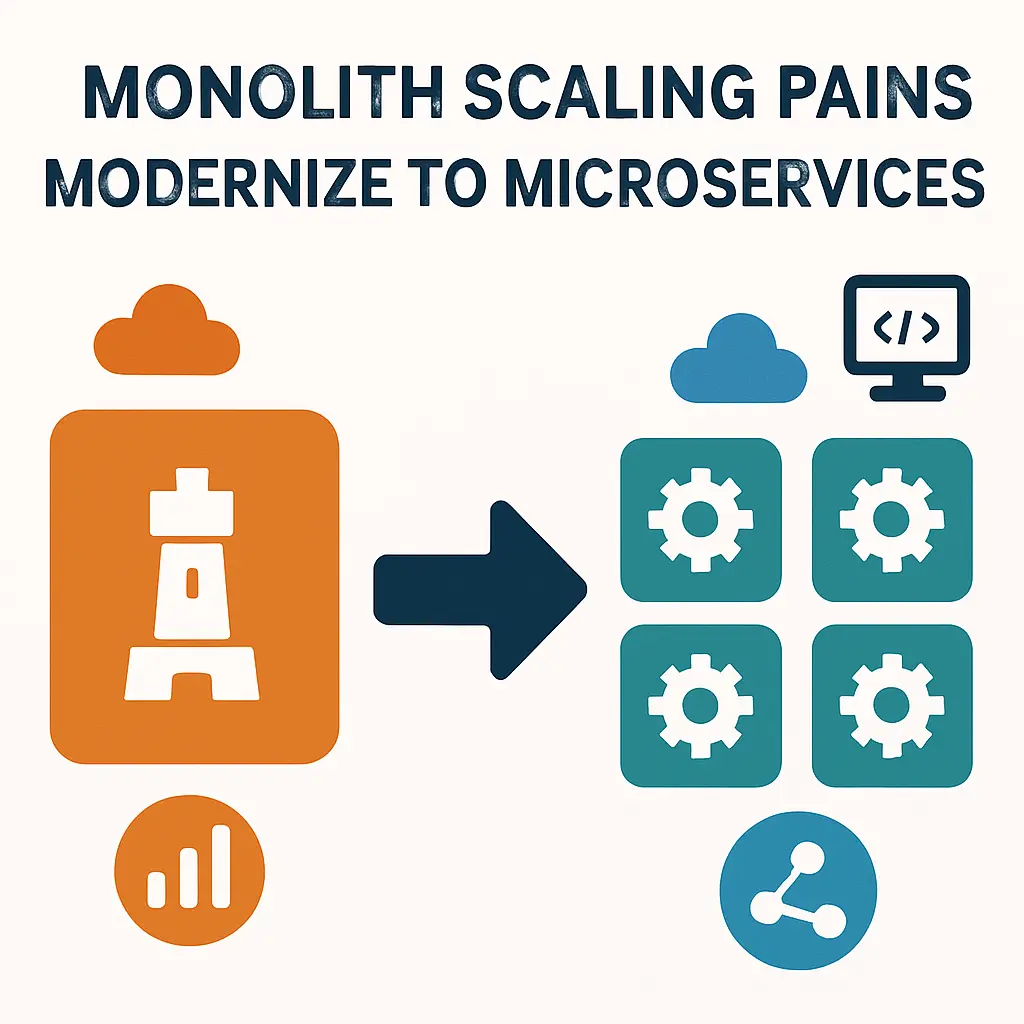
Is your legacy monolith silently capping your growth? As user expectations, data volumes, and release velocity increase, monolithic architectures can shift from reliable workhorses to serious bottlenecks. In this article, we’ll explore how to spot those scaling pains, why they’re so hard to fix within a monolith, and how a well-planned modernization path toward microservices can realign your architecture with your business goals.
The Hidden Costs and Scaling Pains of Monolithic Architectures
Monoliths are not inherently bad. For many organizations, a single deployable application was exactly what they needed in the early stages. One codebase, one deployment pipeline, a single database, and everybody could “see everything.” But as the product, team, and customer base grow, this simplicity often becomes a liability rather than an asset.
Recognizing when that transition has happened is crucial. As highlighted in Scaling Pains You Can’t Ignore: How to Recognize When a Monolith Is Holding Your Business Back, there are recurring patterns that signal your monolith is now constraining — not enabling — your business.
1. Organizational and Delivery Pain as Early Warning Signals
Before performance graphs explode, your people and processes usually suffer first. Watch for these early symptoms:
Slow, risky releases
- Long lead times: Features that involve small, localized changes still take weeks to get to production because every change triggers a full regression cycle.
- Big bang deploys: Releases are infrequent and “all or nothing,” increasing the odds of production incidents and rollbacks.
- Fear of deployment: Teams plan releases like military operations. Everyone is on standby, and nobody wants to be responsible for pressing the deploy button.
These patterns mean the system has become too tightly coupled. A change in one area can break something entirely unrelated. That fragility is a hallmark of an overgrown monolith.
Coordination overhead and tangled ownership
- Too many cooks in the same kitchen: Multiple teams are constantly editing the same core modules or services, creating merge conflicts, accidental regressions, and political tension over “who owns what.”
- Cross-team firefighting: A bug in the billing logic requires help from the search team because both parts depend on a shared utility or data model.
- Opaque dependencies: Nobody can easily answer: “If we change this module, who will be affected?” Documentation lags far behind reality.
When the architecture does not map cleanly to team boundaries, everything from planning to incident response becomes slower and more error-prone.
2. Technical Constraints that Throttle Scale and Resilience
As your user base and data volumes grow, the monolith’s technical limitations become more visible.
Indivisible scaling
- Scaling everything to support one hotspot: Suppose checkout logic is CPU-intensive while user profiles are relatively light. With a monolith, you often scale the entire application when only a small part truly needs additional capacity.
- Cost inefficiency: Horizontal scaling becomes expensive, as you provision extra resources for low-traffic modules just to keep up with one or two high-load features.
This “all-or-nothing” scaling is a direct consequence of coupling. You cannot independently scale a specific capability because it is inseparable from the rest of the system.
Limited fault isolation
- One bug, many outages: A memory leak in a rarely touched feature can compromise the entire application instance, affecting critical features as well.
- High blast radius: When everything runs in one process space, a cascading failure is more likely, and recovery is more complex.
Monoliths can be made robust, but they tend to have coarser fault domains. Distinct services with clear boundaries naturally offer smaller blast radii and better resilience strategies (such as circuit breakers and per-service rate limits).
Rigid technology choices
- One stack to rule them all: Introducing a new programming language, messaging system, or database is difficult because it must coexist with everything else in a single deployment.
- Innovation drag: Teams who want to adopt newer frameworks or data stores are blocked by the need to coordinate with every other team that depends on the shared monolith.
Over time, technology stagnation becomes a subtle but powerful form of technical debt. The system becomes harder to maintain, fewer engineers are excited to work on it, and hiring becomes more difficult.
3. Business Symptoms that Reveal Architectural Debt
Architecture is not just a technical concern; it influences what the business can or cannot do. Some of the most critical scaling pains manifest as missed opportunities.
Slowed product experimentation
- Long feedback loops: Product teams avoid running small tests or A/B experiments because each requires substantial engineering effort and complex deployment coordination.
- Overloaded backlogs: Simple changes like adding a new pricing tier or feature flag require touching multiple parts of the monolith and thus get queued behind “bigger” work.
When the cost of a small experiment is high, you run fewer experiments, which directly impacts innovation and competitiveness.
Difficulty supporting new business lines or markets
- Feature coupling: Launching your product in a new country requires changing localization, tax logic, compliance features, and payment gateways, all intertwined in the monolith.
- Regulatory blocks: Meeting local legal requirements (e.g., data residency, consent management) becomes a hazardous refactoring project instead of a contained extension.
When your core system is too brittle to adapt, your go-to-market strategies become constrained, even if the demand and funding are there.
Misalignment between teams and architecture
- Teams depending on each other’s backlogs: The “search” team cannot ship improvements without help from the “user account” team because their code is tightly intertwined.
- Accountability gaps: Ownership of critical paths (checkout, onboarding, SLA-critical APIs) is blurred, making post-incident analysis and long-term ownership difficult.
This misalignment often shows that the logical domain boundaries of the business have never been properly reflected in the architecture, a problem that microservices, when correctly implemented, are designed to solve.
4. Assessing Whether Modernization is Worth It
Not every monolith needs to be replaced or decomposed. In fact, a clean, modular monolith is often a great architecture for smaller organizations. The key question is whether the cost and risk of modernization will be outweighed by the benefits.
Key questions to ask:
- How often do releases cause regressions? If each deploy triggers production issues, the architecture is likely an impediment.
- Where are your scaling hot spots? If 80% of your capacity is spent on 20% of features, this is a candidate for isolated scaling.
- Are you hitting a hiring or retention problem? If senior engineers are leaving because “everything is tangled and hard to change,” the monolith is already costing you.
- What is the business roadmap? Ambitious expansion plans, ecosystem partnerships, and API strategy all benefit from more modular, independent services.
When many of these answers point to pain, modernization from monolith to microservices — or at least toward a more modular architecture — becomes a strategic discussion, not just a technical one.
From Legacy Monolith to Microservices: A Practical Modernization Path
Once you recognize that your monolith limits you, the immediate temptation may be a full rewrite. That is almost always the riskiest option: long timelines, moving business requirements, and the danger that you rebuild yesterday’s system for tomorrow’s market. A more effective strategy is incremental modernization.
The journey from a legacy monolith to a microservices-based ecosystem, as explored in more detail in Legacy Application Modernization: Monolith to Microservices, should be guided by business outcomes, domain-driven boundaries, and careful technical execution.
1. Clarify Business Drivers and Success Metrics
Modernization is not an end in itself. It must be justified by clear, measurable business drivers, such as:
- Faster time-to-market: Cutting the time from idea to deployment from months to weeks or days.
- Improved reliability and SLAs: Isolating critical services so that issues in non-critical areas don’t bring them down.
- Scalable cost structure: Scaling specific services based on load, aligning infrastructure costs more closely with actual usage.
- Regulatory or compliance needs: Segregating data domains for privacy, residency, or audit requirements.
Define KPIs before you start: deployment frequency, mean time to recovery (MTTR), lead time for changes, defect rates, and infrastructure cost per transaction are typical examples.
2. Understand and Reshape Your Domain Boundaries
Good microservices derive from well-understood domain boundaries, not from arbitrary technical splits. An effective first step is to map your business domains and subdomains:
- Identify core domains: Areas directly tied to competitive advantage (e.g., recommendation engine, pricing logic).
- Identify supporting and generic domains: Authentication, billing, notifications, reporting, etc.
- Describe the interactions: Which domains consume data from others? Which operations are high-throughput and which are batch or low-frequency?
Leverage domain-driven design concepts such as bounded contexts. Each microservice should encapsulate a coherent domain or subdomain with its own data model, logic, and clear API boundaries. This domain decomposition is the blueprint for your service boundaries.
3. Choose a Modernization Strategy: Strangler, Extraction, or Modularization
The Strangler Fig pattern
This pattern incrementally replaces functionality at the system boundary:
- Front door first: Introduce an API gateway or edge service that routes incoming requests either to the legacy monolith or to newly created microservices.
- Slice by slice: Implement a specific capability (e.g., user profile management) as a new service, then route related traffic away from the monolith.
- Gradual decommissioning: Over time, legacy modules become unused and can be retired.
This approach reduces risk by allowing you to migrate functionality gradually while maintaining a working production system.
Service extraction from within the monolith
For domains deeply embedded inside the monolith, a more surgical extraction might be required:
- Isolate logic: Refactor the monolith to concentrate domain logic into clearer modules or libraries inside the existing codebase.
- Define interfaces: Introduce clear module boundaries and interface contracts, even before splitting the deployment unit.
- Externalize the module: Turn the module into a separate service, expose a network API, and replace internal calls in the monolith with API calls.
This internal modularization step often yields benefits even before you adopt microservices, by improving code organization and testability.
4. Establish a Technical Foundation Before Large-Scale Decomposition
Extracting one or two services is only the beginning. You need an ecosystem that can sustain dozens or hundreds of services without collapsing under operational complexity.
Key building blocks include:
- API Gateway and service discovery: A central entry point for clients, routing to internal services, and a mechanism for services to find each other dynamically.
- Observability stack: Centralized logging, metrics, and distributed tracing to understand behavior across service boundaries and to troubleshoot incidents.
- Automated testing and CI/CD: Pipelines that support frequent, independent deployments for each service, including unit, contract, integration, and end-to-end tests.
- Security and policy enforcement: Authentication, authorization, and encryption at the service-to-service level, plus rate limiting and input validation at the perimeter.
Investing early in these platform capabilities avoids an operational nightmare later, when more services are in play.
5. Data Strategy: Untangling the Monolithic Database
One of the hardest parts of modernization is dealing with the shared relational database that underpins the monolith. Moving to microservices usually implies some degree of data decentralization.
Key principles:
- Service-owned data: Each service should own its data schema, controlling how it is stored, accessed, and evolved.
- Avoid shared write access: Two services directly writing to the same tables create hidden coupling and synchronization problems.
- Use APIs or events for data sharing: Instead of coupling through the database, services exchange data via HTTP/REST, gRPC, or event streams.
Common patterns for data migration:
- Table-per-service extraction: Gradually refactor tables so that a specific set of tables is exclusively used by one service, then move or replicate them to a dedicated database.
- Event-driven replication: Use events (e.g., “OrderCreated,” “UserUpdated”) to maintain read models in other services, while preserving a single source of truth for each data domain.
- Strangler for data: Similar to code, you can route write operations to the new service while letting the monolith continue to read from the old schema during a transition period.
Data consistency becomes a design concern. You may need to move from ACID, single-transaction operations to eventual consistency in some flows, which requires careful UX and business process design.
6. Evolving Team Structure and Culture Alongside Architecture
Architecture and organization structure are tightly coupled. Adopting microservices while keeping monolithic team structures usually fails.
Align teams with services
- Cross-functional squads: Each team owns one or more services end to end, including design, implementation, deployment, and operations.
- Clear ownership boundaries: Teams are accountable for specific domains and APIs, with clear SLAs and decision rights.
Shift to a platform mindset
- Internal platform team: Provide shared tooling and infrastructure — CI/CD, observability, API gateway — as a product to internal service teams.
- Golden paths and templates: Make it easy to spin up new services that follow best practices by default.
Embrace DevOps practices
- Continuous delivery: Small, frequent deployments reduce risk and provide fast feedback.
- Operational responsibility: Service-owning teams monitor, respond to alerts, and drive post-incident improvements.
Without this organizational evolution, microservices can amplify chaos rather than improve agility.
7. Manage Risk with Incremental Milestones
Modernization is a multi-year journey for most mid-sized and large organizations. Success depends on breaking it into incremental steps and continuously validating value.
Practical milestones:
- Pilot service: Select a non-critical but meaningful domain to extract first. Use it to harden your CI/CD, observability, and platform basics.
- Critical path services: Move high-value, high-change domains next, where the benefits of independent scaling and deployment are most pronounced.
- Retire legacy modules: Track which parts of the monolith are unused and formally decommission them, reducing maintenance overhead.
- Regular retrospectives: After each major extraction or platform improvement, reassess architecture, team structures, and KPIs.
This incremental approach ensures that at every stage, you can measure progress, adjust strategy, and avoid the “big bang” rewrite trap.
Conclusion
Monolithic architectures often start as enablers of rapid growth, but beyond a certain scale they can impose severe constraints on performance, reliability, and innovation. By learning to recognize organizational, technical, and business symptoms, you can identify when your monolith is holding you back. A deliberate modernization path — guided by domain boundaries, strong platform foundations, and aligned teams — allows you to evolve toward microservices incrementally, reducing risk while unlocking long-term agility and scalability.