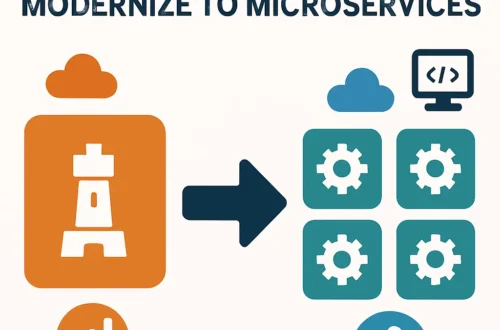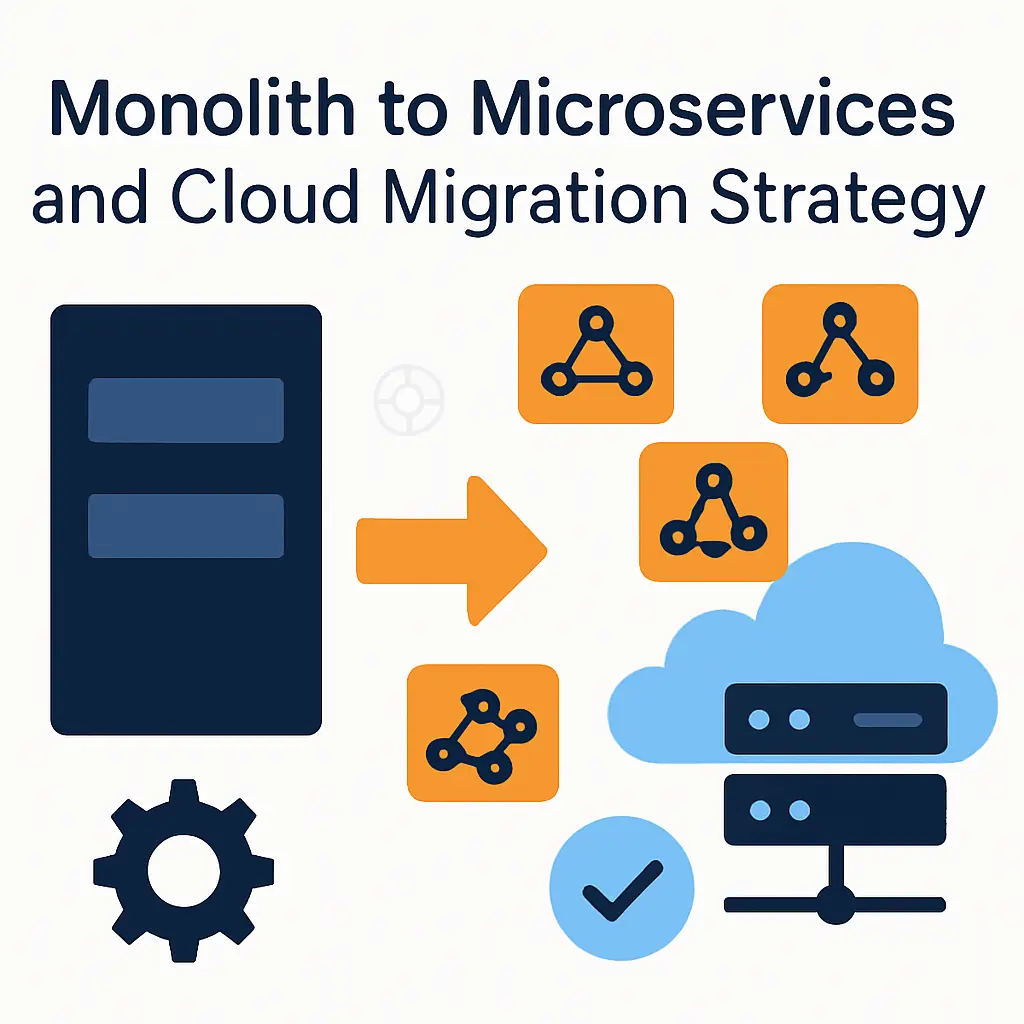
Modern enterprises are under constant pressure to deliver new features faster, scale globally, and stay resilient in the face of failures. This has pushed organizations to rethink their legacy monolith architectures and on‑premise deployments. In this article, we explore how migration from monoliths to microservices intersects with cloud migration strategies, and how a well‑designed, step‑by‑step approach can reduce risk while maximizing business value.
From Monolith to Microservices: Why, When, and How
A monolithic application is typically built as a single, tightly coupled codebase where all business logic, data access, and user interface components are packaged and deployed together. While this architecture can be simple to start with, it becomes increasingly fragile and slow to change as the system and organization grow.
In contrast, a microservices architecture decomposes the system into a suite of small, independently deployable services. Each service is responsible for a well‑defined business capability, has its own lifecycle, and can be scaled, deployed, and updated without impacting the rest of the system.
Understanding whether a microservices approach is right for your organization requires a clear look at the limitations of your current monolith and the business outcomes you want to achieve.
Common pain points of legacy monoliths include:
- Slow delivery cycles: A small change in one part of the system can require rebuilding, retesting, and redeploying the entire application.
- Scaling bottlenecks: You often have to scale the whole application just to handle load on a single function or module, wasting resources.
- Fragile deployments: Tight coupling means one defective module can bring down the entire system.
- Technological lock‑in: Changing the tech stack (e.g., programming language or database) for part of the system is nearly impossible.
- Team coordination overhead: Large codebases with many contributors lead to merge conflicts, hidden dependencies, and complex release coordination.
Microservices address these pain points by separating responsibilities and allowing teams to move at different speeds. However, this comes with added architectural, operational, and organizational complexity. You must be deliberate about how you approach a migration from monolith to microservices, or you risk trading one set of problems for another.
Key benefits of a well‑executed microservices journey include:
- Independent deployments: Teams can release features and fixes for a single service without coordinating a full‑system deployment.
- Fine‑grained scaling: Scale only the services that need more capacity, reducing infrastructure costs.
- Higher resilience: Failures in one service are less likely to cascade and bring down the entire system when bounded correctly.
- Technology diversity: Teams can choose the right tool, language, or database for their specific service.
- Closer alignment with business domains: Microservices often map to business capabilities, enabling business‑aligned teams to own end‑to‑end outcomes.
To achieve these benefits, you should not start by “slicing the codebase” at random. Instead, approach the decomposition as a strategic transformation grounded in domain modeling, business priorities, and a pragmatic migration plan.
1. Use domain‑driven design to identify service boundaries
A successful microservices design typically mirrors the structure of the business itself. Domain‑Driven Design (DDD) encourages you to model the core business domains and subdomains, identify bounded contexts, and ensure each service encapsulates a clear responsibility.
Key DDD‑inspired steps might include:
- Conducting domain discovery workshops with business and technical stakeholders.
- Mapping out business capabilities such as “Order Management”, “Billing”, “Inventory”, “Customer Profile”, and “Authentication”.
- Identifying where concepts and terminology differ across the organization (a sign of distinct bounded contexts).
- Designing microservice boundaries that minimize synchronous dependencies and data sharing.
This domain‑centric view helps avoid creating services that are too fine‑grained (chatty nano‑services) or too broad (mini‑monoliths), both of which undermine the benefits of microservices.
2. Decide on a migration pattern: Strangler fig vs. big bang
A “big bang” rewrite involves building the full microservices system from scratch and switching over all traffic at once. This is almost always extremely risky for large, business‑critical systems: timelines slip, integrations are underestimated, and you end up maintaining two incomplete systems simultaneously.
Most successful organizations opt for the strangler fig pattern instead. Inspired by how the strangler fig tree gradually encases its host, you incrementally replace portions of the monolith with new microservices, routing traffic to the new components while the rest remains unchanged.
In practical terms:
- Identify a specific business capability (for example, “Catalog Search” or “User Notifications”) as the first candidate for extraction.
- Build a new microservice that implements this capability behind a stable API boundary.
- Introduce an edge layer (API gateway, reverse proxy, or routing rule) that directs relevant requests either to the monolith or to the new service.
- Retire the old code from the monolith once the new service is validated and stable.
- Repeat the process for additional capabilities, gradually shrinking the monolith over time.
This incremental approach allows you to de‑risk the transformation, gather feedback early, and adjust your architecture and practices as you learn.
3. Modernize around data ownership and consistency
One of the most challenging aspects of decomposing a monolith is dealing with its database. Most legacy systems use a single shared relational database with tightly coupled schemas, stored procedures, and cross‑module joins.
In a microservices world, each service should own its own data store, exposing changes via APIs or events instead of direct database access. Otherwise, you recreate hidden dependencies that erode service isolation.
Practical strategies include:
- Database view or schema segmentation: Start by segregating tables into logical schemas for each domain, then gradually move ownership to service‑specific data stores.
- Change‑data‑capture (CDC) and events: Use CDC tools or event publishing to keep read models in sync across services without tight coupling.
- Embrace eventual consistency: Replace strong, cross‑module transactional guarantees with patterns like saga orchestration, outbox pattern, and idempotent message handling.
- Read models and CQRS: For query‑heavy use cases, separate write models (owned by a service) from read models that aggregate data across services.
This shift requires not only technical adjustments but also a mindset change: architects and engineers need to accept that data is no longer globally consistent at every moment, and instead design processes and user experiences that tolerate short windows of inconsistency.
4. Build the platform capabilities first: CI/CD, observability, and security
Microservices multiply the number of deployable units. Without automation, visibility, and strong governance, operations quickly become chaotic. Before you aggressively decompose the monolith, invest in a solid platform foundation:
- CI/CD pipelines: Automate build, test, and deployment pipelines for each service. Use trunk‑based development and frequent, small releases to reduce risk.
- Service discovery and configuration: Centralize how services find each other and manage configuration (e.g., via service mesh or a configuration service).
- Observability: Implement distributed tracing, centralized logging, and metrics from day one. In a microservices environment, understanding cross‑service call paths is critical for debugging.
- Resilience patterns: Apply circuit breakers, timeouts, bulkheads, and retries at service boundaries so failures don’t cascade.
- Security and zero trust: Secure service‑to‑service communication with mutual TLS, token‑based authentication, and least‑privilege authorization.
These platform capabilities are significantly easier to implement and operate when you are already in the cloud, which leads to the next critical dimension: your cloud migration strategy.
Aligning Microservices Modernization with Cloud Migration Strategy
Moving to microservices and moving to the cloud are often treated as separate projects, owned by different teams and funded from different budgets. In reality, they are deeply intertwined transformations that can either reinforce each other or create friction and duplication of effort.
To design an integrated approach, start by clarifying what is cloud migration strategy in the context of your business. A cloud migration strategy is more than “put everything on Kubernetes” or “lift‑and‑shift to a new data center”. It defines how, when, and why applications, data, and infrastructure are moved to cloud environments, with explicit trade‑offs between speed, cost, and modernization depth.
Common cloud migration patterns and how they relate to microservices
Most organizations use a mix of the following patterns, sometimes referred to as the “7 Rs” of migration. The relevance of each to microservices varies:
- Rehost (lift and shift): Move the application as‑is to cloud infrastructure (e.g., from physical servers to virtual machines in the cloud). This is fast but doesn’t address monolith complexity. It can, however, be a first step to gain cloud‑native tooling and flexibility.
- Replatform: Make limited changes to leverage managed services (databases, queues, load balancers) without changing the core architecture. This can simplify operations and pave the way for future decomposition.
- Refactor / Re‑architect: Redesign applications to take full advantage of cloud‑native capabilities, including microservices, serverless, containers, and event‑driven architectures.
- Repurchase: Replace existing applications with SaaS solutions. This reduces the scope of what needs to be decomposed or migrated.
- Retire: Decommission obsolete applications, simplifying the overall landscape before or during the microservices transition.
- Retain: Keep certain systems as they are (e.g., for regulatory or economic reasons) while integrating them with new cloud‑native services.
Microservices fit naturally into the “refactor / re‑architect” pattern. However, you might choose to rehost or replatform a monolith first to minimize initial risk, then gradually refactor it into microservices once it is running reliably in the cloud.
1. Choosing the right sequencing: Cloud first, microservices first, or parallel?
There is no single correct order for every organization, but a thoughtful sequence can significantly reduce complexity.
Cloud‑first then microservices:
- Rehost or replatform the monolith into the cloud.
- Establish foundational cloud services: networking, identity, observability, managed databases.
- Gradually decompose the monolith in the cloud environment using the strangler pattern.
This approach is attractive when your on‑premise infrastructure is a major bottleneck or cost center, and you want quick wins from cloud elasticity and managed services. It also ensures that your platform tooling is cloud‑native from the start.
Microservices‑first then cloud:
- Decompose the monolith while still on‑premise.
- Create a service‑oriented environment internally, possibly leveraging containers and orchestration.
- Once services are stable, migrate them to the cloud.
This may make sense when regulatory or data sovereignty constraints complicate an immediate cloud move, or when you have strong internal platform capabilities already in place.
Parallel transformation:
- Migrate selected components or domains both to microservices and to the cloud at the same time.
- Use new cloud‑native microservices to gradually replace specific functionalities of the on‑premise monolith.
This can be efficient but requires careful coordination and non‑trivial integration between cloud and on‑premise environments. Hybrid connectivity, data synchronization, and security become central design concerns.
In practice, many organizations adopt a hybrid of these approaches, using parallel paths for different applications and domains depending on their criticality and technical readiness.
2. Using the cloud to accelerate microservices adoption
The cloud is not just a new data center; it provides building blocks that directly support microservices patterns:
- Managed container orchestration: Services like AWS ECS/EKS, Azure AKS, or Google GKE reduce operational overhead for containerized microservices.
- Serverless Functions: For fine‑grained business logic, serverless platforms provide scale‑to‑zero and event‑driven execution without managing servers.
- Managed databases and caches: Per‑service data stores (SQL, NoSQL, time‑series, in‑memory cache) can be provisioned and scaled independently.
- Messaging and event streaming: Queues and streaming platforms (e.g., SNS/SQS, Pub/Sub, Event Hubs, Kafka services) support decoupled, event‑driven communication between services.
- API gateways and service meshes: These services centralize routing, security, observability, and reliability features for microservices.
By leaning on these managed services, your teams can focus on business logic rather than undifferentiated infrastructure. Moreover, the elasticity and pay‑as‑you‑go model of the cloud align well with the independently scalable nature of microservices.
3. Governance, costs, and organizational change
A double transformation—architecture and hosting model—inevitably changes how teams collaborate, how budgets are allocated, and how success is measured.
Governance and standards:
- Define minimal standards for APIs, logging, metrics, alerts, and security that all services must follow.
- Create cross‑functional platform teams that provide paved paths (templates, tooling, pipelines) for product teams.
- Balance autonomy with guardrails: allow teams to choose technologies within a curated set that aligns with operational capabilities.
Cost management:
- Microservices can increase infrastructure line items (more running processes, databases, and network traffic). Use tagging and cost dashboards to attribute costs per service or domain.
- Regularly review idle resources and right‑size instances, autoscaling policies, and storage tiers.
- Factor in the operational savings of managed services and the opportunity costs of slower innovation in the old environment.
Organizational structure and skills:
- Shift from siloed development and operations teams to product‑oriented, cross‑functional squads that own services end‑to‑end.
- Invest in upskilling around cloud platforms, observability, DevOps practices, and distributed systems concepts.
- Adopt iterative change management: communicate the vision, show early wins, and involve teams in designing processes and standards.
Ultimately, migrating to microservices in the cloud is as much a people and process transformation as it is a technical one. Ignoring this dimension is a common cause of stalled or failed initiatives.
4. Risk mitigation and incremental value delivery
The combined complexity of microservices and cloud migration makes risk management paramount. Instead of planning a multi‑year “big reveal”, design your transformation to deliver value in small, observable increments.
Effective practices include:
- Pilot projects: Start with a non‑critical, well‑bounded domain to validate patterns, tooling, and processes before touching core revenue flows.
- Feature flags and canary releases: Gradually roll out new services to a subset of users, monitor performance and errors, and roll back quickly if needed.
- Shadow traffic: Route a copy of production traffic to new services or cloud environments without affecting real users, to test behavior at scale.
- Progressive decommissioning: As you move functionality out of the monolith, remove dead code and unused infrastructure to reduce maintenance burden.
Each incremental step should have a clear success metric—reduced lead time, improved reliability, better performance, or cost optimization—so stakeholders can see tangible benefits, not just architectural diagrams.
Conclusion
Transforming a legacy monolith into microservices while adopting the cloud is a complex but high‑value journey. By grounding service boundaries in business domains, using incremental patterns like the strangler fig, and aligning with a deliberate cloud migration strategy, you can reduce risk and avoid re‑creating old problems in a new environment. Treat platform capabilities, governance, and organizational change as first‑class concerns, and deliver value step by step rather than in a single, risky leap.