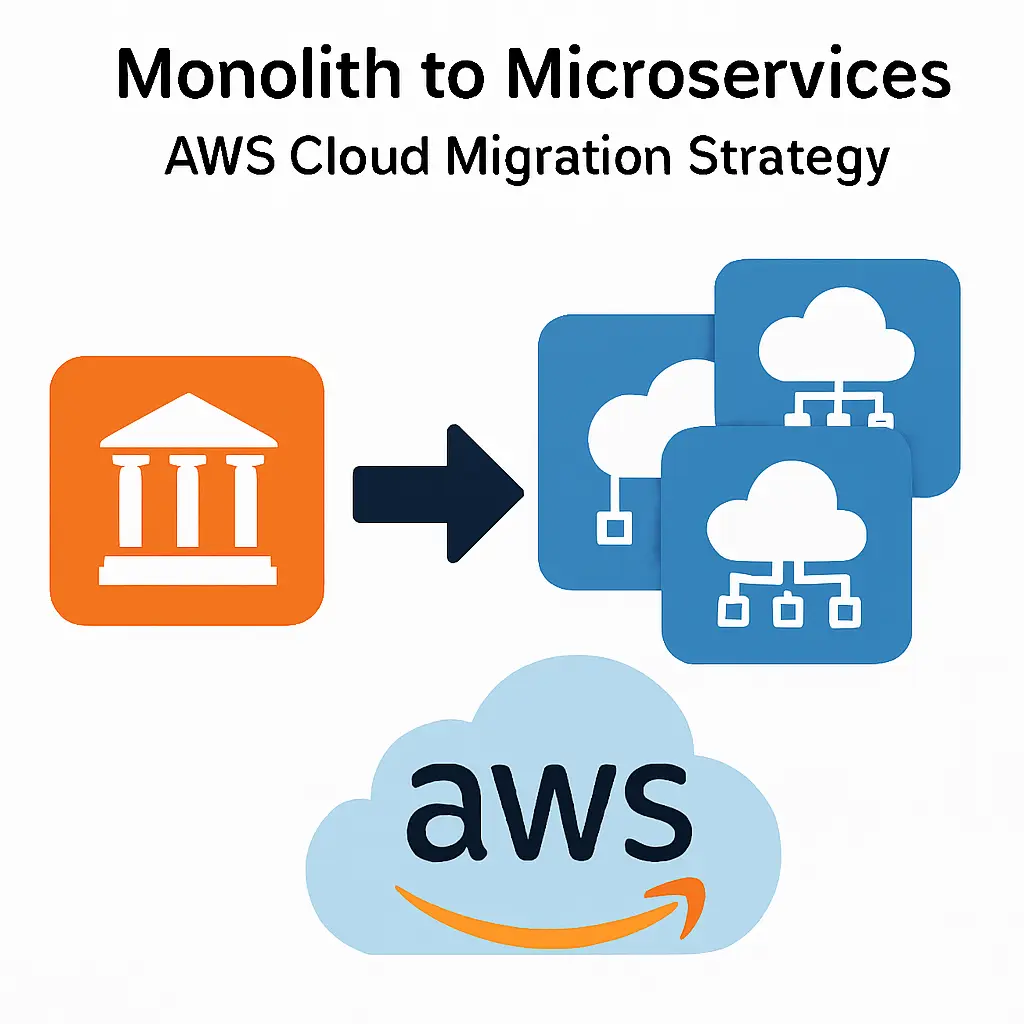
The pressure to modernize legacy applications is higher than ever. Organizations want the agility, scalability, and speed of innovation that cloud-native architectures promise—but getting there from a monolithic, on‑premise setup is complex. This article explores how to move from a legacy monolith to microservices in the cloud, and how to craft a robust AWS migration strategy that reduces risk and maximizes long‑term value.
From Legacy Monoliths to Cloud‑Native Microservices
Modernization usually starts with a harsh reality check: the monolith that once powered your growth is now slowing you down. Releases are risky, scaling is inefficient, and even small changes require full regression tests. Before you can define a transformation roadmap, you need to clearly understand what you are transforming—and why.
Key pain points of legacy monolithic systems
Most organizations face a similar set of issues with their monolith:
- Tight coupling and low agility – Business capabilities, data models, and UI logic are intertwined. Changing one feature often requires modifying multiple unrelated modules, making releases slow and brittle.
- Scaling the whole system for one hotspot – When one function (e.g., search or checkout) is under heavy load, you must scale the entire application stack, wasting compute resources and increasing costs.
- Single point of failure – A bug, memory leak, or resource exhaustion in one part of the monolith can crash the entire product, impacting all customers and channels.
- Technology stagnation – Upgrading frameworks, libraries, or runtimes is so painful that teams defer it for years, accumulating security vulnerabilities and technical debt.
- Slow onboarding and knowledge silos – New developers must understand the whole codebase to make safe changes, while institutional knowledge tends to concentrate in a few long‑term engineers.
These problems are not purely technical—they directly impact business outcomes: slower time to market, higher operational risk, and an inability to respond quickly to customer needs.
Why microservices and cloud are usually combined
When organizations think about breaking up their monolith, they often simultaneously evaluate a move to the cloud. This combined rethink is no coincidence: modern cloud platforms are built to support distributed, decoupled architectures.
Microservices and cloud complement each other in several ways:
- Independent scaling – Each service runs as an independently scalable unit. Cloud infrastructure makes it easy to autoscale only the components experiencing load, matching resources to demand in near real time.
- Polyglot freedom – Different services can be implemented using different languages or frameworks. Managed cloud services (databases, event buses, queues) integrate with a wide ecosystem of runtimes and tools.
- Managed operations – Cloud providers offer logging, monitoring, security, networking, and deployment services tailored for distributed systems, reducing operational overhead.
- Resilience and reliability – Managed databases, multi‑AZ deployments, and load balancers make it easier to design for fault isolation and graceful degradation, which are central to microservice architectures.
The transition, however, is not trivial. Moving from a monolith to microservices while simultaneously migrating to the cloud can be risky if not planned carefully. That is why it is useful to think about this change as a multi‑stage journey rather than a one‑time “big bang.”
Strategic approaches to breaking the monolith
Before touching code, define the target boundaries of your microservices. This is not just about chopping up the monolith by technical layers; it is about aligning services to business capabilities and domain concepts.
Domain‑driven boundaries
Start by mapping your domain: customer management, billing, catalog, order processing, inventory, notifications, etc. Use tools like event storming and domain‑driven design to identify bounded contexts. Each context is a candidate for a separate microservice, with its own data model and clear API contracts.
Questions to ask as you define these boundaries:
- Which capabilities change at different speeds? Fast‑changing areas benefit more from independent deployment.
- Where do we see clear ownership in the organization? A well‑defined team boundary often mirrors a natural service boundary.
- Which modules have the fewest dependencies? Low‑coupling areas are excellent starting points for gradual extraction.
For a deeper dive into patterns, anti‑patterns, and migration stages, a dedicated monolith to microservices migration resource can help structure your approach, but the key is always to let business domains, not frameworks, drive the decomposition.
Strangler fig pattern and incremental extraction
The most widely used pattern for monolith decomposition is the strangler fig pattern. Instead of rewriting the entire system, you progressively replace specific features with microservices:
- Front‑door interception – Introduce an API gateway or edge proxy layer in front of the monolith. All external traffic first goes through this gateway.
- Service carve‑out – Select a low‑risk, well‑bounded feature (e.g., user profile management) and implement it as a separate service. The gateway routes requests for this feature to the new service while everything else still goes to the monolith.
- Data migration and synchronization – Gradually create an independent data store for the new service, migrating data out of the monolith’s database and establishing synchronization or event‑driven integration if needed.
- Progressive strangling – Repeat the carve‑out process for additional features, shrinking the monolith over time until it becomes either very small or disappears entirely.
This approach lets you deliver value continuously, validate assumptions early, and reduce the risk of a massive rewrite that might never ship.
Technical enablers: APIs, events, and DevOps
To make microservices workable in practice, invest in a few foundational capabilities from the start:
- API design and management – Use clear, versioned APIs (REST or gRPC) and establish governance for breaking changes, documentation, and authentication. An API gateway can centralize rate limiting, routing, and security.
- Event‑driven communication – Where possible, prefer asynchronous messaging using events and queues over synchronous, chatty APIs. This decouples services in time and improves resilience.
- Observability – Implement centralized logging, distributed tracing, and metrics from day one. Microservices are harder to debug than monoliths; observability is non‑negotiable.
- Automation and CI/CD – Microservices increase the number of deployable units. Robust CI/CD pipelines, automated tests, and infrastructure‑as‑code are essential to keep operational overhead under control.
Only once these foundations are roughly in place does it make sense to push large portions of your workload into a public cloud platform like AWS.
Cloud Migration as the Backbone of Modernization
Decomposing the monolith is one dimension of modernization; selecting and executing your cloud strategy is the other. The key is to align these two trajectories: you want your cloud migration to support, not conflict with, your architectural evolution.
Clarifying objectives and constraints
Before you decide “what goes where,” determine what success looks like and what constraints you must respect:
- Business outcomes – Are you optimizing for cost reduction, faster releases, global reach, improved reliability, or all of the above? Prioritize objectives to avoid conflicting decisions.
- Risk tolerance – How much downtime or functional change can your business accept? Highly regulated or mission‑critical systems may require a more conservative path.
- Skill readiness – Do your teams have strong AWS, container, security, and DevOps skills? If not, budget for training, coaching, or external expertise.
- Compliance and data residency – Know where data is allowed to reside, what encryption and logging requirements apply, and how you will prove compliance.
These considerations feed directly into your AWS migration model and the pace at which you can adopt cloud‑native services.
Phased AWS migration models
A pragmatic aws cloud migration strategy often uses a mix of migration patterns rather than a single, universal approach:
- Rehost (“lift and shift”) – Move the monolith as‑is to virtual machines in the cloud. This is fast and low risk but does not solve architectural problems. It can, however, be a good first step to free you from data center constraints.
- Replatform – Migrate to managed databases, application servers, or containers without significant code changes. Operational burden drops, and you get some immediate reliability and scaling benefits.
- Refactor – Restructure and partially rewrite components to fully exploit cloud‑native capabilities (e.g., microservices, serverless, event‑driven workflows). This is where you combine microservice decomposition with your cloud journey.
Many organizations initially rehost the monolith into AWS to quickly decommission on‑premise infrastructure, then gradually replatform parts of the system and refactor specific domains into microservices. This staged strategy balances short‑term wins with long‑term modernization goals.
Choosing the right AWS building blocks
Once you have decided on your migration approaches, define a reference architecture that uses a consistent set of AWS services. Typical components include:
- Compute – EC2 instances for legacy workloads, managed Kubernetes (EKS) or ECS for containerized microservices, and Lambda for event‑driven or bursty workloads.
- Storage and databases – RDS for relational databases, DynamoDB for high‑scale key‑value access, S3 for object storage, and possibly Aurora for cloud‑optimized relational performance.
- Networking and access – VPCs, security groups, load balancers, and private endpoints to segment and protect your services.
- Messaging and integration – SNS, SQS, EventBridge, or Kafka on AWS MSK to support asynchronous, event‑driven microservice communication.
- Management, security, and observability – CloudWatch, X‑Ray, IAM, KMS, and AWS Config to enforce security, monitor performance, and maintain operational visibility.
Resist the temptation to adopt every new service immediately. Standardize a core, battle‑tested subset that all teams can learn and support, then extend it selectively for specialized needs.
Orchestrating decomposition and migration together
The highest risk scenario is trying to rewrite everything as microservices while simultaneously moving the entire stack to AWS in one shot. Instead, define a combined roadmap that sequences architectural and infrastructure changes.
A typical integrated path might be:
- Stabilize and prepare – Improve test coverage for the monolith, document critical dependencies, and introduce basic observability while still on‑premise.
- Lift and secure – Rehost the monolith in AWS with minimal changes, but apply modern security and networking practices (hardened IAM, VPC segmentation, encryption).
- Introduce a gateway and shared services – Deploy an API gateway and shared observability stack in AWS, using the monolith as a backend behind the gateway.
- Incremental microservice extraction – Carve out well‑bounded features into microservices running in containers or serverless, each with its own database where appropriate.
- Optimize and retire – Gradually turn off corresponding modules in the monolith, reduce its footprint, and optimize cloud resources once traffic has fully shifted to microservices.
This staged journey ensures you are never betting the entire business on one “flag day” cutover.
Governance, Risk Management, and Organizational Change
Technical architecture is only half the battle. Modernization often fails not because the design was bad but because governance, culture, and processes did not adapt.
Security and compliance in a distributed world
Moving to microservices and AWS multiplies the number of components to secure. To avoid a fragmented security posture, define central guardrails:
- Identity and access management – Use a least‑privilege approach with fine‑grained IAM roles for services, and centralize user identity through SSO or a dedicated identity provider.
- Encryption – Mandate encryption in transit (TLS) and at rest (e.g., KMS‑managed keys) for all services and data stores.
- Secure defaults – Provide infrastructure templates and service blueprints that embed best practices so teams do not start from scratch each time.
- Continuous compliance – Use automated tools and policies to flag misconfigurations or drifts from your security baseline.
Operational resilience and incident management
Distributed architectures fail in more complex ways than monoliths. Prepare by:
- Defining clear SLOs and SLIs for critical services (latency, error rates, availability).
- Establishing runbooks and on‑call rotations for incidents, including escalation paths and communication protocols.
- Running game days and chaos experiments to test how systems behave when dependencies fail or degrade.
Over time, microservices should increase resilience, but that benefit only materializes if you actively design for failure and rehearse your response.
Team structure and culture
Microservices and cloud work best in organizations where teams own services end‑to‑end. This usually implies:
- Cross‑functional teams – Each product team includes developers, QA, operations, and often security representation, collectively owning one or more services.
- Autonomy with alignment – Teams can choose appropriate tools and patterns within a set of shared platform standards (logging, metrics, security baselines).
- Shared learning – Post‑incident reviews, architecture reviews, and internal guilds help spread knowledge and avoid repeated mistakes.
Without these organizational shifts, you risk re‑creating monolithic bottlenecks in a microservice world—just with more moving parts.
Conclusion
Modernizing legacy systems is not simply about adopting microservices or moving to the cloud; it is about carefully orchestrating both so they reinforce each other. By decomposing your monolith along business domains, using incremental patterns like the strangler fig, and executing a phased AWS migration with clear security and governance, you can reduce risk while steadily increasing agility, resilience, and speed of delivery. The organizations that succeed treat modernization as an ongoing capability, not a one‑time project.