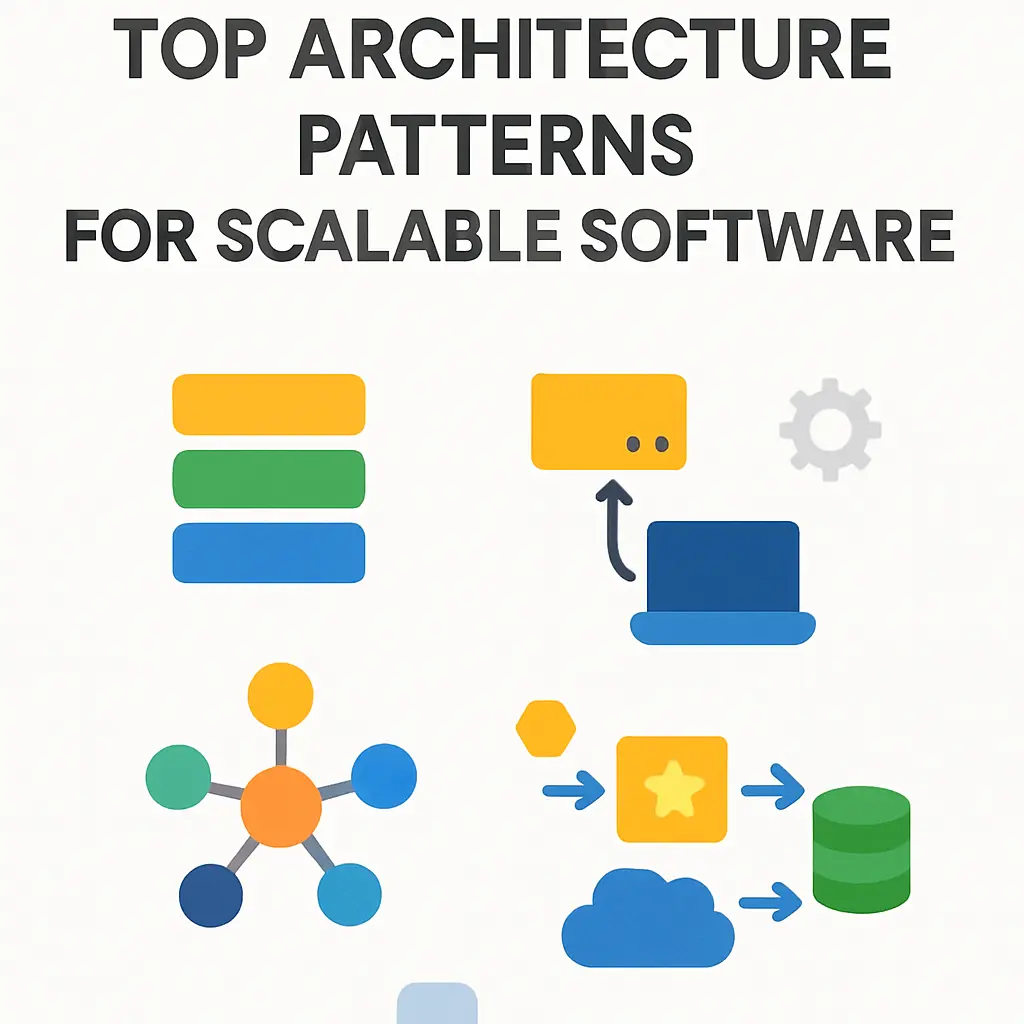
Modern software must do more than function correctly; it must grow without collapsing under rising traffic, data volume, and feature complexity. This article explores how scalable software systems are designed, why architecture patterns matter, and how teams can choose among them. It also examines the trade-offs behind common approaches so readers can make practical, long-term architectural decisions.
Understanding Scalability as an Architectural Goal
Scalability is often described too narrowly as the ability of a system to handle more users. In practice, it is a broader architectural quality that includes performance under increased load, operational stability, maintainability as the codebase expands, and the ability of teams to deliver changes without introducing fragility. A system that responds quickly today but becomes impossible to update tomorrow is not truly scalable. Likewise, a platform that survives traffic spikes but requires constant manual intervention lacks the operational maturity associated with sound architecture.
At its core, scalable architecture is about managing growth in multiple dimensions. User growth increases the number of requests and interactions. Data growth expands storage requirements, indexing demands, and the complexity of reporting. Feature growth introduces more business rules, edge cases, and dependencies. Team growth complicates collaboration, ownership, deployment coordination, and consistency in engineering practices. Architecture patterns are important because they provide proven structural approaches for handling these pressures before they become existential problems.
Many organizations make the mistake of treating architecture as an abstract design exercise disconnected from business outcomes. In reality, architectural choices shape product velocity, infrastructure costs, security posture, and customer experience. For example, a tightly coupled application may be quick to launch, but as the product matures, every change can ripple unpredictably across the codebase. Conversely, a carefully modular design can reduce risk, support faster releases, and help teams isolate failures. The architectural pattern does not guarantee success on its own, but it creates the conditions under which success becomes more likely.
Scalability also involves trade-offs, and this is where architectural maturity is tested. There is no universal “best” pattern because every option optimizes for something while sacrificing something else. A monolithic system can be easier to develop and reason about in early stages, but harder to scale organizationally when many teams need to work independently. Microservices can improve autonomy and fault isolation, yet they introduce network complexity, distributed data challenges, and a heavier operational burden. Event-driven architecture can increase responsiveness and decoupling, but debugging asynchronous flows can become difficult without strong observability.
To design well, teams must first understand what kind of scale they are preparing for. Is the main issue unpredictable traffic volume? Is it a global user base requiring low latency across regions? Is it a domain with rapidly changing workflows? Is the engineering organization growing faster than the product? These questions matter because architecture should address real constraints, not fashionable assumptions. This is why pattern selection begins with diagnosis rather than imitation.
Several principles consistently support scalability regardless of the chosen pattern:
- Separation of concerns: Distinct responsibilities should be isolated so changes in one area do not destabilize the whole system.
- Loose coupling: Components should minimize assumptions about one another, allowing independent evolution.
- High cohesion: Related logic should live together to improve clarity and maintainability.
- Observability: Logs, metrics, traces, and alerts are essential for understanding system behavior at scale.
- Resilience: Failures should be contained, tolerated, or recovered from gracefully.
- Automation: Deployment, testing, infrastructure management, and recovery procedures should not depend on manual heroics.
These principles help explain why architecture patterns exist. They are not rigid formulas but structured ways of applying design principles under particular conditions. Teams exploring Top Architecture Patterns for Scalable Software Systems often find that the best pattern is the one that solves current problems while leaving room for controlled evolution. Architecture is therefore not a single decision made once; it is a sequence of informed decisions that respond to complexity over time.
Another critical point is that scalability is both technical and organizational. Conway’s Law suggests that systems tend to mirror the communication structures of the teams that build them. If teams are organized around clear business domains, architecture can reflect those boundaries. If teams are forced to coordinate constantly across unclear responsibilities, the software often becomes tangled in the same way. This means architecture should align with how people work. In scalable environments, technical design and team design are closely related.
When evaluating architecture, it is useful to think in terms of pressure points. Where does the system break first? In some cases, the bottleneck is the database because too many functions depend on one centralized store. In others, deployment cycles become painful because even small updates require full-system releases. Sometimes the issue is not raw performance but the inability to reason about change, especially when hidden dependencies make testing unreliable. Architecture patterns should reduce these pressure points by creating boundaries that are technically enforceable and operationally visible.
Good architecture also pays attention to time. Early in a product’s life, over-engineering is a real risk. Building a highly distributed platform for a product with uncertain demand can waste energy and slow validation. Yet under-engineering is equally dangerous if growth arrives and the system cannot adapt. The most effective teams design for the next meaningful stage of growth, not for hypothetical extremes. This usually means choosing patterns that are simple enough to support momentum but structured enough to avoid expensive rewrites.
Choosing and Applying Architecture Patterns for Real-World Scale
The most practical way to understand architecture patterns is to see how they solve different categories of problems. While names like monolith, microservices, event-driven architecture, layered architecture, and hexagonal architecture are common, the deeper issue is what each pattern enables. Scalable systems are not built from pattern labels alone; they are built by matching structural choices to the realities of domain complexity, operational needs, and team capability.
A modular monolith is often underestimated in discussions about scale. Unlike a poorly structured monolith, a modular monolith is intentionally organized into clear internal boundaries. Business capabilities are grouped into cohesive modules with limited dependencies, and the application is deployed as a single unit. This can be highly effective for startups and mid-stage products because it preserves development simplicity while reducing internal chaos. Transactions are easier to manage, testing is often more straightforward, and operational overhead remains relatively low. The key challenge is discipline: if module boundaries are not respected, the system gradually degrades into a tightly coupled codebase. But when done well, a modular monolith can scale much farther than many assume.
Microservices become attractive when independent deployability, team autonomy, and domain separation become dominant concerns. In a microservices architecture, services encapsulate specific capabilities and communicate through APIs or messaging. This allows teams to release changes independently, scale only the components under pressure, and isolate some failures. However, these benefits do not come for free. Distributed systems are inherently more complex than single-process applications. Network latency, service discovery, retries, timeout handling, versioning, and eventual consistency all become architectural concerns. Operational tooling must mature as well, including centralized logging, distributed tracing, container orchestration, and robust monitoring.
One common misconception is that microservices automatically create agility. In reality, they only do so when service boundaries are meaningful and the organization can support the operational complexity. Poorly defined services can create more coupling than a monolith because dependencies move from code-level calls to network-level calls, which are slower and harder to reason about. Excessively granular services can multiply failure points and make local development frustrating. This is why service decomposition should follow business domains, not technical fashion. Domain-driven thinking often helps here by identifying bounded contexts where vocabulary, rules, and ownership are naturally aligned.
Event-driven architecture addresses a different scalability need: decoupling producers and consumers through asynchronous communication. Instead of forcing one component to wait for another in a direct request-response chain, events allow systems to react independently when something happens, such as an order being placed or a payment being confirmed. This supports high throughput, responsiveness, and extensibility. New consumers can subscribe to events without requiring deep rewrites of existing services, which makes growth more manageable over time.
Yet event-driven systems require strong design discipline. Events must be clearly defined, versioned carefully, and documented in a way that preserves semantic meaning. Teams must also handle idempotency, duplicate events, delayed delivery, and eventual consistency. If these concerns are ignored, the architecture may become opaque and fragile. Observability is especially important because asynchronous workflows are harder to trace than direct calls. Without correlation IDs, event lineage tracking, and meaningful dashboards, teams can struggle to diagnose incidents in production.
Layered architecture remains useful because many applications benefit from separating presentation, business logic, and data access. This pattern encourages maintainability and can be highly effective when business workflows are relatively straightforward. However, traditional layered systems can become rigid if every request must pass through the same dependency chain regardless of actual complexity. For scalability, layers should support clarity without becoming bureaucratic. In mature systems, strict layers often evolve into more domain-centric structures where business capabilities are the primary organizing principle.
Hexagonal architecture, also known as ports and adapters, is especially valuable when scalability must include long-term adaptability. It centers the domain logic and keeps external concerns such as databases, user interfaces, and third-party integrations at the edge. This makes core logic easier to test and less vulnerable to infrastructure churn. While hexagonal architecture does not scale traffic by itself, it scales change extremely well. Systems that can evolve predictably are more likely to remain stable as complexity grows.
For data-intensive systems, architecture decisions around storage are just as important as service structure. A single relational database can often support significant growth when optimized well, but there comes a point where read patterns, write throughput, or global distribution demands different approaches. Teams may introduce read replicas, partitioning, caching layers, CQRS patterns, or specialized stores for search and analytics. These choices should emerge from measured constraints rather than assumptions. Polyglot persistence can be powerful, but it also increases operational complexity and consistency challenges.
Caching deserves special attention because it is often the fastest path to better scalability, but it is frequently implemented carelessly. Effective caching requires understanding data access patterns, freshness requirements, and invalidation strategies. Caching can reduce database load dramatically and improve response times, yet stale data and cache inconsistency can create subtle bugs. Architecture should therefore treat caching as part of the system’s consistency model, not merely as a performance add-on.
Scalable architecture also depends heavily on resilience patterns. As systems grow, failures become normal rather than exceptional. A service may become slow, a dependency may time out, a queue may back up, or a deployment may introduce a regression. Resilient systems use techniques such as circuit breakers, bulkheads, retries with backoff, graceful degradation, health checks, and load shedding. These patterns prevent localized problems from turning into system-wide outages. The larger and more distributed the architecture, the more important these safeguards become.
Security and scalability are interconnected as well. A system under growth attracts more users, handles more sensitive data, and exposes more interfaces. Authentication, authorization, rate limiting, secret management, and auditability must be incorporated into the architecture rather than patched on later. In distributed systems especially, trust boundaries become more numerous. Internal service communication may require strong identity mechanisms, and event streams may need access controls and encryption. Ignoring these concerns can make scaling dangerous rather than beneficial.
Deployment strategy is another architectural dimension often overlooked in early design discussions. If scaling requires frequent releases, rollback safety, and low downtime, the architecture should support blue-green deployments, canary releases, feature flags, and infrastructure-as-code workflows. Teams should be able to release small changes with confidence. This is one reason why deeply entangled systems become obstacles to scale: technical coupling leads directly to deployment coupling, which slows innovation and increases risk.
To choose among patterns, teams should ask a sequence of practical questions:
- What kind of growth is expected? More users, more features, more regions, or more teams each create different architectural pressures.
- Where is the current bottleneck? Application logic, deployment speed, database throughput, integration complexity, or team coordination problems?
- What operational maturity exists? A distributed architecture without strong DevOps and observability practices may fail under its own complexity.
- How stable are domain boundaries? If business capabilities are still evolving rapidly, premature fragmentation may be costly.
- What trade-offs are acceptable? Simplicity, speed, fault tolerance, consistency, and autonomy must be balanced intentionally.
These questions help transform architecture from a style preference into a strategic decision. Teams comparing ideas from Top Architecture Patterns for Scalable Software should remember that architectural success depends as much on implementation discipline as on high-level structure. A clean pattern with weak governance can fail; a simpler pattern with strong engineering practices can perform remarkably well.
In practice, many scalable systems are hybrid. A company may begin with a modular monolith, extract a few high-change or high-scale services, adopt event-driven workflows for asynchronous processing, and use hexagonal design within services for maintainability. This evolutionary approach is often healthier than a radical rewrite. It allows architecture to respond to verified pain points and business priorities rather than to abstract perfectionism.
The strongest architectural cultures also accept that revisiting decisions is part of maturity, not a sign of failure. Patterns are tools, and tools should be reevaluated as context changes. A design that fit a ten-person engineering team may not fit a hundred-person organization. A database strategy that worked at one million records may break at one billion. Scalability is therefore not achieved by choosing one pattern forever, but by building a system and a team capable of adapting intelligently.
Ultimately, scalable architecture is about preserving useful change under increasing load and complexity. Performance matters, but so do clarity, resilience, deployment safety, and team autonomy. The best patterns are those that help software absorb growth without becoming brittle. By grounding architectural choices in domain realities, measured constraints, and operational readiness, organizations can build systems that remain both powerful and sustainable.
Scalable software architecture is not about chasing trends but about making deliberate structural choices that support growth in traffic, features, data, and teams. Whether using a modular monolith, microservices, event-driven design, or a hybrid approach, success depends on discipline, observability, resilience, and alignment with real business needs. Readers should choose patterns pragmatically, evolve them gradually, and design for sustainable change.